
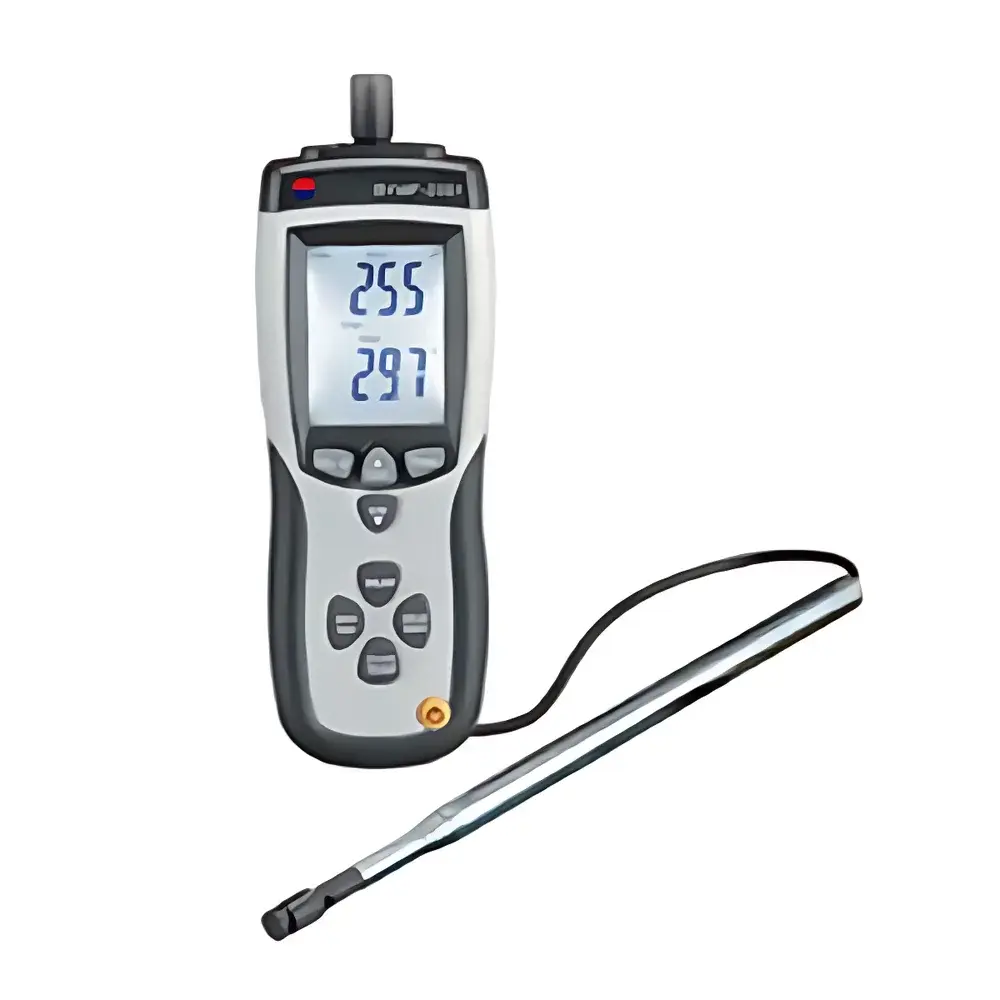
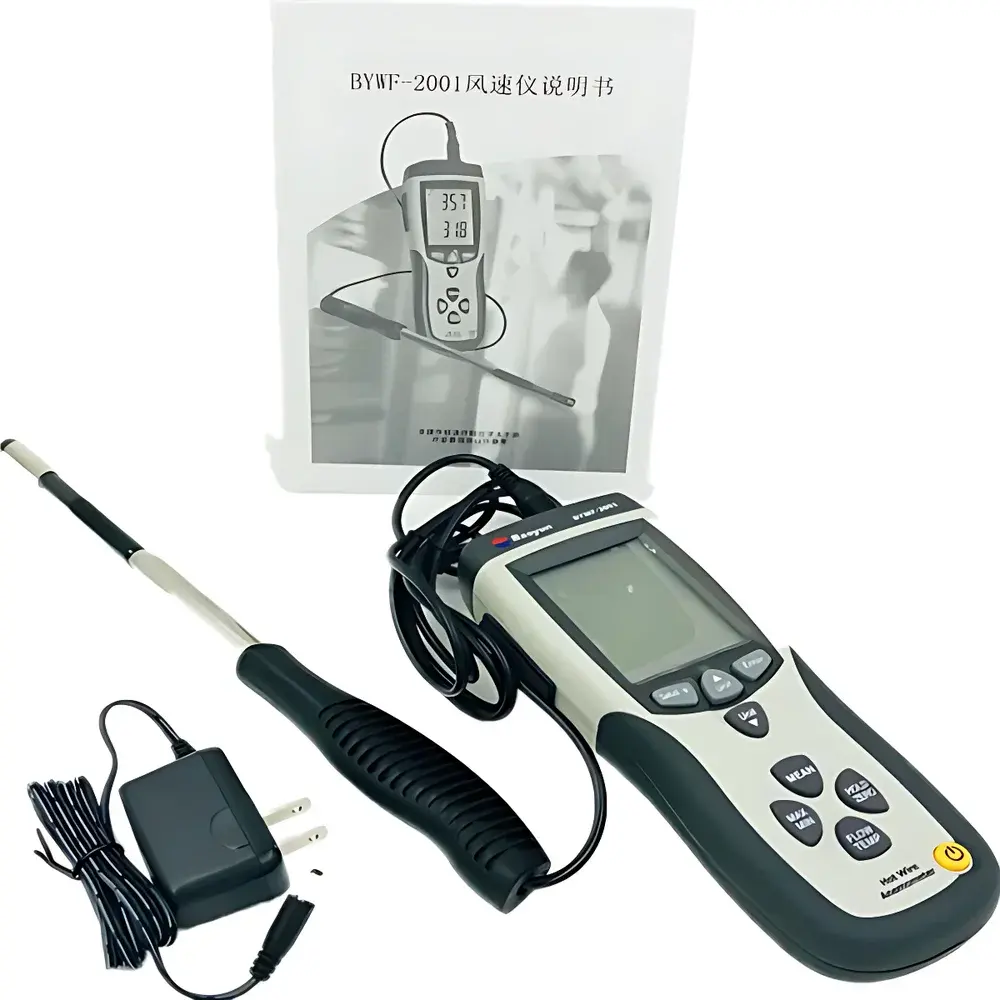
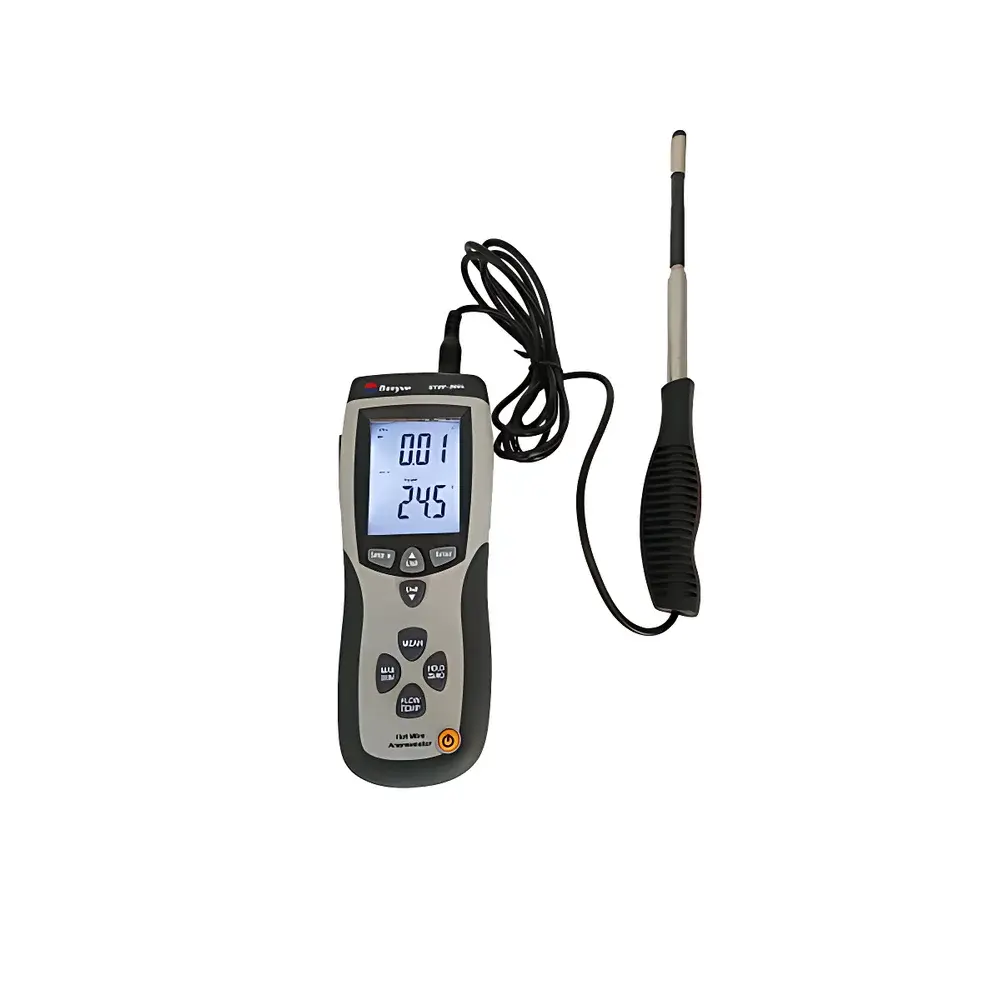
BJBY BYWF-2001 Digital Hot-Wire Anemometer
| Brand | BJBY |
|---|---|
| Origin | China |
| Manufacturer Type | Authorized Distributor |
| Instrument Type | Hot-Wire Anemometer |
| Measurement Range | 0.00–25 m/s |
| Resolution | 0.01 m/s |
| Accuracy | ±(2% of reading + 0.1 m/s) |
| Operating Temperature | 0°C to 60°C |
| Sensor Type | Constant-Temperature Anemometry (CTA) Thermal Probe |
| Power Supply | 9 V alkaline battery or 220 V AC/DC adapter |
| Battery Life | >100 hours (on 9 V battery) |
| Display | Backlit LCD, simultaneous wind speed and temperature readout |
| Weight | <1.5 kg (including carrying case) |
| Compliance | Certified by National Institute of Metrology (NIM), P.R. China (CNAS-accredited calibration traceable to SI units) |
Overview
The BJBY BYWF-2001 Digital Hot-Wire Anemometer is a compact, handheld environmental measurement instrument engineered for high-sensitivity, low-velocity airflow quantification in non-turbulent and laminar flow regimes. It operates on the principle of constant-temperature anemometry (CTA), where a fine platinum or tungsten wire sensor—maintained at a stable temperature above ambient—is cooled proportionally by convective heat transfer from moving air. The electrical power required to sustain the wire’s setpoint temperature correlates directly with local air velocity, enabling precise digital conversion via integrated signal conditioning and microprocessor-based compensation algorithms. Designed specifically for sub-1 m/s applications—including HVAC duct balancing, cleanroom air curtain verification, laboratory fume hood face velocity checks, and indoor air quality (IAQ) assessments—the BYWF-2001 delivers metrologically traceable measurements validated by the National Institute of Metrology (NIM), China, under CNAS-accredited procedures aligned with ISO/IEC 17025 requirements.
Key Features
- High-resolution thermal sensing with 0.01 m/s resolution and detection threshold down to 0.01 m/s—optimized for low-flow environments where vane or cup anemometers lack sensitivity.
- Integrated dual-parameter display: simultaneous real-time readout of wind speed (m/s) and ambient temperature (°C) using a matched thermistor sensor with rapid thermal response (<2 s time constant).
- Intelligent data retention functions including MAX/MIN capture, hold mode, and repeatable recall—enabling field personnel to document transient events without external logging hardware.
- Ruggedized probe design featuring a precision-machined grid diffuser and miniature cylindrical thermal sensor head—minimizing flow disturbance and improving spatial resolution during point measurements.
- Low-power microcontroller architecture ensures >100 hours of continuous operation on a single 9 V alkaline battery; optional AC/DC adapter support enables extended benchtop use.
- Backlit LCD interface with contrast adjustment—facilitating legible readings under low-light conditions such as ceiling plenum inspections or nighttime ventilation audits.
Sample Compatibility & Compliance
The BYWF-2001 is suitable for gaseous media within standard atmospheric composition (N₂/O₂/Ar/H₂O vapor mixtures) at ambient pressures ±10 kPa. It is not rated for explosive, corrosive, or particulate-laden airstreams without protective filtration. Calibration is performed against NIM-traceable reference standards in accordance with JJG 038–2021 (Chinese National Verification Regulation for Anemometers). While not certified to IEC 61000-4 electromagnetic immunity standards or ATEX directives, its design conforms to general-purpose industrial safety practices per GB/T 2423.1 (cold test) and GB/T 2423.2 (dry heat test). For regulatory reporting in occupational health contexts (e.g., OSHA 1910.94 or GBZ 2.1–2019), users must apply documented uncertainty budgets incorporating the stated accuracy specification: ±(2% of reading + 0.1 m/s).
Software & Data Management
The BYWF-2001 operates as a standalone instrument with no proprietary software dependency. All measurement data are displayed and retained locally; no Bluetooth, USB, or RS-232 interfaces are included. However, manual transcription into compliant electronic records (e.g., Excel, LIMS, or audit-ready PDF reports) is supported through standardized field log templates. When used in GLP- or GMP-aligned environments, operators may implement procedural controls—including daily zero-checks, periodic recalibration intervals (recommended annually or after 200 hr of cumulative use), and operator identification logging—to satisfy documentation requirements under ISO/IEC 17025 Clause 7.7 and FDA 21 CFR Part 11 Annex 11 principles for non-automated systems.
Applications
- HVAC system commissioning: supply/return register velocity profiling, diffuser performance verification, and duct traverse validation per ASHRAE Guideline 12–2020.
- Indoor environmental quality (IEQ) monitoring: classroom air exchange rate estimation, office workspace draft assessment, and hospital isolation room pressure differential verification.
- Industrial hygiene surveys: localized exhaust ventilation (LEV) hood face velocity compliance checks per HSE HSG258 and GB 8978–1996 emission control protocols.
- Research-grade airflow characterization: boundary layer studies in wind tunnels, fan coil unit airflow mapping, and thermal comfort parameter collection (e.g., for PMV/PPD modeling).
- Educational laboratories: hands-on instruction in fluid mechanics fundamentals, sensor physics, and metrological traceability concepts.
FAQ
Is the BYWF-2001 suitable for outdoor wind speed measurement?
No—it is calibrated and optimized for indoor, low-turbulence environments. Outdoor use introduces uncontrolled thermal drift, solar loading, and gust-induced dynamic errors beyond its specified accuracy envelope.
Does the instrument require annual recalibration?
Yes. To maintain metrological integrity, NIM-recommended recalibration is advised every 12 months or after exposure to mechanical shock, extreme humidity (>90% RH), or temperatures exceeding 60°C.
Can it measure air velocity in ducts with high particulate concentration?
Not without upstream HEPA filtration. Dust accumulation on the thermal wire degrades sensitivity and introduces hysteresis; routine cleaning with isopropyl alcohol and lint-free swabs is required between uses in dusty settings.
What is the temperature measurement range and accuracy?
The integrated thermistor measures ambient air temperature from 0°C to 60°C with ±0.5°C typical accuracy (calibrated at 25°C), referenced to ITS-90.
Is the device compatible with data acquisition systems?
No native analog or digital output is provided. For automated logging, users must employ external video capture or manual entry into validated spreadsheet templates meeting ALCOA+ data integrity criteria.
Related Products







