
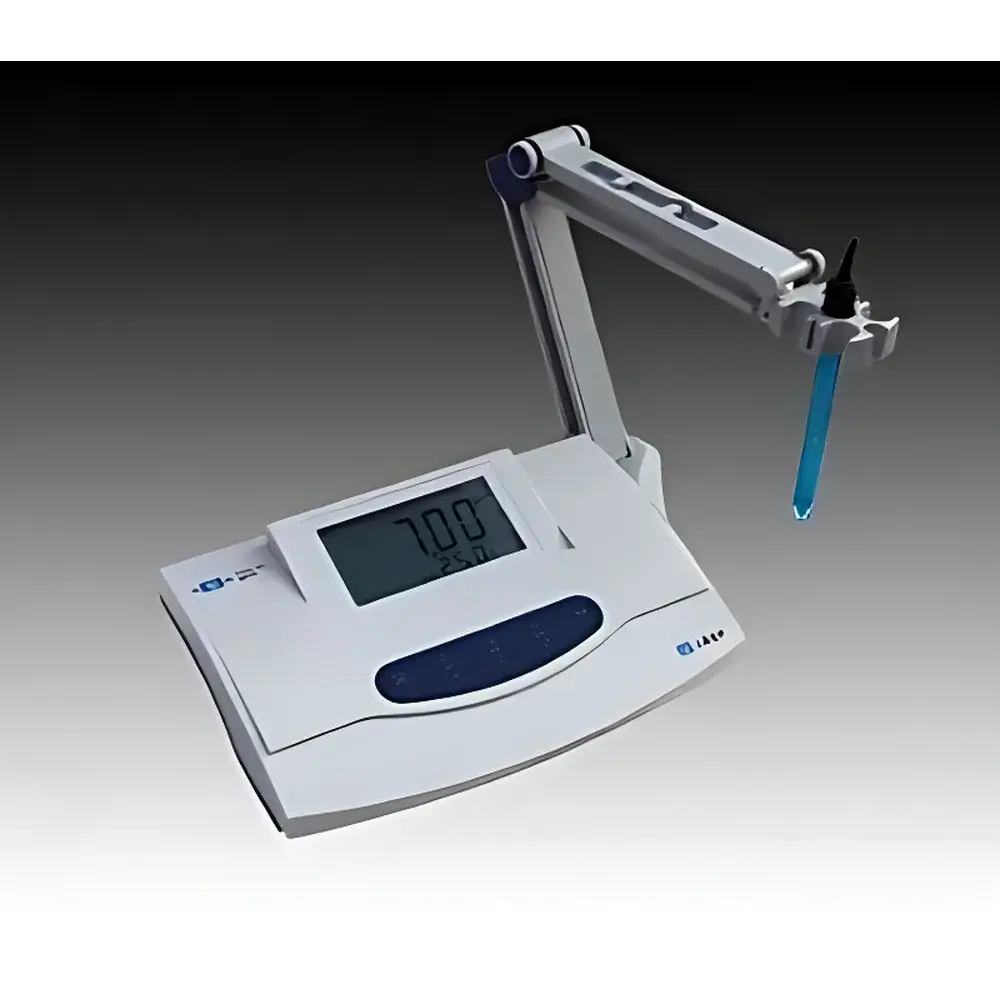
PHS-3C Digital pH Meter
| Origin | Shanghai, China |
|---|---|
| Manufacturer Type | Authorized Distributor |
| Origin Category | Domestic (China) |
| Model | PHS-3C |
| Pricing | Available Upon Request |
| Display | 3½-digit LED |
| Temperature Compensation | Manual (0–60 °C) |
| Calibration | One-point or Two-point |
| Compatible Electrode | E-201-C pH Combination Electrode |
| Accuracy Class | 0.01 |
| pH Range | 0.00–14.00 pH |
| mV Range | ±0.00–1800.00 mV |
| pH Resolution | 0.01 pH |
| mV Resolution | 1 mV |
| pH Basic Error | ±0.01 pH ±1 digit |
| mV Basic Error | ±1 mV ±1 digit |
| Input Impedance | ≥1×10¹² Ω |
| Drift | ≤±0.01 pH ±1 digit / 3 h |
| Sample Temperature Range | 5–60 °C |
Overview
The PHS-3C Digital pH Meter is a precision benchtop electrochemical instrument engineered for reliable, repeatable pH and millivolt measurements in routine laboratory, quality control, educational, and industrial process environments. Based on the potentiometric measurement principle, it determines hydrogen ion activity in aqueous solutions by measuring the potential difference between a pH-sensitive glass electrode (e.g., the standard E-201-C combination electrode) and a stable reference electrode—converted into pH units via the Nernst equation. Designed to meet Class 0.01 accuracy requirements per Chinese national metrological standard JJG 119–2018 (equivalent in functional scope to ISO 7027 and ASTM D1293 for pH instrumentation), the PHS-3C delivers traceable performance suitable for GLP-compliant documentation workflows. Its analog front-end features high-input-impedance circuitry (≥1×10¹² Ω) to minimize loading effects on high-impedance electrodes, ensuring signal integrity across low-conductivity samples such as deionized water, ethanol-water mixtures, and dilute buffer solutions.
Key Features
- 3½-digit LED display with high-contrast numeric readout for rapid visual verification under varied ambient lighting conditions
- Manual temperature compensation (0–60 °C) enabling correction of pH readings based on solution temperature—critical for accurate interpretation when calibrating or measuring outside 25 °C reference conditions
- Flexible calibration architecture supporting both single-point (e.g., pH 7.00 buffer) and two-point (e.g., pH 4.01 and 9.21 buffers) procedures to accommodate varying sample matrix complexity and required uncertainty budgets
- Dedicated mV mode (±0–1800 mV) for direct electrode potential monitoring, redox (ORP) assessment, and non-pH ion-selective electrode (ISE) applications when paired with compatible sensors
- Stability specification of ≤±0.01 pH ±1 digit over 3 hours—validated under controlled thermal and electrical conditions—supporting extended measurement sessions without recalibration
- Optimized input stage design with guarded inputs and low-noise amplification to maintain measurement fidelity in electrically noisy lab environments
Sample Compatibility & Compliance
The PHS-3C is validated for use with aqueous and mildly organic-aqueous solutions within a temperature range of 5–60 °C and conductivity ≥50 µS/cm. It is not intended for non-aqueous solvents (e.g., pure methanol, acetone), highly viscous media, or aggressive HF-containing matrices that may damage the E-201-C electrode’s glass membrane. The instrument complies with GB/T 11165–2005 (Chinese national standard for laboratory pH meters), aligning with core functional expectations of IEC 62304 Class B medical device software safety principles (where applicable to embedded firmware), and supports audit-ready operation under ISO/IEC 17025-accredited laboratories when used with documented calibration records, certified reference materials (e.g., NIST-traceable pH buffers), and electrode maintenance logs.
Software & Data Management
As a standalone analog-digital hybrid instrument, the PHS-3C does not feature onboard data logging, USB connectivity, or PC interface capabilities. All measurements are displayed in real time and must be manually recorded. For regulated environments requiring electronic records, users may integrate the meter into validated workflows using external digital loggers or LIMS-compatible capture tools—provided such systems undergo IQ/OQ validation per FDA 21 CFR Part 11 Annex 11 requirements. Electrode calibration data, measurement timestamps, and environmental notes should be retained in bound lab notebooks or structured electronic formats meeting ALCOA+ (Attributable, Legible, Contemporaneous, Original, Accurate, Complete, Consistent, Enduring, Available) data integrity criteria.
Applications
- Routine pH verification in pharmaceutical excipient testing (per USP ) and water-for-injection (WFI) monitoring
- Acid-base titration endpoint confirmation in undergraduate chemistry teaching labs
- Quality assurance of food-grade buffers, dairy products, and beverage formulations
- Environmental water analysis (surface water, wastewater effluent) in municipal and industrial compliance testing
- Preliminary screening of corrosion inhibitor efficacy in cooling water treatment programs
- Calibration verification of higher-tier pH analyzers using transfer-standard methodology
FAQ
What electrode is required for operation?
The PHS-3C is designed for use with the E-201-C pH combination electrode—a general-purpose, double-junction sensor with Ag/AgCl reference system and low-resistance glass membrane optimized for aqueous samples.
Can the instrument perform automatic temperature compensation?
No. Temperature compensation is manual only; users must enter the measured sample temperature using the front-panel controls prior to reading.
Is the PHS-3C compliant with ISO/IEC 17025 requirements?
The instrument itself is not certified, but its metrological performance (Class 0.01 accuracy, stability, input impedance) enables compliance when operated within a validated method, with documented calibration, and traceable standards.
What is the recommended recalibration frequency?
Recalibration is advised before each analytical session, after electrode cleaning or storage, and whenever measurement drift exceeds ±0.02 pH relative to control buffer values.
Does the unit support GLP audit trails?
No built-in electronic audit trail exists; however, manual calibration logs, measurement records, and electrode history files satisfy GLP documentation mandates when maintained per institutional SOPs.






