
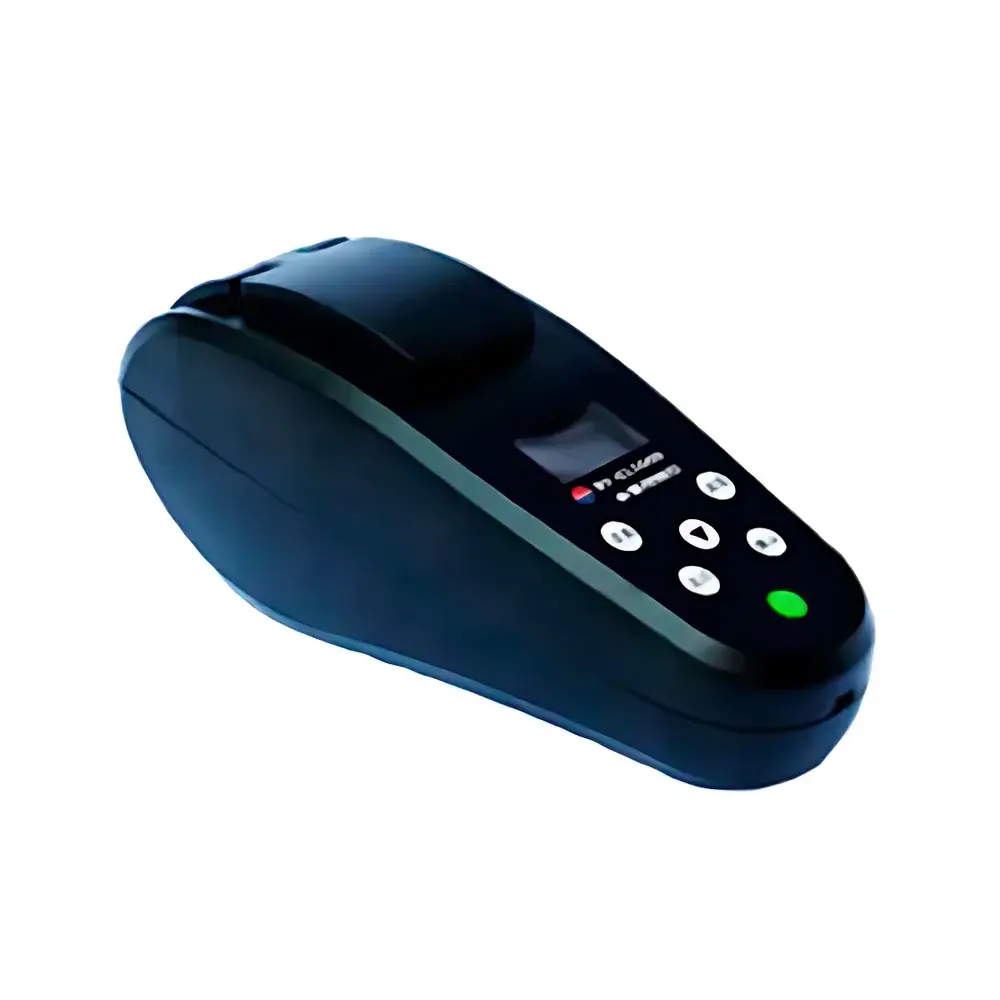
BJBY BY-CL1600 Portable Residual Chlorine Analyzer
| Brand | BJBY |
|---|---|
| Origin | Beijing, China |
| Model | BY-CL1600 |
| Detection Method | DPD Colorimetric Spectrophotometry |
| Measurands | Free Chlorine & Total Chlorine |
| Range | 0.00–5.00 mg/L |
| Resolution | 0.01 mg/L |
| Accuracy | ≤ ±1% FS + 0.01 mg/L |
| Measurement Time | 1 min |
| Light Source | Pulsed LED (100,000 hr lifetime) |
| Display | Integrated LCD |
| Calibration | User-defined zero and span calibration |
| Environmental Operating Range | 0–50 °C |
| Power Supply | Replaceable alkaline batteries |
| IP Rating | IP65-equivalent mechanical sealing (shock- and moisture-resistant enclosure) |
| Optical Design | Integrated LED-as-source-and-monochromator architecture with fixed-path cuvette chamber and flip-type light-shielding cover |
Overview
The BJBY BY-CL1600 Portable Residual Chlorine Analyzer is a field-deployable, optical absorption-based instrument engineered for rapid, on-site quantification of free chlorine and total chlorine in drinking water, distribution systems, swimming pools, cooling towers, and wastewater effluents. It employs the standardized N,N-diethyl-p-phenylenediamine (DPD) colorimetric method per ASTM D1253, ISO 7393-2, and EPA Method 334.1. Unlike conventional benchtop spectrophotometers, the BY-CL1600 integrates the light source, spectral filtering element, sample chamber, and photodetector into a single monolithic optical path—eliminating moving parts, alignment drift, and mechanical wear. Its solid-state LED functions simultaneously as both broadband emitter and effective narrowband filter via wavelength-selective emission, enabling stable 515 nm excitation without gratings, prisms, or interference filters. This architecture delivers high photometric reproducibility (<0.5% RSD over 8-hour operation) and long-term baseline stability under variable ambient conditions.
Key Features
- Monolithic optical design: LED serves as both light source and intrinsic monochromator—no moving optics, no recalibration required between field deployments.
- Pulsed LED drive circuitry extends effective source lifetime to ≥100,000 hours while minimizing thermal drift and self-heating artifacts.
- Integrated flip-type light-shielding cover ensures stray-light rejection during measurement—critical for low-concentration (<0.1 mg/L) residual chlorine determination.
- Ruggedized housing rated for shock resistance (MIL-STD-810G drop-tested to 1.2 m) and moisture resilience (equivalent to IP65 ingress protection).
- Battery-powered operation with low-power LCD interface and intelligent battery-level monitoring—supports >2,000 measurements per set of AA alkaline cells.
- One-button zero calibration and pre-packaged vacuum-sealed DPD reagent tablets for chlorine, plus dedicated vacuum-stabilized reagents for chlorine dioxide and chlorite—ensuring batch-to-batch consistency and shelf-life retention in high-humidity environments.
Sample Compatibility & Compliance
The BY-CL1600 accepts standard 10 mm pathlength glass or quartz cuvettes (10 mL volume), compatible with clarified, filtered, or membrane-filtered aqueous samples per Standard Methods 4500-Cl G. It complies with regulatory measurement principles outlined in US EPA Drinking Water Regulations (40 CFR Part 141), WHO Guidelines for Drinking-water Quality (4th ed.), and EU Council Directive 98/83/EC. The DPD method implemented satisfies performance criteria for precision (RSD < 3% at 0.2 mg/L Cl₂), linearity (r² ≥ 0.999 across 0–5 mg/L), and interference tolerance (e.g., <5% bias from ≤10 mg/L nitrite or ≤0.5 mg/L manganese). Instrument firmware supports GLP-compliant data logging—including timestamp, operator ID (via optional alphanumeric input), calibration history, and measurement metadata—for audit-ready recordkeeping.
Software & Data Management
Data output is accessible via direct LCD readout (mg/L, with dual-unit toggle option) and non-volatile internal memory storing up to 500 test records. Optional infrared (IrDA) or Bluetooth 5.0 wireless module (sold separately) enables secure export to Windows/macOS desktop applications or LIMS platforms. Exported CSV files include full metrological traceability fields: measurement ID, date/time stamp, calibration status flag, raw absorbance value, temperature-compensated concentration, and user-defined sample ID. Firmware supports configurable auto-zero validation intervals and password-protected calibration lockout—meeting FDA 21 CFR Part 11 requirements for electronic records when paired with validated IT infrastructure.
Applications
- Drinking water utilities: Routine verification of disinfectant residual at entry points, storage tanks, and endpoint taps.
- Swimming pool & spa maintenance: Real-time compliance monitoring against CDC Model Aquatic Health Code (MAHC) thresholds (1–3 mg/L free Cl).
- Hospital central sterile supply departments (CSSD): Validation of chlorine-based instrument washer-disinfector rinse cycles.
- Food & beverage processing: Monitoring sanitizing solution concentrations in CIP (clean-in-place) systems.
- Environmental field surveys: Rapid assessment of chlorine persistence in surface water following emergency disinfection events.
- Wastewater treatment plants: Effluent compliance checks prior to discharge under NPDES permits.
FAQ
What DPD reagent formats are supported?
The BY-CL1600 uses factory-sealed, vacuum-packed DPD tablets for free/total chlorine, and separately optimized vacuum-stabilized reagents for chlorine dioxide and chlorite—each lot certified for homogeneity and stability up to 24 months at ≤30 °C.
Does the instrument compensate for temperature variations during measurement?
Yes—integrated NTC thermistor continuously monitors sample temperature and applies empirically derived correction coefficients to absorbance readings per ISO 7393-2 Annex B.
Can calibration be performed outside the factory-default range?
User-defined two-point calibration (zero and span) is supported using NIST-traceable chlorine standards; calibration curves remain stored until overwritten.
Is the device suitable for use in tropical field conditions?
Rated for continuous operation at 0–50 °C and up to 90% relative humidity (non-condensing); the sealed optical path and conformal-coated PCBs prevent moisture-induced signal drift.
How is data integrity ensured during power interruption?
All measurement records and calibration parameters are written to EEPROM prior to display update—no data loss occurs during unexpected battery depletion.
Related Products







