
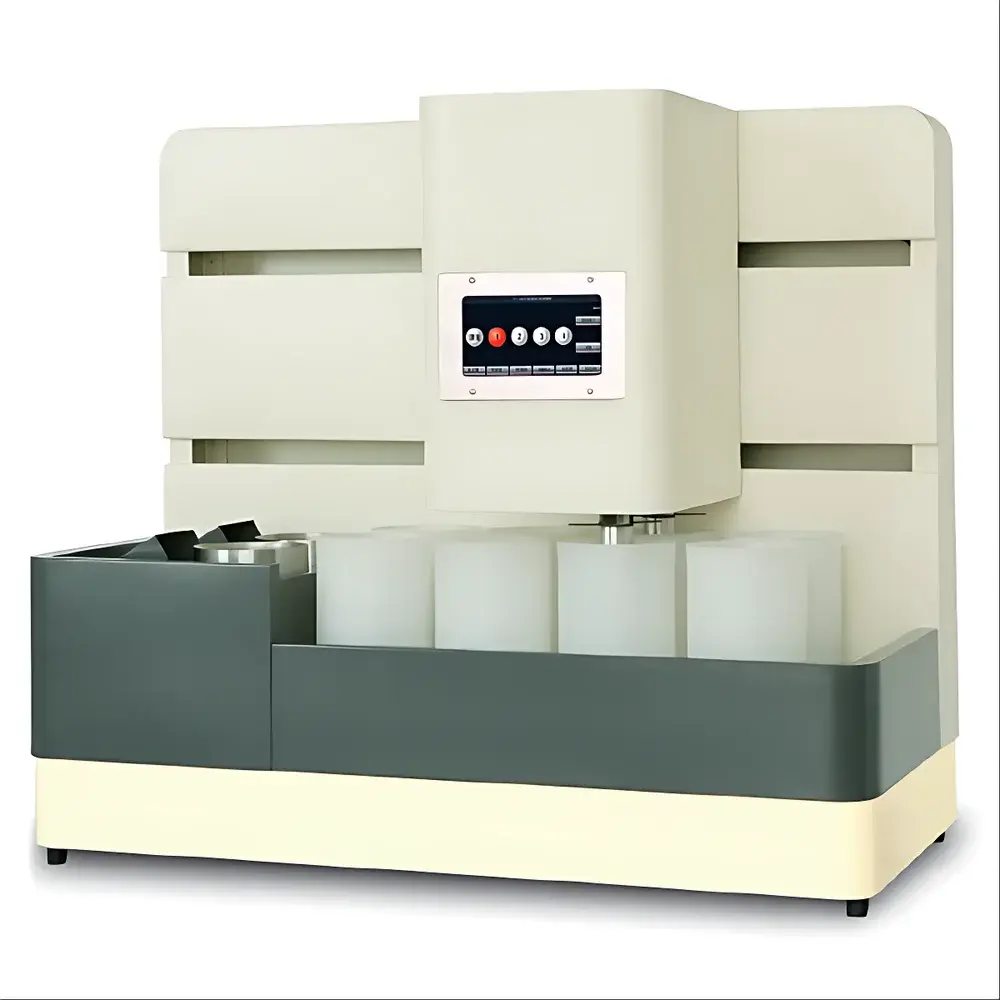
Tongtailian TTL-580 Fully Automated Knife Mill
| Brand | Tongtailian (TTL) |
|---|---|
| Origin | Beijing, China |
| Manufacturer Type | Direct Manufacturer |
| Product Category | Domestic |
| Model | TTL-580 |
| Instrument Type | Knife Mill |
| Sample Suitability | Hard, Semi-hard, Elastic, Moist, Oily, or Fatty Materials |
| Output Particle Size | ≤ 300 µm (typical, sample-dependent) |
| Feed Particle Size | 10–40 mm |
| Batch Processing Capacity | 500 g (for fruits/vegetables), 300 g (for meat/fish) |
| Grinding Principle | High-shear mechanical comminution via rotating blades |
| Motor Power | 2.2 kW |
| Motor Speed | 18,000 rpm |
| Grinding Vessel Volume | 2.2 L (stainless steel or PP) |
| Blade Configuration | Dual-layer, 4-blade assembly (stainless steel or titanium alloy) |
| Control Interface | 7-inch color touchscreen |
| Operating System | Embedded Linux |
| Cleaning System | Dedicated external cleaning chamber with peristaltic detergent dosing, three-stage cleaning (tap water → high-power ultrasonic → hot-air drying) |
| Safety Features | Dual interlock system, emergency stop, blade misalignment detection, low-water-pressure cutoff, motor overcurrent/overvoltage/overheat/overload protection |
| Dimensions | 950 W × 450 D × 815 H mm |
Overview
The Tongtailian TTL-580 Fully Automated Knife Mill is an industrial-grade, high-throughput sample preparation instrument engineered for reproducible, contamination-free mechanical size reduction of heterogeneous biological and food-related materials. It operates on the principle of high-shear comminution—utilizing precisely balanced, high-speed rotating blades to generate controlled impact, cutting, and shearing forces within a sealed grinding chamber. Unlike conventional grinders relying solely on impact or attrition, the TTL-580 employs a progressive, multi-mode blade motion strategy (including gradual engagement, intermittent pulsing, and floating pressure control) to ensure uniform particle distribution while minimizing thermal degradation and cross-contamination. Its dual-channel architecture supports either parallel single-sample processing or sequential batch operation—ideal for laboratories requiring strict traceability across diverse sample types such as cereals, herbs, seafood, cooked meats, and botanicals.
Key Features
- Fully automated workflow: Integrated control of grinding, three-stage blade cleaning (tap water rinse → ultrasonic cavitation → hot-air drying), and system self-diagnosis—all executed without manual intervention.
- Dedicated external cleaning station: Equipped with a peristaltic pump for precise detergent delivery and independent drainage, eliminating carryover between samples and satisfying GLP-compliant lab requirements.
- Intelligent blade management: Supports interchangeable stainless steel and titanium alloy blades; full cleaning cycle includes blade, shaft, and pressure cap in one sequence.
- Multi-mode grinding logic: Programmable operation modes—progressive engagement for heat-sensitive matrices, intermittent pulsing for fibrous tissues, and floating pressure for variable-density samples—optimize particle homogeneity and throughput.
- Embedded Linux-based control system: Real-time display of process parameters (elapsed time, rotational status, temperature alerts), fault logging, and audit-ready event history.
- Robust safety architecture: Dual hardware/software interlocks, automatic shutdown on blade misalignment or water pressure loss, and comprehensive motor protection (overcurrent, overvoltage, thermal overload).
Sample Compatibility & Compliance
The TTL-580 accommodates a broad spectrum of natural matrices—including fresh/frozen vegetables, cereal grains, dried herbs, animal muscle tissue, processed seafood, dairy products, and feed formulations—with feed sizes ranging from 10 mm to 40 mm and final particle distributions consistently below 300 µm (D90). Its stainless steel and PP grinding vessels are chemically inert and autoclavable, supporting compliance with ISO 5725 (accuracy and precision of measurement methods) and ASTM D5680 (standard practice for sample preparation of solid biofuels). The instrument’s closed-loop cleaning protocol meets internal SOPs for cross-contamination prevention and aligns with FDA 21 CFR Part 11 data integrity expectations when paired with validated software configurations.
Software & Data Management
The embedded Linux OS provides deterministic real-time control with non-volatile storage of up to 64 user-defined grinding protocols—each configurable for speed ramping, dwell time, pulse frequency, and cleaning intensity. All operational events (start/stop timestamps, error codes, cleaning stage completion) are logged with UTC synchronization and exportable via USB to CSV format. Optional network integration enables remote monitoring through secure HTTP(S) endpoints, facilitating centralized lab instrument management and alignment with enterprise LIMS environments. Audit trails include operator ID (via optional RFID login), parameter changes, and system health diagnostics—supporting GMP/GLP documentation workflows.
Applications
This instrument serves critical preprocessing roles in food safety testing (e.g., pesticide residue analysis per EN 15662), nutritional profiling (AOAC 991.42 fiber determination), veterinary drug screening in animal feed, herbal quality control (Chinese Pharmacopoeia ChP 2020 Section IV), and environmental monitoring of soil-plant matrices. Its ability to homogenize high-fat, high-moisture, or elastic samples—without cryogenic assistance—reduces method variability in subsequent extraction and instrumental analysis (HPLC, GC-MS, ICP-OES). Laboratories performing routine QC in agri-food certification bodies, contract testing labs, and university research cores rely on the TTL-580 for its repeatability (RSD < 3.2% for replicate cornmeal batches, n=6) and minimal operator dependency.
FAQ
What sample types are compatible with the TTL-580?
Fruits, vegetables, grains, seeds, meat, fish, dairy, herbs, spices, animal feed, and soft-to-medium-hard biological tissues.
Can the instrument handle oily or fatty samples without clogging?
Yes—the dual-layer 4-blade geometry, combined with programmable floating pressure and intermittent grinding modes, prevents adhesion and ensures consistent throughput for lipid-rich matrices.
Is the cleaning process validated for residue removal?
The three-stage cleaning protocol (water rinse → ultrasonic degreasing → thermal drying) has been verified using ATP bioluminescence assays, achieving <10 RLU residual contamination post-cycle across stainless steel and PP surfaces.
Does the system support regulatory-compliant data archiving?
Yes—full audit trail logging, electronic signatures (with optional authentication), and tamper-evident CSV exports comply with FDA 21 CFR Part 11 and EU Annex 11 requirements when deployed under validated IT infrastructure.
What maintenance intervals are recommended?
Blade inspection every 200 operating hours; ultrasonic transducer calibration annually; peristaltic pump tubing replacement every 6 months under continuous use.



