
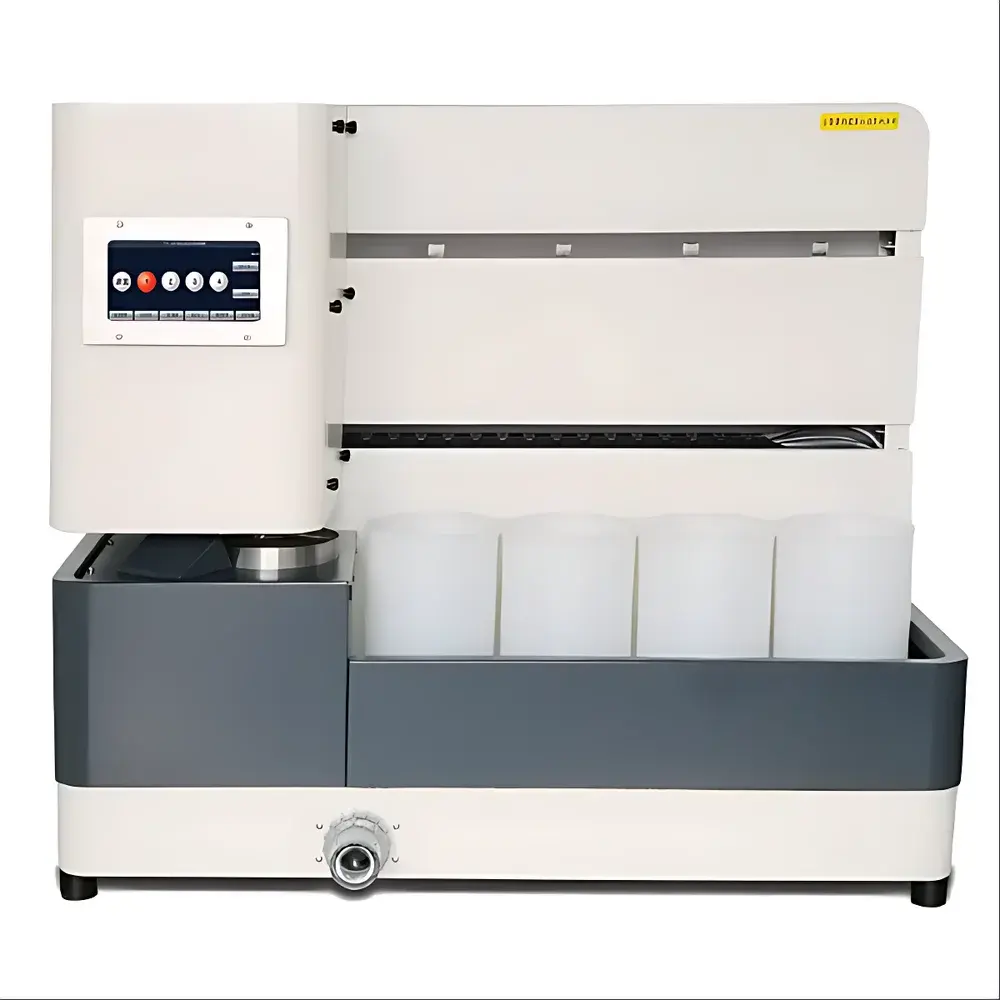
Tongtailian TTL-500S Knife Mill
| Brand | Tongtailian (TTL) |
|---|---|
| Origin | Beijing, China |
| Manufacturer Type | Direct Manufacturer |
| Region of Origin | Domestic (China) |
| Model | TTL-500S |
| Instrument Type | Knife Mill |
| Sample Applicability | Soft to moderately hard, elastic, high-moisture/fat/oil content samples |
| Output Particle Size | ≤ 300 µm |
| Feed Particle Size | ≤ 40 mm |
| Batch Processing Capacity | 1.2–2.0 kg |
| Motor Power | 2.2 kW |
| Max. Rotational Speed | 18,000 rpm |
| Grinding Principle | High-shear cutting |
| Grinding Modes | Dry & Wet |
| Programmable Grinding Time | User-defined |
| Preloaded Programs | 8 standard protocols |
| Customizable Protocols | 64 editable methods |
| Rotor Material Options | Stainless steel, titanium alloy |
| Rotor Configuration | Dual-blade, single-layer |
| Grinding Vessel Capacities | 1 L / 2.2 L / 3.2 L (stainless steel or PP) |
| Control Interface | 7-inch color touchscreen |
| Operating System | Embedded Linux |
| Cleaning System | Dedicated wash basin with detergent dispensing, 3-stage cleaning (tap water rinse, high-power ultrasonic cleaning, hot-air drying) |
| Safety Features | Dual interlock system, emergency stop, rotor misalignment detection, low-water-pressure cutoff, motor overcurrent/overvoltage/overheat/overload protection |
Overview
The Tongtailian TTL-500S Knife Mill is an industrial-grade, fully automated sample preparation instrument engineered for high-throughput homogenization and size reduction of soft, elastic, and moisture-rich biological and organic materials. It operates on the principle of high-shear mechanical cutting—utilizing precisely balanced dual-blade rotors rotating at up to 18,000 rpm to generate controlled shear forces that fracture cellular structures while preserving biochemical integrity. Unlike conventional grinders relying on impact or compression, the TTL-500S achieves consistent particle size distribution through adjustable rotational dynamics—including progressive, intermittent, and floating grinding modes—enabling simultaneous coarse comminution and fine homogenization in a single cycle. Designed for routine use in QC laboratories, food safety testing facilities, agricultural research centers, and pharmaceutical R&D units, it meets core operational requirements for reproducibility, traceability, and cross-contamination control in regulated environments.
Key Features
- Fully automated workflow: Integrated control of grinding, three-stage rotor cleaning (water rinse, ultrasonic decontamination, thermal drying), and vessel handling—all initiated via 7-inch color touchscreen interface.
- Dedicated cleaning basin with programmable detergent dosing eliminates carryover between batches, supporting GLP-compliant workflows where sample integrity is critical.
- Embedded Linux OS ensures deterministic real-time process monitoring, including dynamic display of elapsed time, remaining duration, error codes, and stage-specific status indicators.
- Three rotor mounting configurations (stainless steel and titanium alloy options) accommodate diverse sample chemistries—from acidic plant extracts to lipid-rich meat tissues—without corrosion or metal leaching.
- Multi-mode grinding logic: Progressive descent of the lid synchronizes with rotor motion to minimize wall adhesion; intermittent pulsing prevents thermal degradation of heat-sensitive analytes.
- Comprehensive safety architecture includes dual hardware/software interlocks, emergency stop circuitry, rotor position verification sensors, and multi-parameter motor protection (overcurrent, overvoltage, thermal overload, mechanical stall).
Sample Compatibility & Compliance
The TTL-500S is validated for processing heterogeneous soft-to-moderately-hard matrices including fresh fruits and vegetables, cereal grains, legumes, animal muscle tissue, cooked seafood, herbal botanicals, compound feed, and dairy-derived products. Its design accommodates variable moisture (5–85%), fat (2–40%), and fiber content without clogging or blade jamming. The instrument supports compliance with ISO 5725 (accuracy and precision of measurement methods), ASTM D7429 (standard practice for homogenization of biological samples), and FDA 21 CFR Part 11 when paired with audit-trail-enabled laboratory information management systems (LIMS). All wet-grind protocols are compatible with aqueous buffers, ethanol, and mild organic solvents—subject to material compatibility verification per vessel construction (PP vs. stainless steel).
Software & Data Management
The embedded control software provides full protocol governance: eight factory-default programs cover common sample classes (e.g., “Leafy Greens,” “Ground Meat,” “Dried Herbs”), while 64 user-editable slots allow granular configuration of speed ramp profiles, dwell times, pulse intervals, and cleaning sequence parameters. Each run logs timestamped metadata—including operator ID, program name, vessel ID, rotor type, batch weight, and final particle size estimate—to internal flash memory. Export options include CSV via USB 2.0 port for integration into ELN or LIMS platforms. Firmware updates are delivered via signed binary packages to ensure version integrity and cybersecurity compliance.
Applications
- Food safety labs: Rapid homogenization of composite food samples prior to pesticide residue analysis (GC-MS/MS), mycotoxin quantification (HPLC-FLD), or pathogen enrichment (ISO 6579).
- Agricultural research: Preparation of grain, seed, and forage samples for proximate analysis (AOAC 985.29), NIR calibration, or DNA extraction (CTAB-based protocols).
- Pharmaceutical QA/QC: Uniform dispersion of herbal powders and excipient blends for dissolution testing and content uniformity assessment (USP <905>).
- Environmental monitoring: Homogenization of soil-plant composites and aquatic biota for heavy metal speciation (ICP-MS) and POPs screening (EPA Method 1613).
- Clinical nutrition studies: Standardized disruption of dietary supplements and functional foods for vitamin stability profiling and bioavailability modeling.
FAQ
What types of samples are unsuitable for the TTL-500S?
Samples with excessive fibrous content (e.g., raw bamboo shoots), highly abrasive mineral inclusions (e.g., sand-contaminated root vegetables), or extreme viscosity (e.g., undiluted honey or molasses) may impair rotor efficiency and require pre-dilution or preprocessing.
Can the TTL-500S be integrated into automated lab workflows?
Yes—the instrument supports digital I/O signals (TTL-level trigger inputs/outputs) and Modbus RTU over RS-485 for synchronization with robotic arms, autosamplers, or central process controllers.
Is validation documentation available for GMP environments?
Factory-issued IQ/OQ documentation packages—including test protocols, acceptance criteria, and executed reports—are provided upon request and align with Annex 15 and ASTM E2500 guidelines.
How often does the rotor require recalibration or maintenance?
No periodic recalibration is required; however, routine inspection of blade sharpness, bearing play, and seal integrity is recommended every 500 operating hours or per quarterly PM schedule.
What is the expected service life of the titanium alloy rotor under normal usage?
Under typical food and botanical processing conditions (≤2 hr/day, dry/wet alternating cycles), titanium rotors demonstrate ≥3,000 operational hours before measurable edge wear affects particle size consistency.



