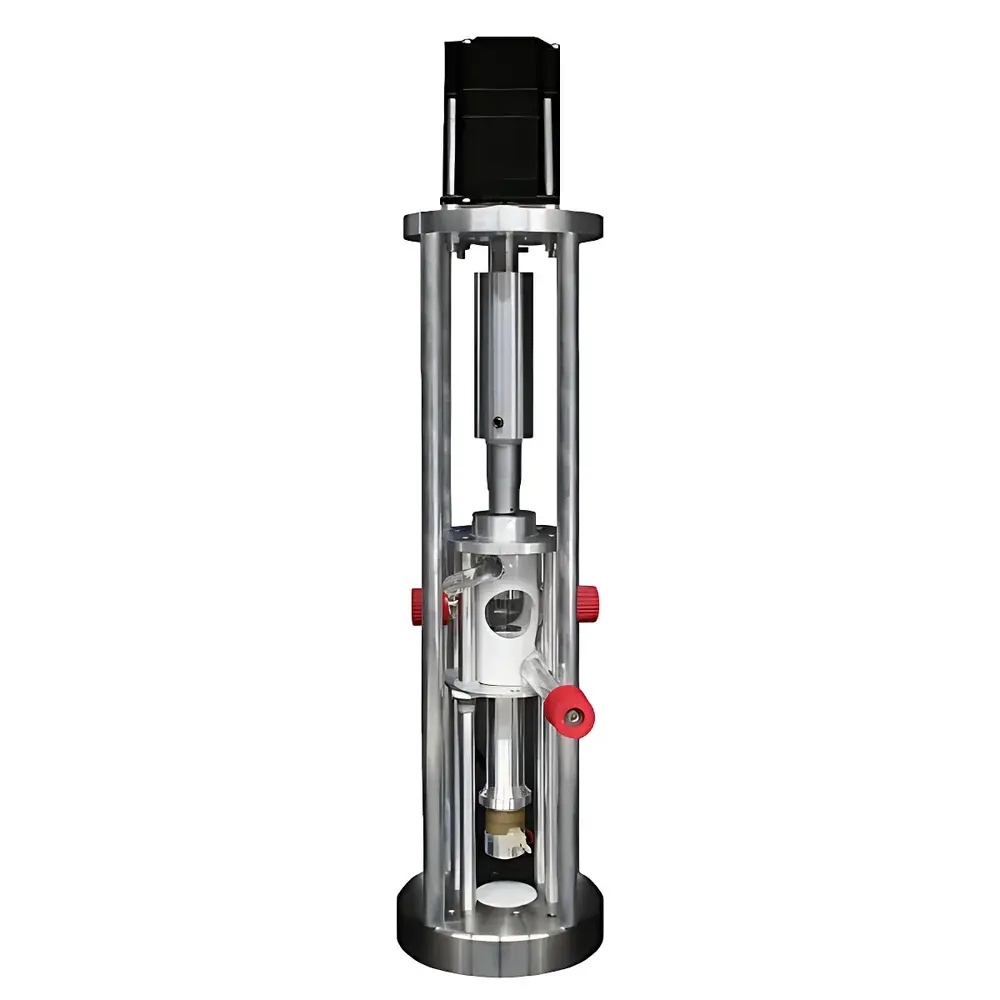
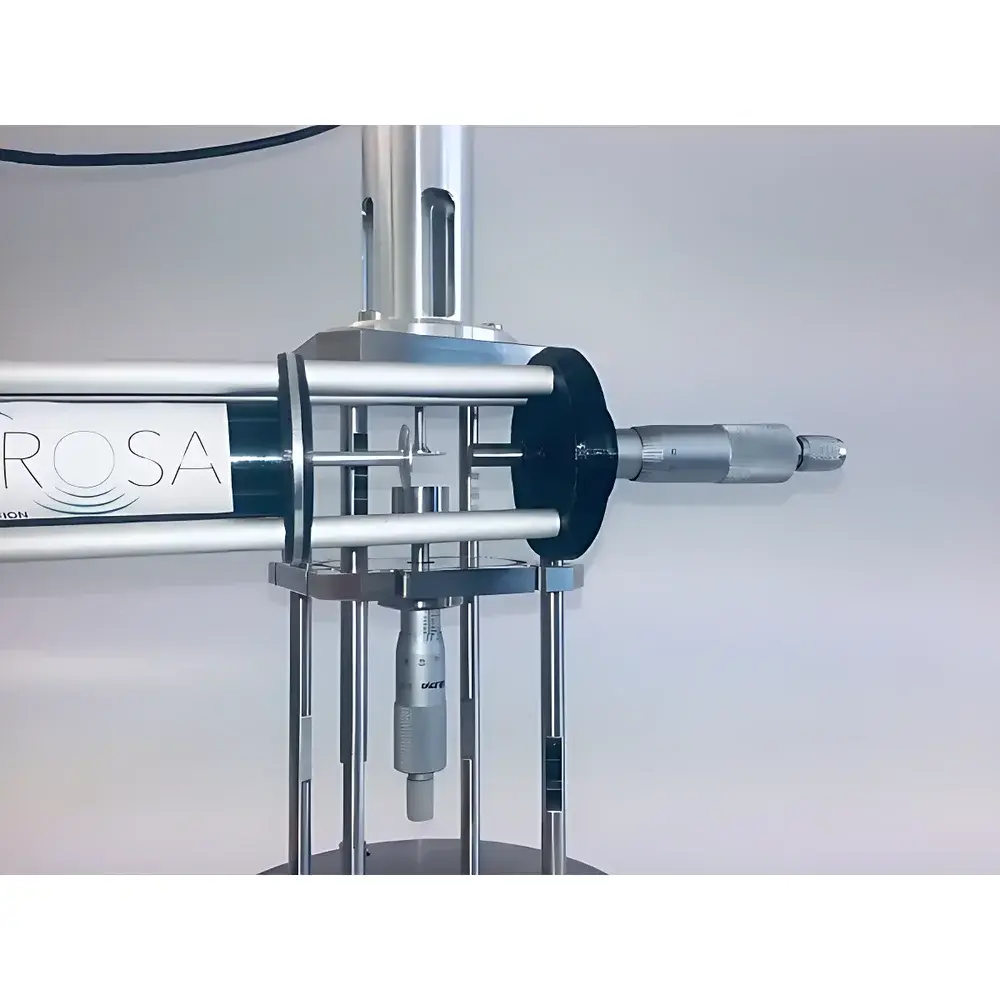
BOROSA L200 Atmospheric Acoustic Levitation System
| Brand | BOROSA |
|---|---|
| Country of Origin | Germany |
| Model | L200 |
| Operating Pressure | Ambient (1 atm) |
| Frequency | ~40 kHz |
| Temperature Range | −20 °C to +180 °C |
| Sample Type | Liquids and Solids |
| Levitation Mode | Standing-wave acoustic levitation (ultrasonic, single-axis) |
| Software Functions | Automated droplet detection, contour analysis, real-time dimensional tracking (axial/radial diameter), volume-time curve fitting, diffusion/transport coefficient derivation |
| Compliance | Designed for GLP-compliant lab environments |
Overview
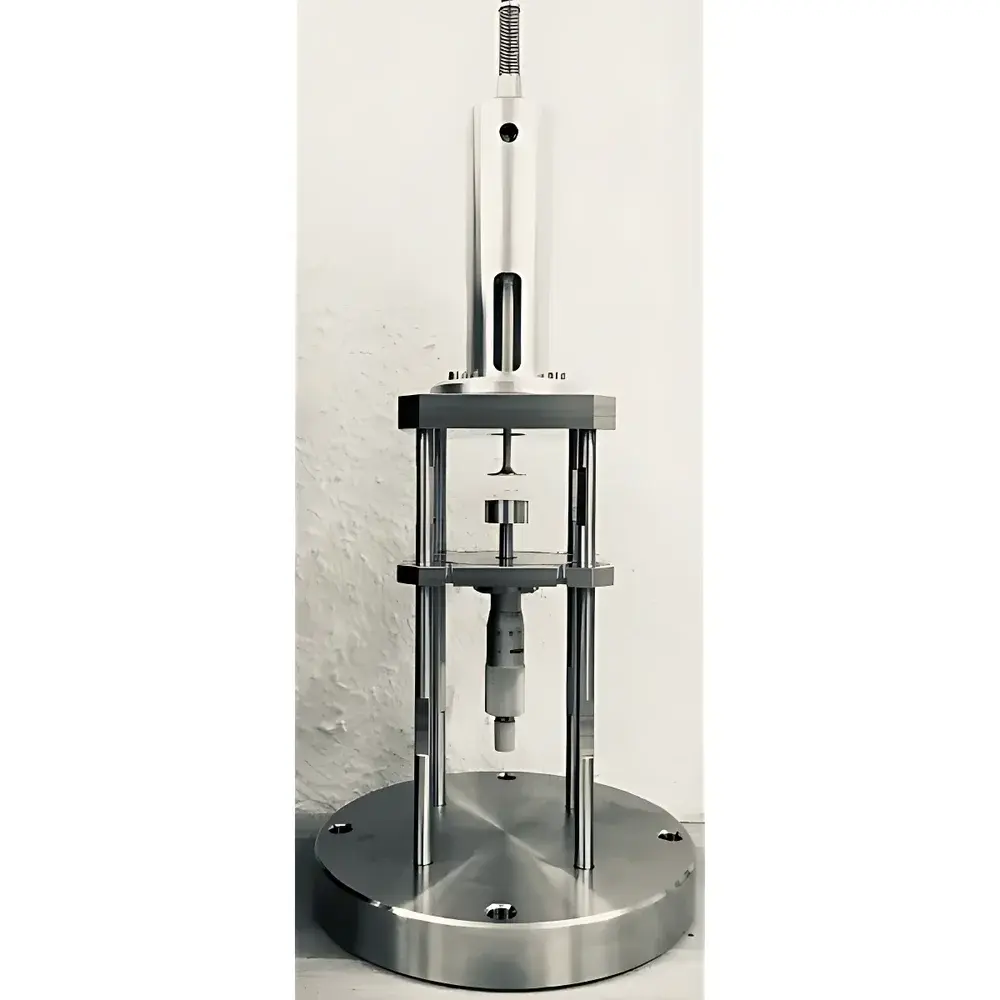
The BOROSA L200 Atmospheric Acoustic Levitation System is a precision-engineered single-axis ultrasonic levitator designed for contactless, containerless sample handling under ambient pressure conditions. It operates on the principle of acoustic radiation force generated by a standing ultrasonic wave—established between a piezoelectric transducer and a precisely aligned reflector—at a nominal frequency of approximately 40 kHz. This configuration produces stable, node-centered levitation of millimeter-scale samples without mechanical support or physical containment. Unlike high-pressure or vacuum-based levitation platforms, the L200 enables direct integration with standard optical, thermal, and spectroscopic instrumentation in conventional laboratory settings. Its core utility lies in eliminating wall-induced artifacts—such as heterogeneous nucleation, thermal conduction bias, surface adsorption, and signal scattering—thereby enabling intrinsic characterization of phase transitions, interfacial phenomena, and kinetic processes in both liquid and solid-phase materials.
Key Features
- Stable, long-duration levitation of spherical and oblate droplets (0.5–4 mm diameter) and small solid particles (up to 3 mm) at atmospheric pressure
- Integrated temperature control capability spanning −20 °C to +180 °C via optional Peltier or fluid-circulated measurement chamber
- Acoustically silent operation: no audible noise emission due to ultrasonic frequency operation (>20 kHz)
- High-precision real-time monitoring of axial and radial diameters, volume, and centroid position using synchronized high-speed imaging
- Programmable reflector positioning for dynamic shape control—from flattened spheroids to near-perfect spheres—enabling systematic study of Laplace pressure effects
- Modular hardware architecture supporting add-on modules including gas environment control (N₂, Ar, CO₂), LED illumination, auto-injection systems, and motorized reflector actuation
Sample Compatibility & Compliance
The L200 accommodates a broad range of sample classes—including aqueous and organic liquids, polymer melts, molten salts, pharmaceutical suspensions, colloidal dispersions, and microcrystalline solids—without requiring encapsulation or substrate deposition. Its ambient-pressure design eliminates vacuum chamber constraints and simplifies alignment with FTIR, Raman, UV-Vis, and laser-induced fluorescence setups. All system firmware and data acquisition modules are structured to support audit-ready documentation workflows. While not inherently certified for regulated GMP production, the L200’s software architecture supports 21 CFR Part 11-compliant user access controls, electronic signatures, and immutable audit trails when deployed with validated third-party data management systems. It aligns with ISO 17025 requirements for method validation in research-grade physical property determination.
Software & Data Management
The proprietary BOROSA Acoustic Levitation Control Suite provides fully automated experimental execution and quantitative post-processing. Core functions include frame-by-frame droplet boundary detection using adaptive edge-enhancement algorithms, sub-pixel contour fitting, and time-resolved volumetric reconstruction from orthogonal projections. Measured parameters—including elapsed time, chamber temperature, instantaneous volume, axial/radial aspect ratio, and center-of-mass displacement—are logged synchronously at up to 100 Hz. The software computes first- and second-order derivatives of volume vs. time curves to extract effective diffusion coefficients, evaporation rates, and solute transport kinetics. Export formats include CSV, HDF5, and MATLAB-compatible .mat files. Optional licensed modules extend functionality to surface tension estimation (via Young–Laplace inversion), density calculation (from buoyancy-corrected levitation force models), and viscosity inference (based on oscillatory damping response).
Applications
- Investigation of homogeneous nucleation pathways during supercooled droplet freezing and crystallization
- Quantitative analysis of molecular diffusion and mass transfer in evaporating sessile and levitated droplets
- In situ monitoring of gelation kinetics in biopolymer and hydrogel precursors
- Containerless synthesis and thermal processing of metastable phases and amorphous pharmaceuticals
- Surface tension and interfacial rheology studies of surfactant-laden interfaces under controlled humidity and temperature gradients
- Nanoscale self-assembly dynamics in confined levitated volumes, relevant to aerosol science and inhalation drug delivery modeling
FAQ
What sample sizes can the L200 stably levitate?
Typical levitation range: 0.5–4 mm diameter for liquids; up to 3 mm for low-density solids (e.g., polymers, ceramics). Maximum mass capacity is ~200 mg depending on density and acoustic contrast factor.
Is vacuum or inert gas purging required?
No—operation is optimized for ambient air, though optional gas-tight chambers support controlled atmospheres (N₂, Ar, synthetic air) for oxidation-sensitive or humidity-controlled experiments.
Can the system be integrated with external analytical instruments?
Yes—the open-top measurement zone and modular optical access ports allow co-location with Raman spectrometers, high-speed cameras (≥1000 fps), IR thermography, and laser Doppler velocimetry systems.
Does the L200 support automated experiment sequencing?
Yes—via Python API and LabVIEW drivers, users can script multi-step temperature ramps, timed injections, reflector repositioning, and synchronized data acquisition across all sensors.
What calibration standards are recommended?
Traceable polystyrene microspheres (1–3 mm), NIST-certified temperature probes, and calibrated volumetric pipettes are used for geometric and thermal validation. BOROSA provides SOPs for routine performance verification per ISO/IEC 17025 Annex A.