
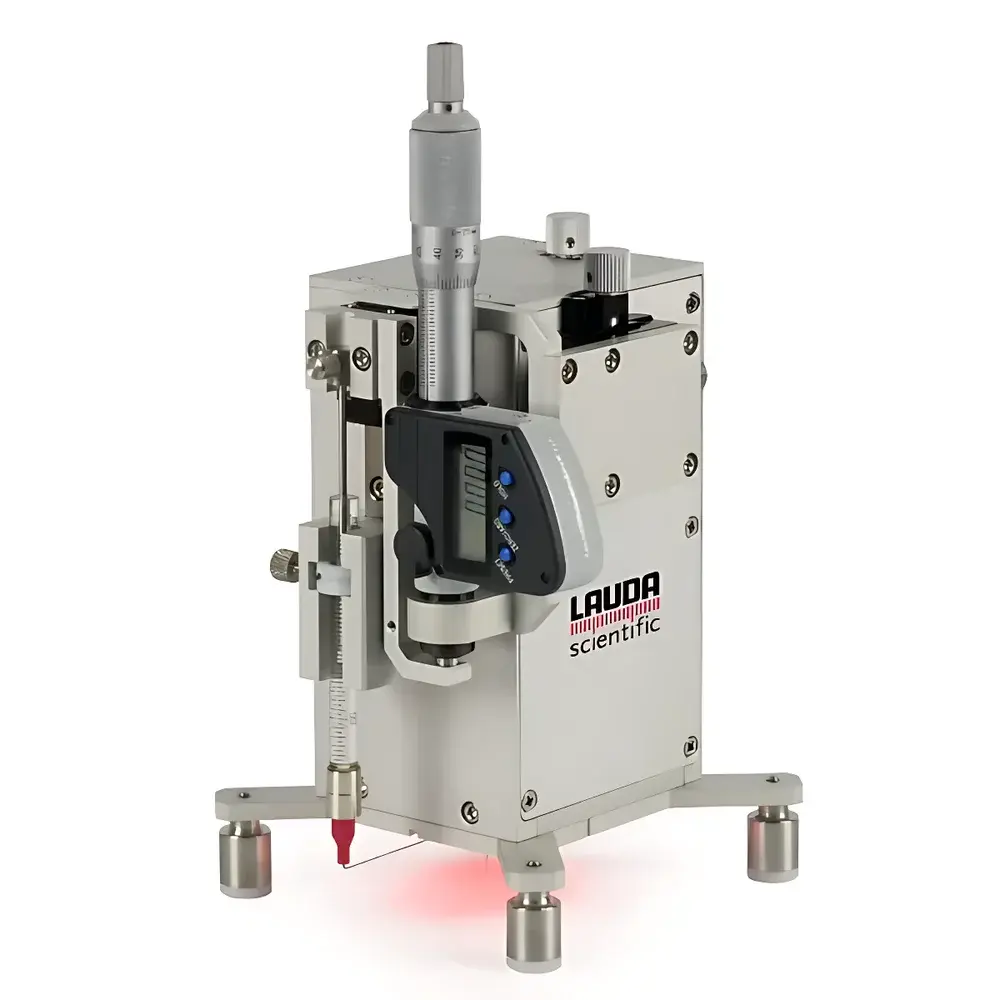
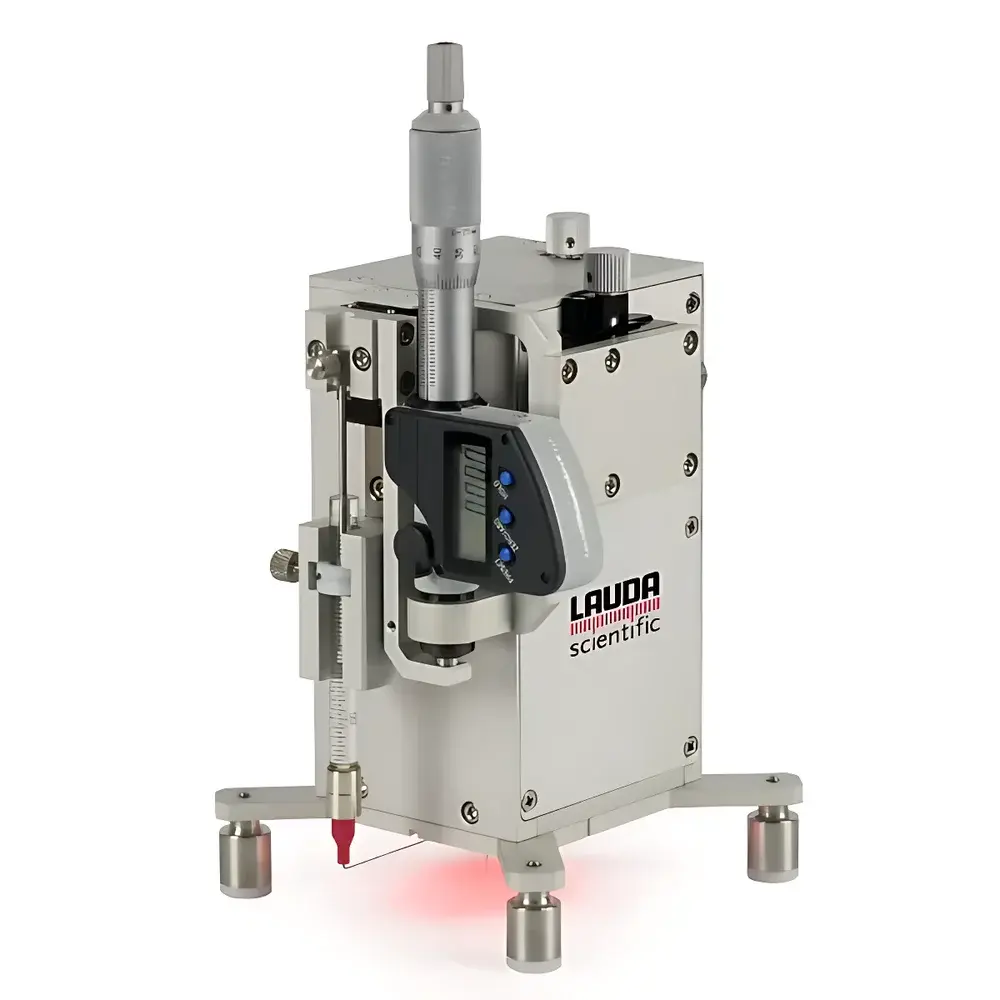
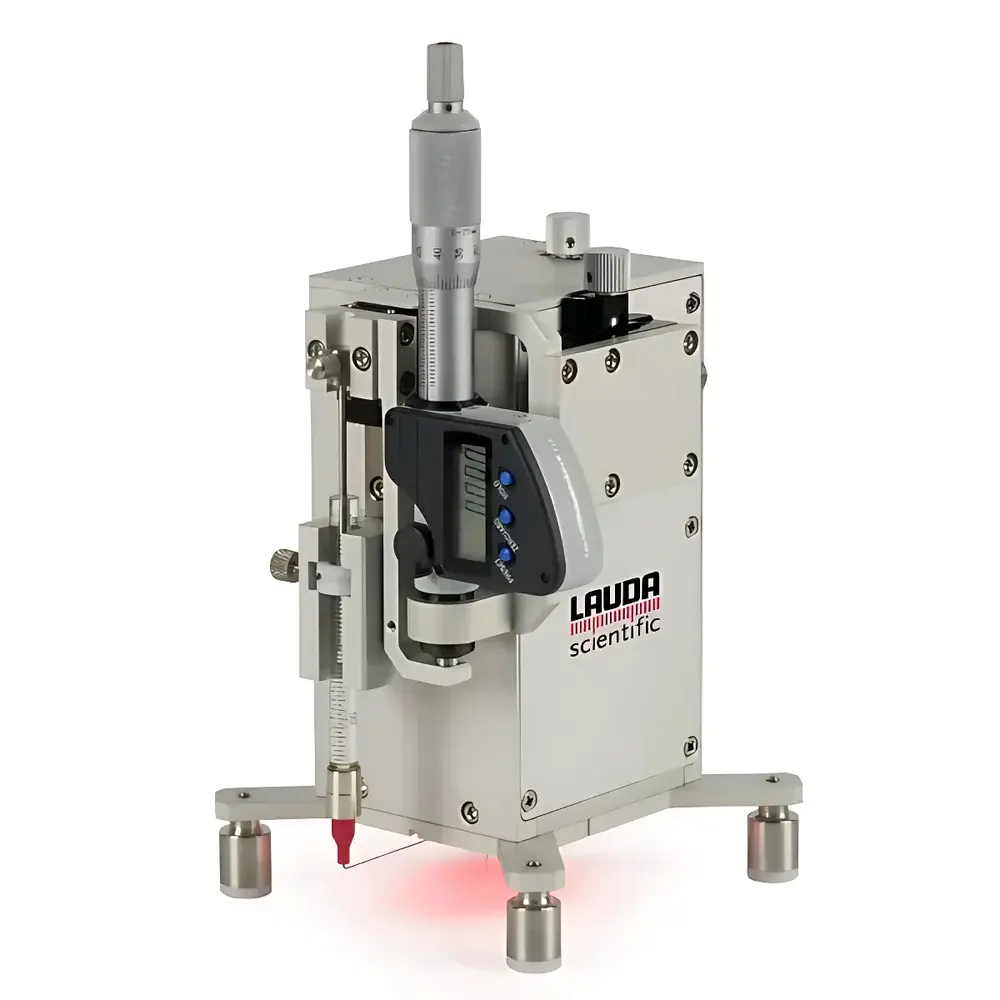
LAUDA Scientific LSA.MOB-M Portable Video-Based Contact Angle Analyzer
| Brand | LAUDA Scientific |
|---|---|
| Origin | Germany |
| Model | LSA.MOB-M |
| Instrument Type | Portable Video Optical Contact Angle Analyzer |
| Contact Angle Range | 0–180° |
| Measurement Accuracy | ±0.1° |
| Angular Resolution | 0.01° |
| Image Magnification | 6.5× |
| Maximum Sample Dimensions | 77 × 60 × 150 mm |
| Sample Stage Load Capacity | Unlimited (no size or weight restriction) |
| Viewing Geometry | Top-View Imaging Configuration |
| Light Source | Monochromatic, Uniform LED Cold Light (Software-Adjustable Intensity) |
| Dispensing System | Integrated Manual Digital Microliter Dispenser |
| Device Dimensions (L×W×H) | 77 × 60 × 150 mm |
| Weight | 1.0 kg |
Overview
The LAUDA Scientific LSA.MOB-M is a fully portable, handheld video-based contact angle analyzer engineered for high-fidelity interfacial characterization under real-world, non-laboratory conditions. Unlike conventional goniometers constrained by fixed-stage geometry and optical alignment requirements, the LSA.MOB-M implements a top-view optical imaging principle—capturing the liquid-solid interface from above using a precisely aligned coaxial optical path. This configuration eliminates parallax error associated with side-view systems and enables robust measurement on surfaces of arbitrary curvature, texture, or spatial orientation. The instrument operates on the fundamental principle of digital image analysis of sessile or dynamic droplets, extracting contact angle values via edge-detection algorithms calibrated against geometric reference standards traceable to NIST. Its design targets applications where sample immobility, large-scale substrates, or field-deployable metrology are critical—such as in-situ quality control of coated automotive panels, on-site assessment of building material hydrophobicity, or rapid evaluation of printed electronics substrates during roll-to-roll manufacturing.
Key Features
- True top-view optical architecture enabling distortion-free contact angle quantification on convex, concave, and irregularly contoured surfaces
- No physical sample stage constraints: measurements possible on substrates of unlimited lateral dimensions and mass, provided surface accessibility permits optical coupling
- Integrated digital microliter dispenser with tactile feedback and real-time volume readout (range: 0.1–10 µL), supporting reproducible droplet deposition across diverse liquid classes (low- to high-surface-tension, varying density)
- High-resolution monochrome CMOS sensor coupled with 6.5× fixed magnification optics optimized for sub-pixel edge detection and angular resolution down to 0.01°
- Uniform, thermally stable LED illumination with software-controlled intensity—minimizing thermal drift and eliminating halation artifacts common with broadband sources
- Self-contained battery operation (optional) and ultra-compact form factor (77 × 60 × 150 mm; 1.0 kg) enabling deployment in cleanrooms, production floors, outdoor environments, or confined industrial spaces
- Capable of measuring static, advancing/receding, and dynamic spreading angles—including zero-degree wetting events—without requiring substrate tilting or mechanical actuation
Sample Compatibility & Compliance
The LSA.MOB-M accommodates heterogeneous sample classes without modification: rigid or flexible polymers, porous ceramics, anodized metals, textile fibers, biological tissues, and functionalized nanocomposites. Its top-view geometry ensures compatibility with vertically oriented, overhead-mounted, or recessed surfaces inaccessible to conventional goniometers. The system supports ASTM D7334–22 (Standard Practice for Surface Wettability of Coatings by Contact Angle Measurement) and ISO 19403-2:2017 (Paints and Varnishes — Determination of Contact Angle — Part 2: Static Contact Angle). All measurement workflows adhere to GLP-compliant data integrity principles: timestamped image capture, operator ID logging, and immutable metadata embedding (exposure time, magnification, light intensity, dispensing volume) satisfy audit requirements per FDA 21 CFR Part 11 when paired with LAUDA’s optional validated software package.
Software & Data Management
Control and analysis are performed via LAUDA’s SCA20 software suite (v5.4+), a Windows-native application compliant with IEC 62304 Class B medical device software standards. The interface supports automated droplet detection, multi-point contact angle mapping across user-defined grids, and statistical reporting of mean, standard deviation, min/max, and histogram distributions. Raw images and processed data are stored in vendor-neutral TIFF + XML metadata containers, ensuring long-term archival integrity. Export options include CSV, PDF reports with embedded calibration certificates, and direct integration into LIMS environments via OPC UA protocol. Audit trails record all parameter changes, image reprocessing events, and user logins—fully traceable for regulatory submissions.
Applications
- In-field verification of plasma, corona, or flame treatment efficacy on polymer films and composites
- Rapid screening of hydrophobicity gradients on architectural façades or roofing membranes
- Quantitative assessment of inkjet printability and droplet coalescence behavior on functionalized paper substrates
- Dynamic wicking analysis of absorbent textiles and medical nonwovens
- Surface energy estimation via Owens-Wendt-Rabel-Kaelble (OWRK) method using multi-liquid contact angle datasets
- Correlation of contact angle hysteresis with adhesion performance in structural adhesive bonding processes
- Quality assurance of anti-fouling coatings on marine or biomedical devices under operational conditions
FAQ
Can the LSA.MOB-M measure contact angles on curved or textured surfaces?
Yes. Its top-view optical design eliminates perspective distortion, enabling accurate measurement on convex lenses, microstructured surfaces, and rough substrates without surface flattening or polishing.
Is calibration required before each measurement session?
A single factory calibration (traceable to NIST SRM 2800) is sufficient for routine use; optional on-site verification using certified spherical lens standards is supported annually.
Does the instrument support dynamic contact angle measurement (advancing/receding)?
Yes—via sequential manual droplet addition/removal or integration with external syringe pumps using TTL-triggered image capture.
Can data be exported to third-party statistical analysis platforms?
Yes. All numerical outputs conform to ASTM E1482-20 format and are directly importable into JMP, Minitab, Python (pandas), and MATLAB.
What environmental conditions affect measurement stability?
Ambient temperature fluctuations >±2°C/min or relative humidity >85% may induce condensation on optics; operation is rated for 10–40°C and 20–70% RH (non-condensing).



