
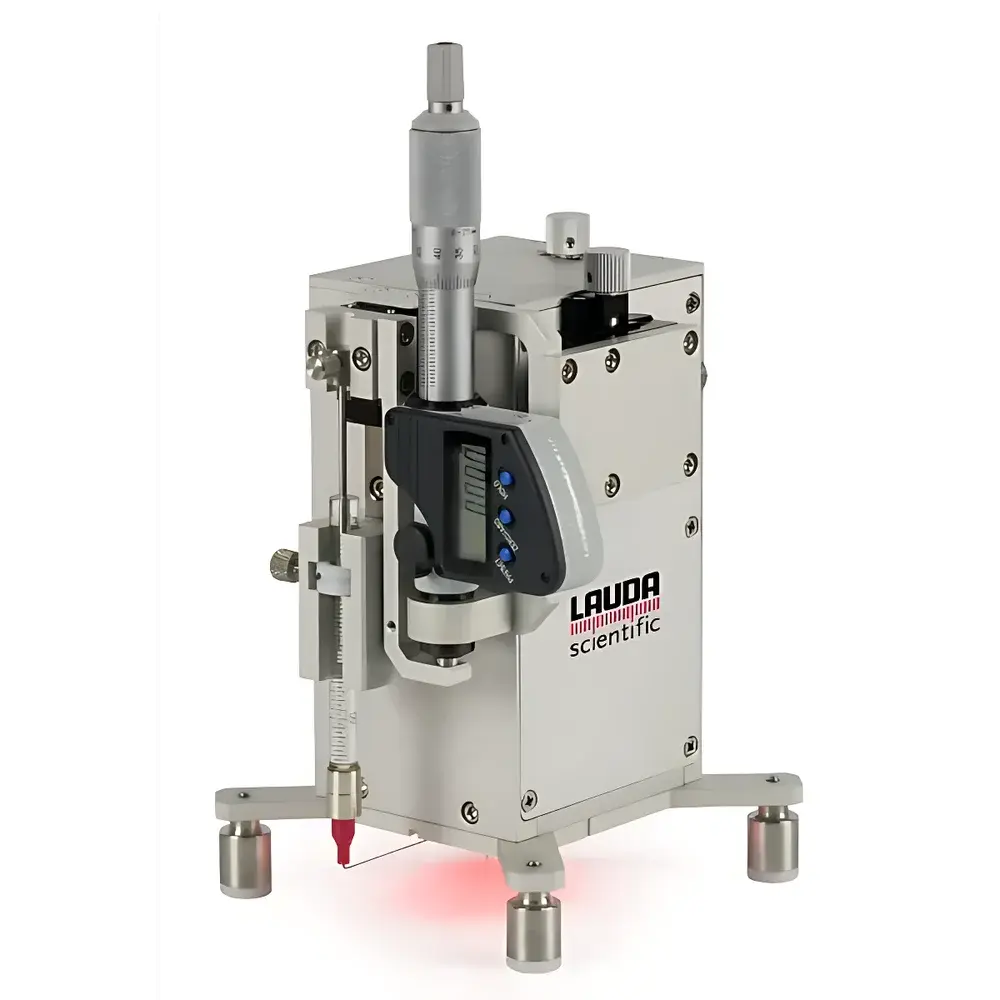
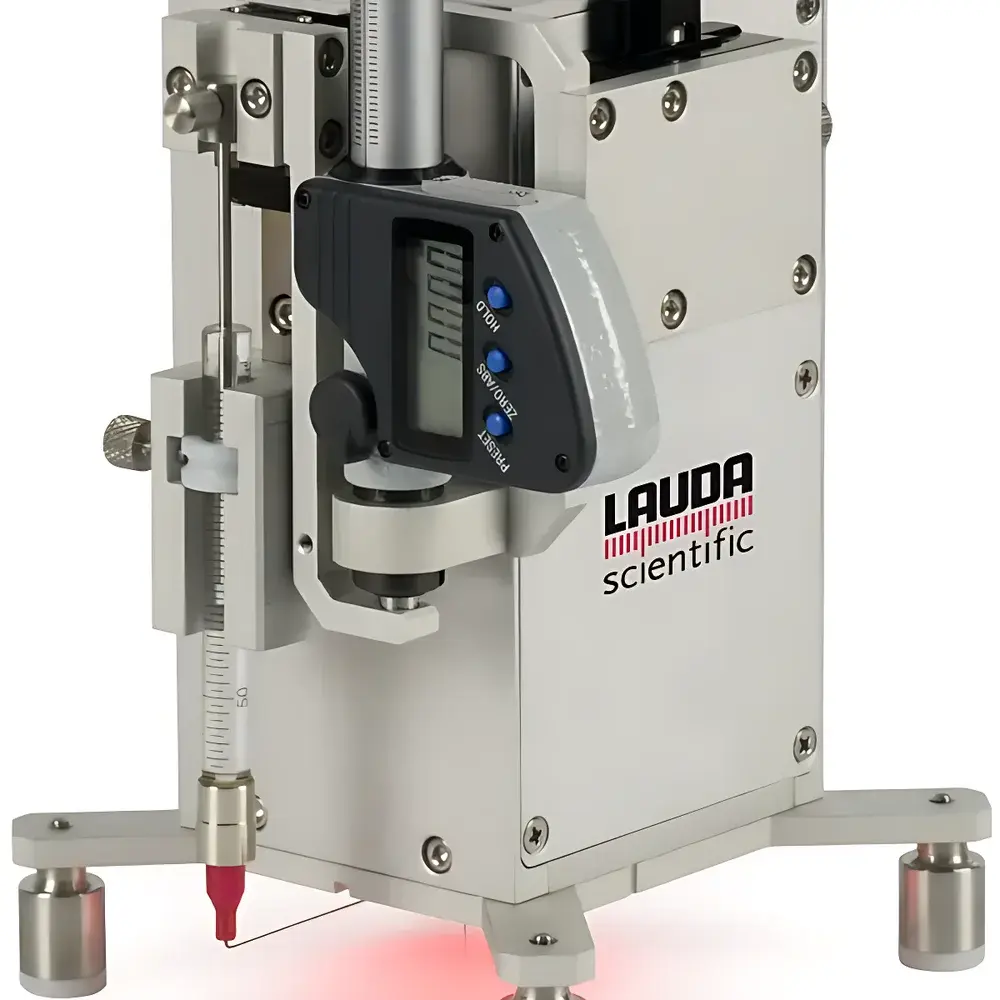
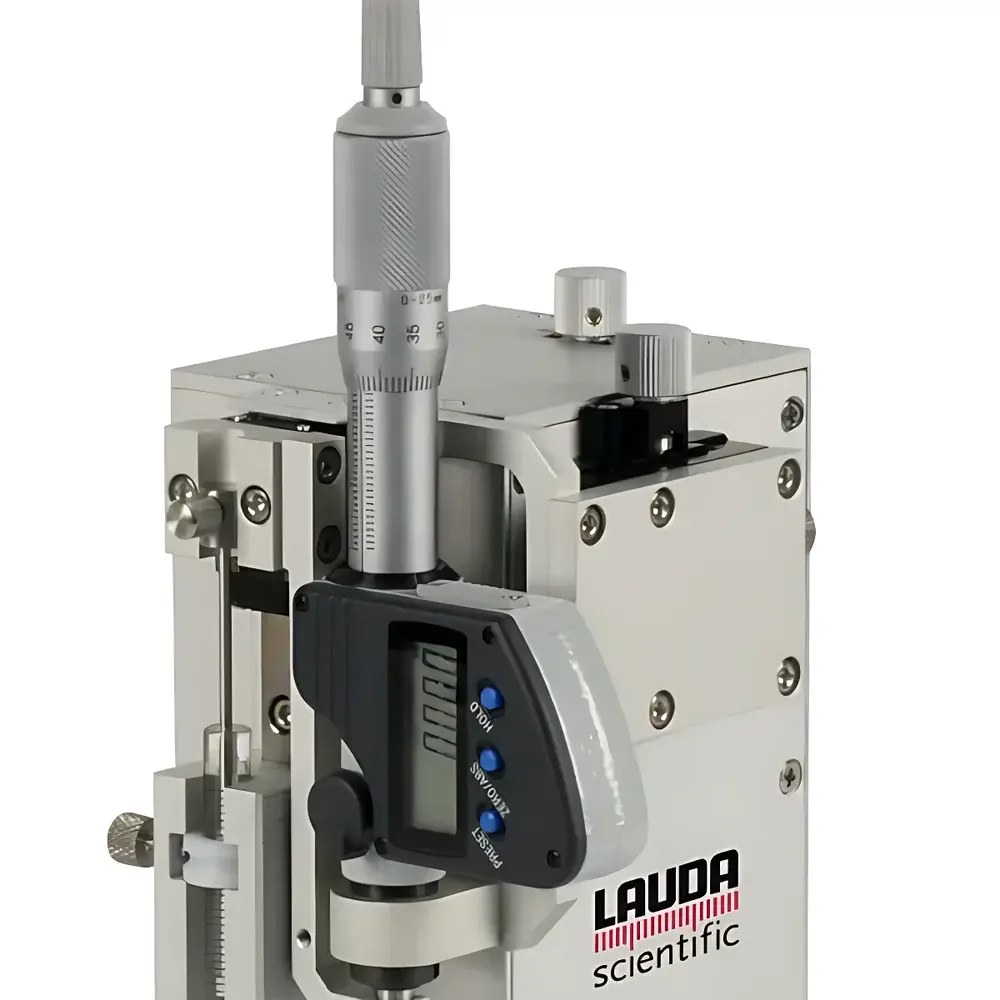
LAUDA Scientific LSA MOB-P Top-View Online Contact Angle Analyzer
| Brand | LAUDA Scientific |
|---|---|
| Origin | Germany |
| Model | LSA MOB-P |
| Instrument Type | Video-based Optical Contact Angle Analyzer (Top-View Configuration) |
| Contact Angle Range | 0–180° |
| Contact Angle Accuracy | ±0.1° |
| Contact Angle Resolution | 0.1° |
| Surface Tension Range | 0.01–2000 mN/m |
| Surface Tension Accuracy | ±0.01 mN/m |
| Imaging System | High-resolution, low-distortion industrial fixed-focus lens |
| Working Distance | Up to 25 mm |
| Sample Stage Dimensions | 100 × 100 mm (fixed base) |
| Measurement Cycle Time | ~1–2 seconds per droplet |
| Interface Options | TTL digital output, software API (TCP/IP or DLL-based) |
Overview
The LAUDA Scientific LSA MOB-P is a purpose-engineered top-view online contact angle analyzer designed for real-time, non-invasive surface wettability monitoring in industrial process environments. Unlike conventional side-view goniometers relying on profile-based droplet contour fitting, the LSA MOB-P employs a rigorous top-view optical methodology—capturing the orthogonal projection of sessile or pendant droplets directly from above—to extract contact angles, circularity metrics, and dynamic wetting parameters without geometric assumptions about droplet symmetry or substrate flatness. This principle enables robust quantification of contact angle hysteresis, advancing front/receding edge tracking, and surface energy mapping even on highly textured, curved, or obstructed surfaces where traditional optical access is physically constrained. The system is engineered for integration into continuous manufacturing lines—including roll-to-roll coating, plasma treatment, cleaning validation, and thin-film deposition—where spatial constraints, ambient vibration, or thermal drift preclude use of benchtop instruments.
Key Features
- True top-view imaging architecture with calibrated fixed-focus industrial lens, delivering high pixel fidelity and minimal radial distortion across the full field of view
- Non-contact liquid dispensing capability via optional piezoelectric or pneumatic micro-dosing modules, eliminating mechanical interference and enabling repeatable sub-µL droplet placement
- Real-time measurement cycle of 1–2 seconds per data point, synchronized with production line triggers via TTL input/output signals
- Working distance up to 25 mm—enabling operation over conveyors, heated stages, or enclosed chambers without repositioning
- No physical limitations on sample dimensions or surface topography: validated on convex cylinders, porous foams, machined grooves, and vertically oriented substrates
- High-precision contact angle resolution of 0.1° and accuracy of ±0.1°, traceable to NIST-traceable calibration standards
- Integrated surface tension calculation using pendant drop analysis (PDA) and Young–Laplace curve fitting, covering 0.01–2000 mN/m with 0.01 mN/m repeatability
Sample Compatibility & Compliance
The LSA MOB-P accommodates heterogeneous substrates without requiring planarization or vacuum fixation. Its top-view geometry permits measurement on moving belts, rotating drums, or stacked components where lateral access is blocked by adjacent fixtures or environmental enclosures. The system supports ISO 19403-2 (contact angle determination), ASTM D7334 (surface energy of polymer films), and ISO 8296 (ink adhesion testing) methodologies. When deployed in regulated environments—such as pharmaceutical packaging line cleanliness verification or medical device hydrophilicity qualification—the instrument’s software optionally complies with FDA 21 CFR Part 11 requirements, including electronic signature support, audit trail logging, and role-based user access control. All firmware and image processing algorithms are validated under GLP/GMP-aligned IQ/OQ protocols.
Software & Data Management
Operating on LAUDA’s proprietary SCA (Surface Characterization Analysis) software platform, the LSA MOB-P provides both standalone operation and seamless SCADA/MES integration. The software includes automated batch processing, statistical process control (SPC) charting, and configurable pass/fail thresholds with real-time alarm generation. Raw image sequences, metadata (timestamp, trigger source, environmental conditions), and calculated parameters (θ_adv, θ_rec, Δθ, γ_sv, γ_sl) are stored in vendor-neutral HDF5 format. A documented RESTful API and native DLL interface allow bidirectional communication with PLCs, MES systems (e.g., Siemens Opcenter, Rockwell FactoryTalk), or custom Python-based analytics pipelines. Data export supports CSV, XML, and PDF report generation compliant with internal QA documentation standards.
Applications
- Real-time validation of plasma, corona, or flame treatment efficacy on polymer films and composites
- In-line monitoring of cleaning agent residue removal on metal stampings and semiconductor carriers
- Dynamic contact angle tracking during solvent evaporation in inkjet printhead nozzle conditioning
- Wettability screening of battery electrode coatings prior to calendering
- Surface energy profiling of 3D-printed polymer parts for adhesive bonding readiness
- Hydrophobicity verification of anti-fouling membranes in water treatment modules
FAQ
Can the LSA MOB-P measure contact angles on curved or vertically oriented surfaces?
Yes. Its top-view optical path eliminates dependency on vertical profile visibility, enabling reliable measurements on cylindrical, conical, or upright surfaces without reorientation.
What interfaces are available for integrating the LSA MOB-P into an existing automation system?
Standard TTL I/O for hardware-level triggering and status signaling; optional TCP/IP or Windows DLL interface for high-level data exchange with PLCs or MES platforms.
Is calibration required before each measurement session?
No. The system uses factory-calibrated optics and temperature-stabilized illumination. Periodic verification using certified reference surfaces (e.g., PTFE, silicon wafer) is recommended per ISO/IEC 17025 guidelines.
Does the instrument require a cleanroom environment?
It operates reliably in ISO Class 8 environments. Optional enclosure kits with HEPA filtration and anti-static shielding are available for Class 7 or stricter settings.
How is droplet volume controlled during automated dispensing?
Via programmable micro-dosing modules with volumetric precision of ±1% CV (coefficient of variation) across 0.5–10 µL range, adjustable per material viscosity and surface energy.



