
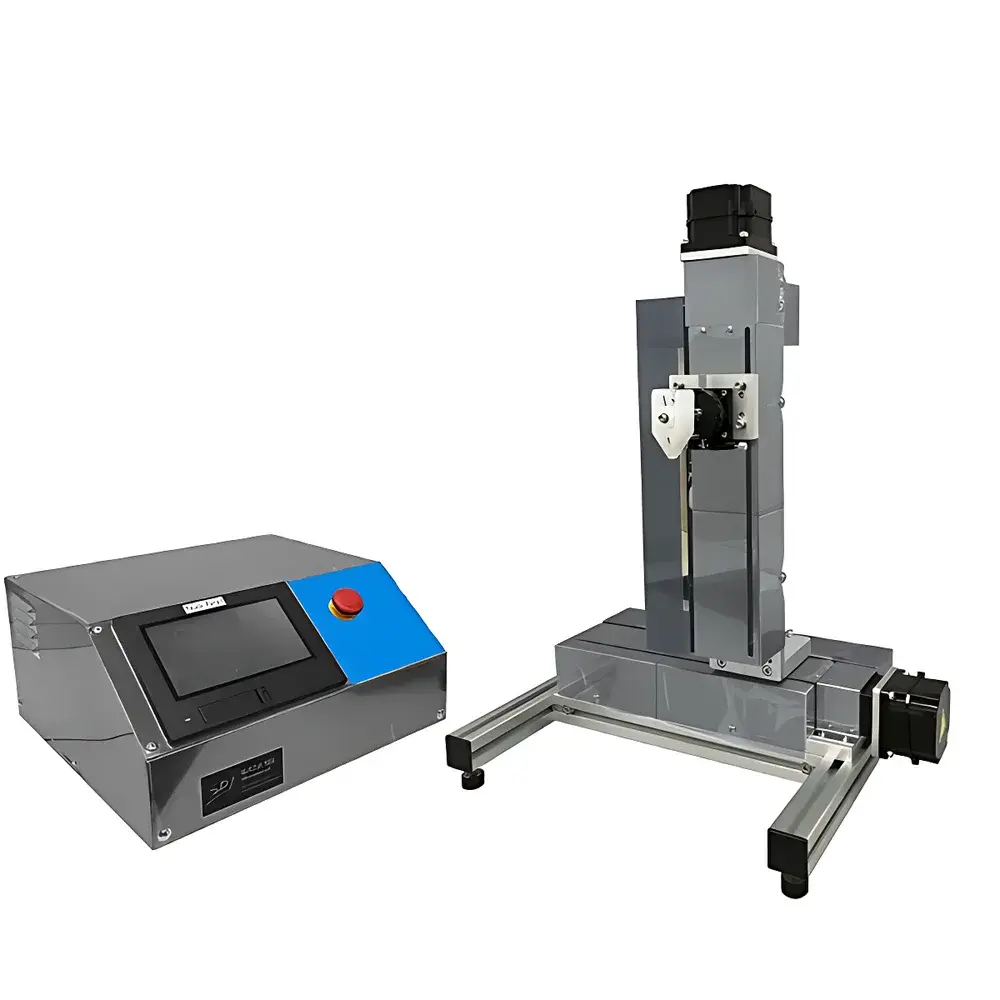
SDI ND-0407-N1-CE Ultra-Low-Speed Dip-Coating and Withdrawal System
| Brand | SDI |
|---|---|
| Origin | Japan |
| Model | ND-0407-N1-CE |
| Z-Axis Travel | 100 mm |
| X-Axis Travel | 100 mm |
| Minimum Withdrawal Speed | 1 nm/s |
| Maximum Withdrawal Speed | 60 mm/s |
| Speed Control Resolution | 1 nm/s |
| Programmable Speed Change Points | 16 |
| Programmable Stop Positions | 16 |
| Programmable Dwell Times | 16 |
| Stored Motion Programs | 8 |
| Max Load Capacity | 500 g |
| Max Substrate Height | 100 mm |
| Power Supply | AC 100 V, 300 VA |
| Dimensions (Unit) | 442 × 250 × 451 mm |
| Dimensions (Control Box) | 300 × 285 × 163 mm |
| Standard Clamp Material | Polypropylene (PP) |
| Operating Languages | English & Japanese (toggleable) |
Overview
The SDI ND-0407-N1-CE is a precision-engineered, CE-certified dip-coating and withdrawal system designed for laboratory-scale sol-gel film fabrication, colloidal self-assembly, and nanoscale thin-film research. Based on the classical immersion-withdrawal principle—governed by the balance among solution viscosity, surface tension, gravitational drainage, and substrate withdrawal kinetics—the system enables controlled formation of wet gel films that evolve into dry xerogels or mesoporous nanostructures upon ambient or thermal post-treatment. Its dual-axis (Z + X) architecture supports both vertical dip-coating and angled withdrawal (θ-adjustment), enabling systematic investigation of meniscus geometry, capillary rise dynamics, and shear-induced particle ordering during film formation. Unlike conventional single-axis systems, the ND-0407-N1-CE implements synchronized orthogonal motion to generate diagonal withdrawal paths—critical for modulating interfacial stress distribution and suppressing edge effects in asymmetric or curved substrates.
Key Features
- Ultra-low-speed capability down to 1 nm/s with sub-nanometer resolution—enabling precise kinetic control over sol-gel condensation and nanoparticle deposition rates.
- Independent and coordinated Z- and X-axis actuation, supporting vertical, tilted (θ-variable), and diagonal withdrawal trajectories—essential for optimizing film uniformity across non-planar or high-aspect-ratio substrates.
- 16-point programmable speed profile: users define discrete velocity steps, dwell times, and positional stops to replicate multi-stage deposition protocols (e.g., alternating adsorption of oppositely charged colloids).
- Eight user-storable motion programs with full parameter recall—including speed sequences, stop positions, dwell durations, and axis coordination logic—supporting GLP-compliant experimental reproducibility.
- Real-time position, velocity, and remaining process time monitoring via integrated status display—critical for time-sensitive gelation studies and in-situ optical characterization integration.
- Bilingual (English/Japanese) capacitive touchscreen interface with one-touch language switching—designed for international lab environments and multilingual research teams.
- PP-based standard clamping system compatible with glass slides, ITO/PET substrates, copper foil, capillary tubes, and cylindrical samples up to 100 mm height and 500 g mass.
Sample Compatibility & Compliance
The ND-0407-N1-CE accommodates rigid and semi-flexible substrates including silica wafers, quartz plates, polymer films (PET, PC), metal foils (Cu, Al), and microfluidic channels. Its open-frame mechanical design allows unobstructed access for in-line spectroscopic monitoring (e.g., UV-Vis, ellipsometry) during withdrawal. The system complies with EU Machinery Directive 2006/42/EC and carries CE marking for safe operation in academic, industrial R&D, and quality control laboratories. While not inherently GMP-certified, its programmable audit trail (via external logging), deterministic motion repeatability (< ±0.5 µm positioning accuracy), and parameter-lock functionality support alignment with ISO 17025 and ASTM C1485 (Standard Test Method for Measuring Film Thickness of Sol-Gel Coatings) requirements when integrated into validated workflows.
Software & Data Management
Operation is fully managed through an embedded real-time control firmware—not reliant on external PCs or proprietary software stacks. All motion parameters—including speed transitions, positional triggers, and dwell intervals—are stored in non-volatile memory and retain integrity after power cycling. Timestamped motion logs (start/stop events, actual vs. setpoint velocity deviations) can be exported via USB for traceability. Though no native FDA 21 CFR Part 11 compliance module is included, the system’s deterministic behavior, parameter immutability during execution, and absence of remote connectivity render it suitable for regulated environments when paired with lab-wide electronic lab notebook (ELN) systems for procedural documentation and data linkage.
Applications
- Sol-gel synthesis of TiO₂, SiO₂, and ZrO₂ antireflective, photocatalytic, or gas-sensing thin films.
- Layer-by-layer (LbL) assembly of polyelectrolytes and functional nanoparticles via sequential dipping with controlled immersion/retraction cycles.
- Colloidal crystal templating for opal and inverse-opal photonic structures—leveraging low-speed withdrawal to minimize convective instabilities and promote face-centered cubic (FCC) packing.
- Preparation of biomimetic hydroxyapatite coatings on metallic implants using calcium-phosphate precursor solutions.
- Kinetic studies of evaporation-driven self-assembly, Marangoni flow suppression, and coffee-ring effect mitigation under variable withdrawal angles.
FAQ
What is the minimum controllable withdrawal speed, and how is it achieved mechanically?
The system achieves 1 nm/s via high-resolution stepper motor control combined with precision lead-screw translation stages and closed-loop position feedback—ensuring stable motion without stalling or step-loss even at sub-micrometer per second regimes.
Can the system perform bidirectional motion (dip-and-withdraw) within a single program?
Yes—programmable upward/downward direction toggling, independent speed assignment per direction, and dwell control enable full immersion-retraction cycles with customizable pause points at any Z-position.
Is vacuum or inert atmosphere compatibility available?
The base configuration operates in ambient air; however, the open mechanical layout permits integration into gloveboxes or custom environmental chambers—provided external feedthroughs are used for power and control signals.
How does θ-angle adjustment affect film thickness uniformity?
Tilting the substrate modifies the effective meniscus height and gravitational drainage vector, thereby altering the capillary rise equilibrium and enabling thickness gradients or edge-thickness compensation—particularly valuable for large-area or tapered substrates.
Does the system support synchronization with external instrumentation (e.g., spectrometers)?
While no native trigger I/O ports are provided, TTL-compatible start/stop signals can be implemented via optional GPIO expansion modules—allowing hardware-level coordination with time-resolved optical measurement systems.



