
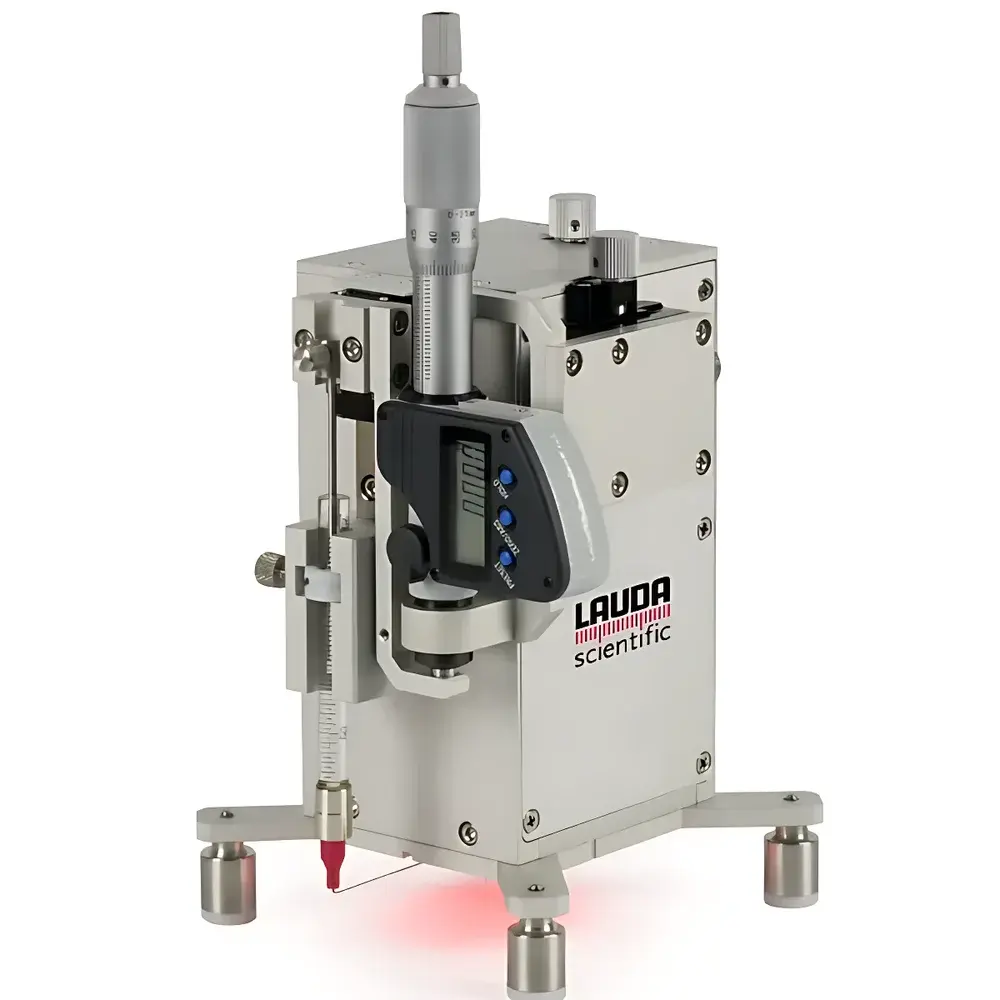
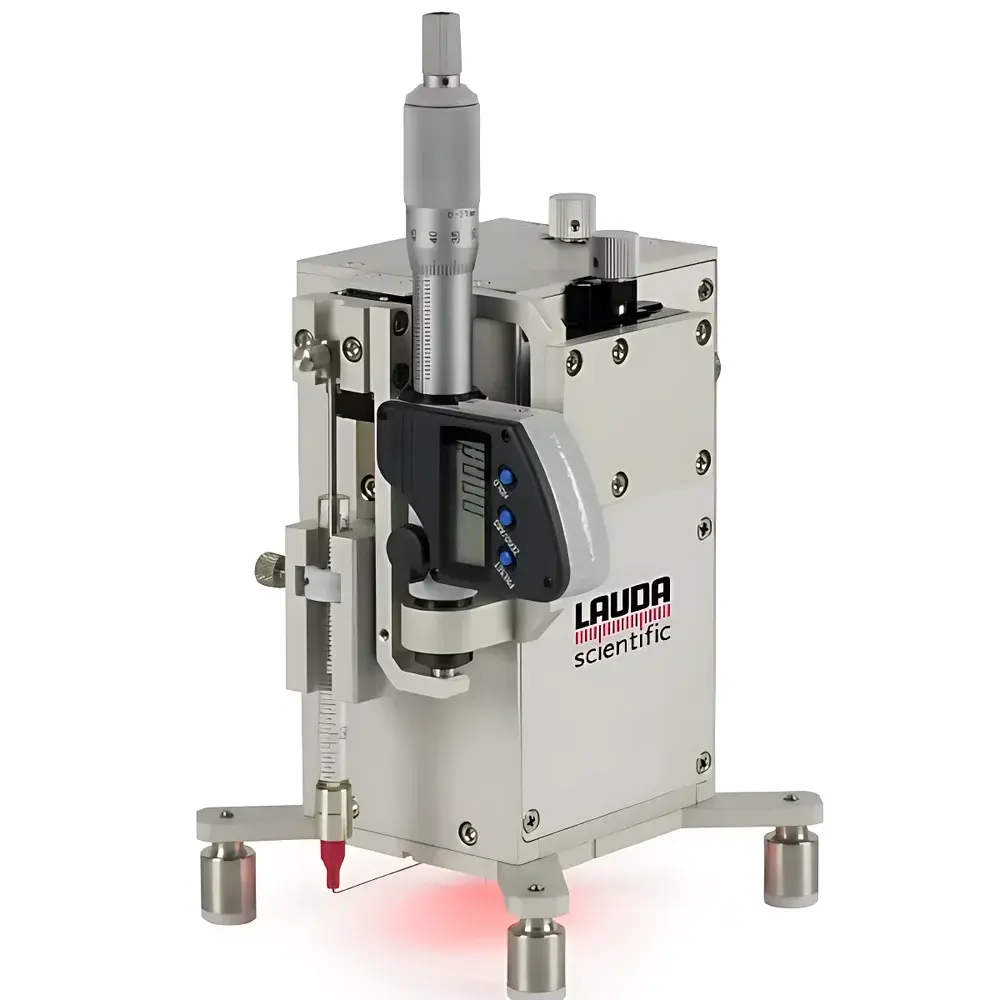
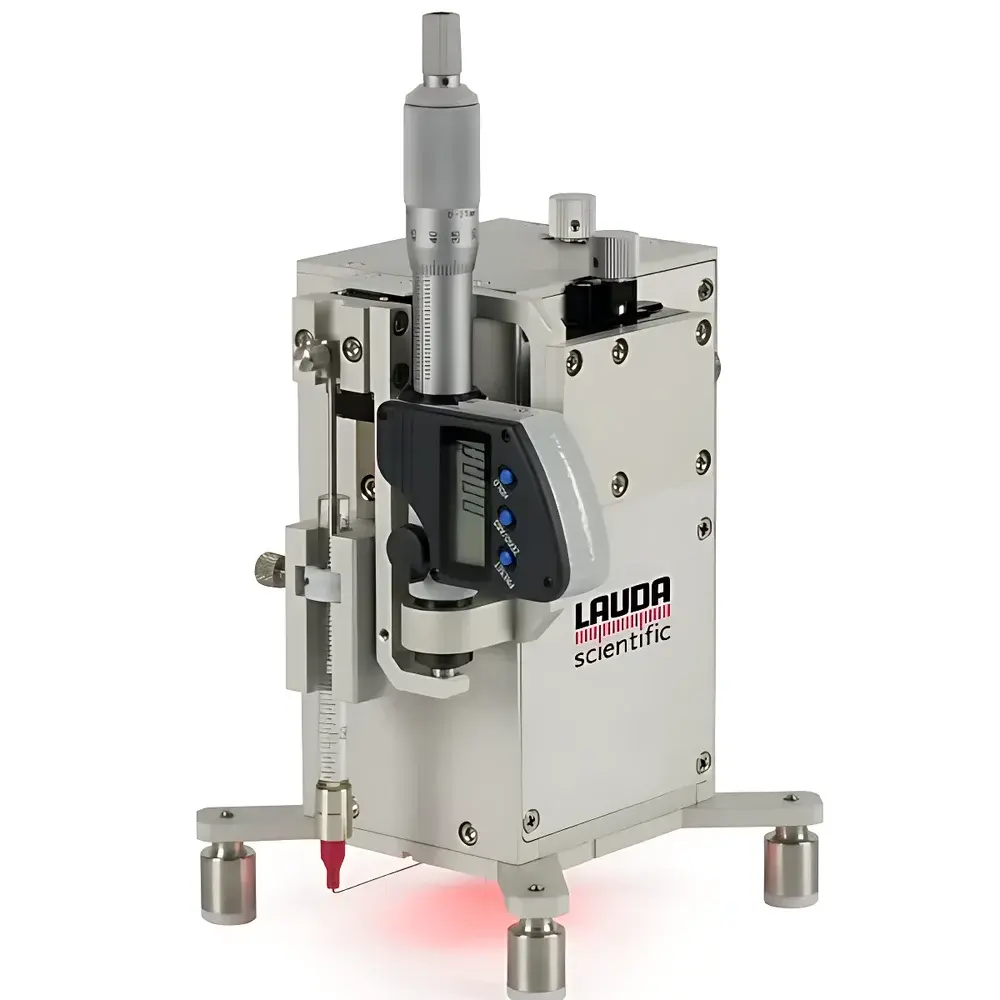
LAUDA Scientific LSA MOB-M Portable Top-View Contact Angle Analyzer
| Brand | LAUDA Scientific |
|---|---|
| Origin | Germany |
| Model | LSA MOB-M |
| Instrument Type | Portable Video-Based Optical Contact Angle Analyzer |
| Contact Angle Range | 0–180° |
| Contact Angle Accuracy | ±0.1° (0–90°), ±0.5° (90–180° for axisymmetric droplets) |
| Contact Angle Resolution | 0.1° |
| Surface Tension Range | 0.01–2000 mN/m |
| Surface Tension Accuracy | ±0.01 mN/m |
| Sample Stage Dimensions | 100 × 100 mm (fixed base unit) |
| Maximum Sample Size | Unlimited |
| Sample Stage Load Capacity | Unlimited |
| Imaging System | High-resolution, low-distortion industrial fixed-focus lens |
| Max Resolution | 752 × 480 px |
| Frame Rate | Up to 60 fps |
| Field of View | 12 × 8 mm |
| Light Source | Monochromatic, uniform LED cold light source with software-controlled intensity |
| Dispensing Unit | Integrated manual digital micro-dosage system |
| Dispensing Precision | 0.004 µL |
| Accuracy | ±0.01 µL |
| Device Dimensions | 77 × 60 × 150 mm (L×W×H) |
| Weight | ~1 kg |
Overview
The LAUDA Scientific LSA MOB-M is a handheld, top-view optical contact angle analyzer engineered for field-deployable and lab-integrated surface wettability characterization. Unlike conventional side-view goniometers relying on profile-based droplet contour fitting, the LSA MOB-M implements the top-view methodology—capturing the orthogonal projection of sessile or pendant droplets directly from above using a calibrated industrial imaging system. This approach eliminates geometric assumptions inherent in side-view analysis, enabling robust quantification of contact angles on non-planar, textured, curved, or macroscopically heterogeneous surfaces without sample reorientation or stage translation. The instrument operates on the principle that droplet footprint geometry—particularly circularity deviation, radial asymmetry, and edge sharpness—correlates directly with local solid-liquid interfacial energy distribution. Its lightweight architecture (≈1 kg), battery-compatible operation, and self-contained dispensing and illumination subsystems make it uniquely suited for on-site quality control, process validation, and in-field material screening across manufacturing, R&D, and environmental monitoring applications.
Key Features
- True top-view optical geometry: Captures droplet footprints orthogonally to minimize perspective distortion and eliminate reliance on droplet symmetry assumptions.
- Unconstrained sample compatibility: Measures contact angles on arbitrarily large, irregularly shaped, or topographically complex specimens—including convex, concave, and porous substrates—without size or weight limitations.
- High-precision microdispensing: Integrated digital syringe pump delivers liquid volumes from 0.1 µL with ±0.01 µL accuracy, supporting reproducible dosing across diverse surface tensions and viscosities.
- Adaptive illumination: Uniform monochromatic LED backlight ensures consistent contrast across reflective, translucent, or absorbent surfaces; intensity is software-regulated to optimize edge detection fidelity.
- Real-time image acquisition: 752 × 480 pixel sensor at up to 60 fps enables dynamic tracking of spreading, absorption, or evaporation kinetics with sub-second temporal resolution.
- Non-contact measurement mode: Adjustable working distance (up to 25 mm) allows assessment of fragile, heated, or contaminated surfaces without physical contact or thermal interference.
Sample Compatibility & Compliance
The LSA MOB-M accommodates samples of unlimited lateral dimensions and mechanical complexity—ranging from semiconductor wafers and polymer films to geological cores, coated textiles, and agricultural biomass. Its top-view configuration inherently supports measurements on surfaces with radii of curvature as low as 2 mm (convex) or 5 mm (concave), and tolerates RMS roughness values exceeding 10 µm without algorithmic bias. The system complies with ISO 19403-2 (contact angle measurement—part 2: static method), ASTM D7334 (surface wettability of coatings via contact angle), and supports GLP-compliant data traceability when operated with LAUDA’s certified software suite. All hardware components meet CE, RoHS, and IEC 61000-4 electromagnetic compatibility standards for use in industrial and laboratory environments.
Software & Data Management
Controlled via LAUDA’s proprietary SCA20 software, the LSA MOB-M provides automated droplet detection, multi-point contact angle mapping, and statistical reporting of angular distributions (mean, standard deviation, skewness). Algorithms employ adaptive edge-thresholding and sub-pixel centroid correction to resolve contact points with ≤0.1° repeatability. Raw image sequences, metadata (timestamp, ambient temperature/humidity, dispensing volume), and processed results are stored in vendor-neutral TIFF and CSV formats. Audit trails include user ID, calibration history, and parameter modification logs—fully compliant with FDA 21 CFR Part 11 requirements when configured with electronic signature modules. Batch export functionality enables integration into LIMS or MES platforms via standardized RESTful API endpoints.
Applications
- On-site evaluation of coating uniformity and plasma treatment efficacy in automotive or aerospace component manufacturing.
- Quantitative assessment of hydrophobicity/hydrophilicity gradients on functionalized membranes used in water filtration or fuel cell applications.
- In-field verification of pesticide adhesion and leaf surface wettability in agrochemical formulation development.
- Dynamic analysis of ink spreading kinetics on flexible packaging substrates during print process qualification.
- Surface energy mapping of heterogeneous catalysts or battery electrode materials via Owens-Wendt or van Oss-Chaudhury-Good models.
- Quality assurance of medical device surface modifications (e.g., anti-fouling PEGylation) under GMP-auditable conditions.
FAQ
Does the LSA MOB-M require sample leveling or stage alignment before measurement?
No—its top-view geometry eliminates dependence on gravitational orientation; measurements remain valid regardless of sample tilt up to ±15°.
Can the system measure advancing and receding contact angles?
Yes, through sequential deposition and retraction cycles using the integrated microdispenser, enabling hysteresis analysis without external syringe pumps.
Is calibration required prior to each measurement session?
A single pixel-to-length calibration is performed during initial setup; subsequent measurements retain accuracy unless lens or working distance is physically altered.
How does the instrument handle highly absorptive or ultra-low-energy surfaces?
The 25-mm non-contact mode minimizes pressure-induced imbibition artifacts, while high-speed imaging captures transient states before full penetration occurs.
Is the software compatible with Windows 10/11 and networked deployment?
Yes—SCA20 supports domain authentication, remote desktop control, and concurrent multi-user access via centralized license server configuration.



