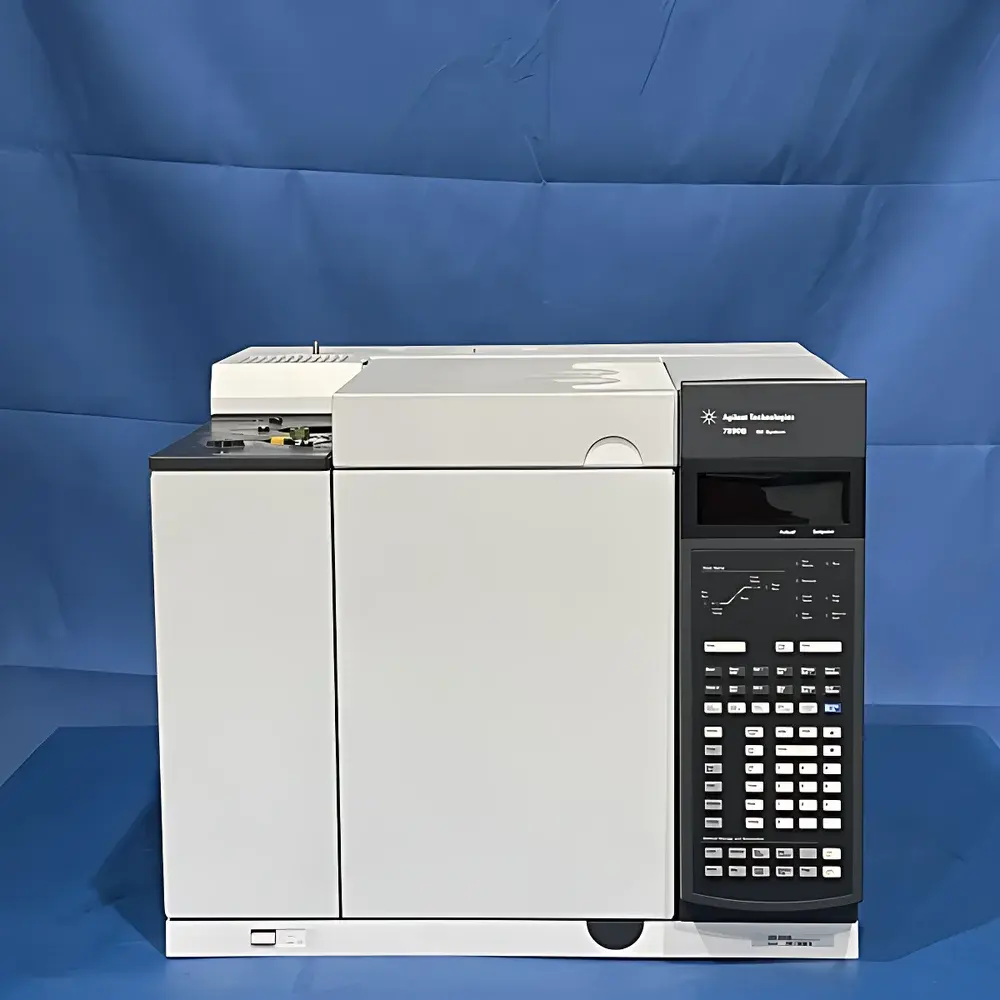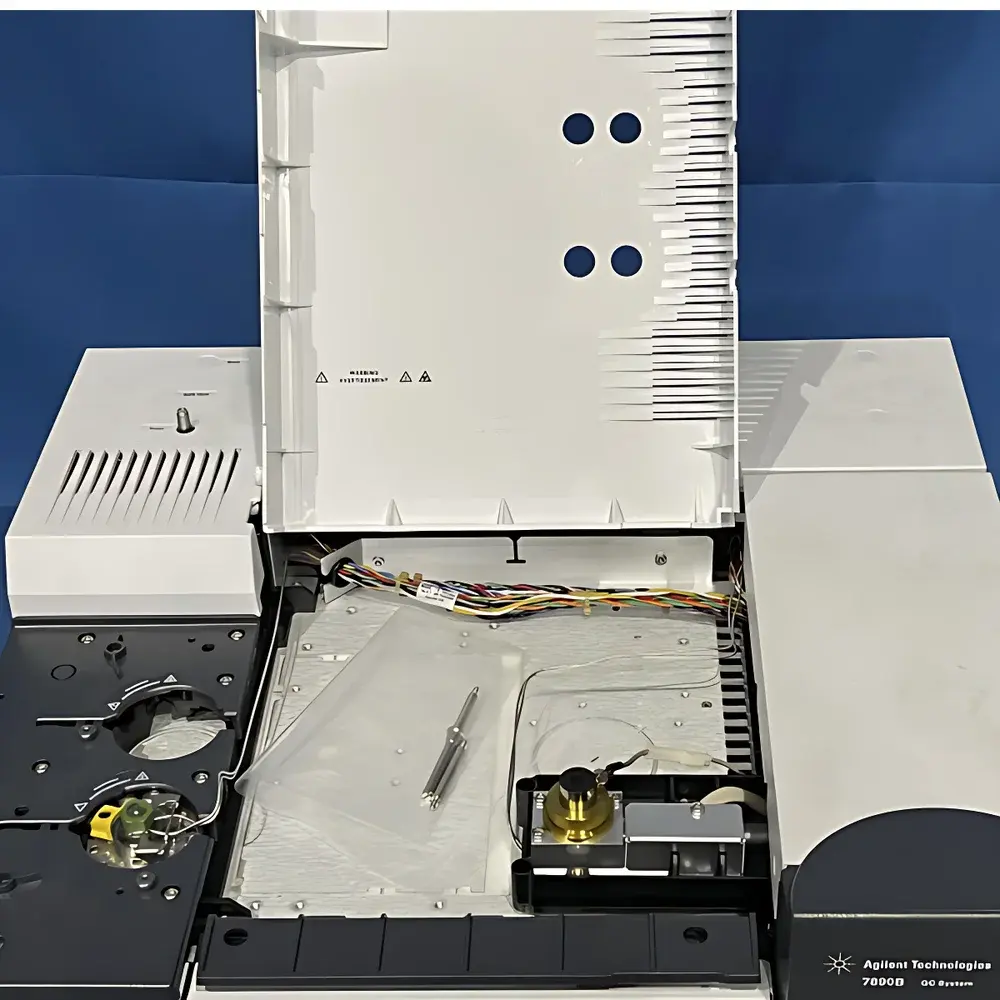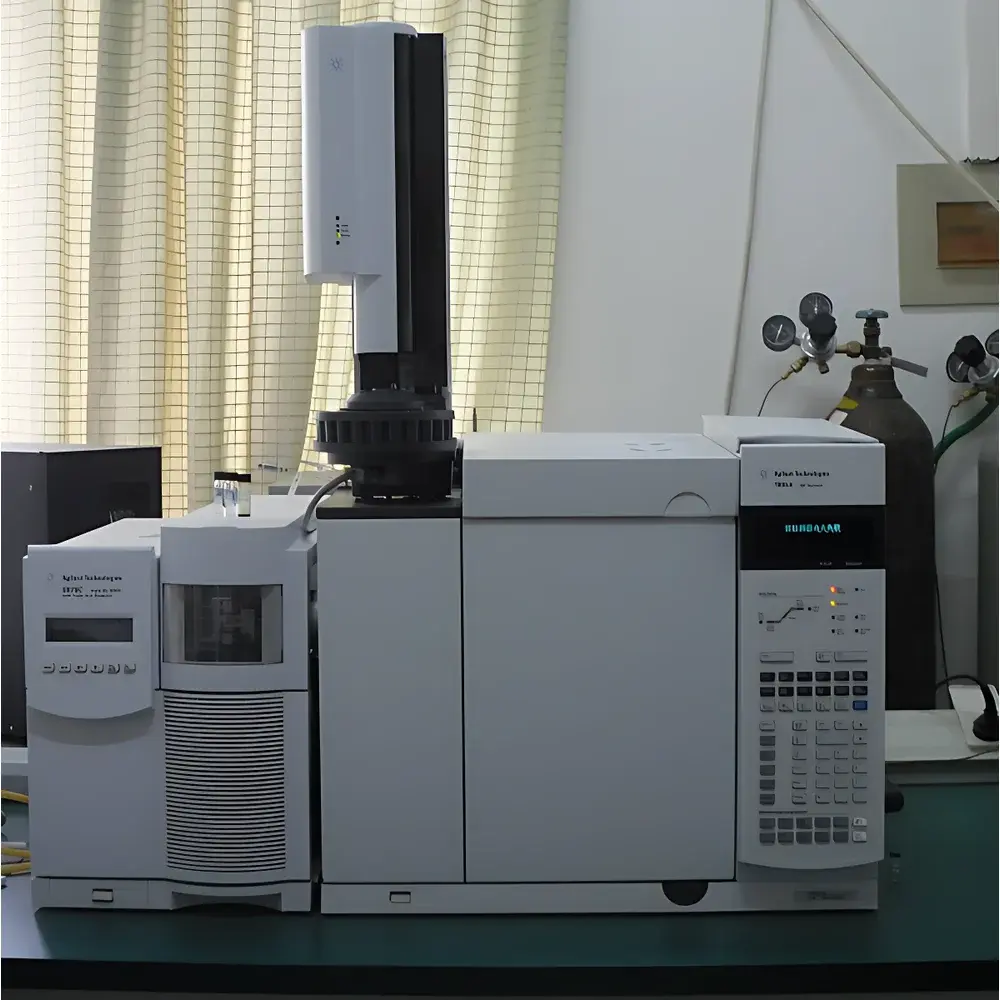
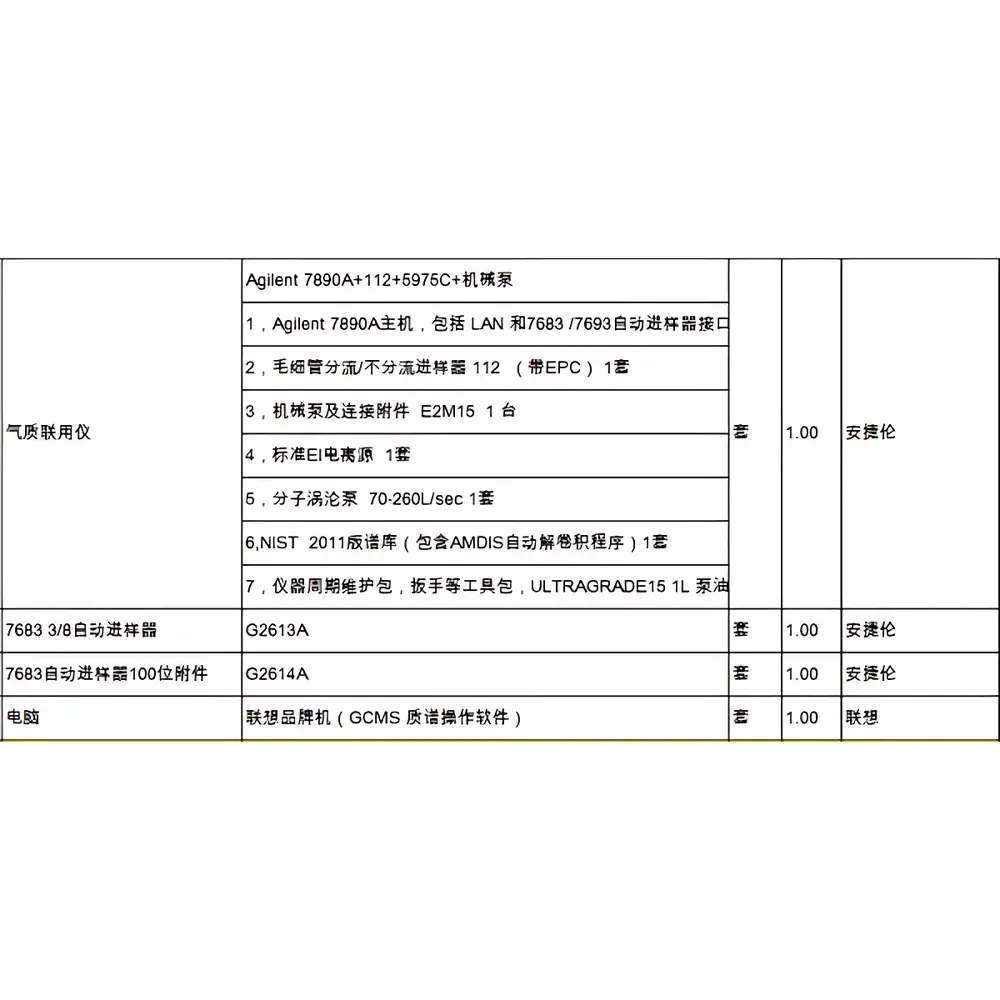
Agilent 7890A GC coupled with 5975C Single Quadrupole Mass Spectrometer (Used, Refurbished)
| Brand | Agilent Technologies |
|---|---|
| Origin | USA |
| Model | 7890A + 5975C |
| Ion Source Temp Range | 100–300 °C (independently controlled) |
| Electron Energy | 10–200 eV |
| Sensitivity (EI) | ≥185:1 S/N for 1 pg OFN (m/z 272, full scan) |
| Sensitivity (NCI) | ≥300:1 S/N for 10 fg OFN (m/z 272, SIM) |
| Mass Range | 1.5–1050 amu |
| Resolution | Unit mass |
| Scan Speed | ≥10,000 amu/sec |
| Mass Axis Stability | ≤0.1 amu/48 h |
| Detector | Off-axis electron multiplier |
| Quadrupole | All-metal molybdenum, pre-filtered, permanently contamination-resistant |
| Carrier Gas Options | Helium, Hydrogen, Nitrogen |
| Software | MSD ChemStation with Deconvolution Reporting Software (DRS), Retention Time Locking (RTL), Capillary Flow Technology support |
Overview
The Agilent 7890A Gas Chromatograph coupled with the 5975C Single Quadrupole Mass Spectrometer represents a mature, field-proven platform for high-fidelity qualitative and quantitative analysis in regulated and research environments. This refurbished system operates on the fundamental principle of gas chromatographic separation followed by electron ionization (EI), chemical ionization (CI), or negative chemical ionization (NCI) mass spectrometric detection. The 7890A GC delivers precise temperature-programmed separation using advanced oven thermal control and optional capillary flow technology (CFT) for split/splitless, heart-cutting, or parallel column configurations. The 5975C MS employs a robust all-metal molybdenum quadrupole mass analyzer with an integrated pre-filter quadrupole — engineered to minimize contamination accumulation and eliminate routine replacement or bake-out cycles. Its off-axis electron multiplier ensures stable signal amplification across dynamic concentration ranges, while unit-mass resolution and rapid scan speeds (≥10,000 amu/sec) support both targeted and untargeted workflows.
Key Features
- High-sensitivity ion source with independent temperature control (100–300 °C), optimized for thermally labile and high-boiling-point analytes
- Triple ionization modes: EI, CI, and NCI — enabling method flexibility for diverse compound classes including pesticides, pharmaceuticals, and environmental contaminants
- Microchannel plate-free, off-axis electron multiplier detector with extended linear dynamic range and low-noise performance
- True heated hyperbolic quadrupole mass filter — maintained at constant temperature to ensure mass axis stability (≤0.1 amu/48 h) without recalibration drift
- Gain normalization tuning algorithm — improves inter-day and inter-instrument data comparability under GLP/GMP-aligned operation
- Retention Time Locking (RTL) capability — allows method transfer between instruments with sub-second retention time reproducibility
- Deconvolution Reporting Software (DRS) with embedded library of 926 compounds — supports automated spectral deconvolution in co-eluting peaks
- Capillary Flow Technology compatibility — enables active flow splitting, backflush, and dual-column simultaneous acquisition
Sample Compatibility & Compliance
This GC/MS system is routinely deployed for residue analysis in complex biological and environmental matrices, including pesticide screening in fruits and vegetables per EPA Method 1694 and EU SANTE/11312/2021 guidelines. It supports sample introduction via standard split/splitless injectors, programmable temperature vaporization (PTV), or large-volume injection (LVI) with appropriate hardware. The inert, high-temperature ion source and low-background vacuum architecture ensure reliable detection of trace-level organochlorines, organophosphates, and pyrethroids. From a regulatory standpoint, the platform is compatible with audit-trail-enabled data acquisition under 21 CFR Part 11 when operated with validated ChemStation software configurations. Routine performance verification follows ASTM D5845 and ISO 17025-aligned protocols, including sensitivity checks using octafluoronaphthalene (OFN) and benzoquinone standards.
Software & Data Management
Control and data processing are performed using Agilent’s MSD ChemStation (E.02.02 or later), configured for instrument diagnostics, sequence management, peak integration, and report generation. The system includes native support for DRS (Deconvolution Reporting Software), which applies mathematical deconvolution algorithms to resolve overlapping mass spectra from co-eluting components — critical for multiresidue pesticide analysis. Retention Time Locking (RTL) functionality permits cross-platform method portability without re-optimization. Raw data files (.D format) are stored in a hierarchical directory structure compliant with laboratory data integrity requirements. For long-term archival, users may export processed results in CSV, PDF, or XML formats; raw data backups adhere to ALCOA+ principles (Attributable, Legible, Contemporaneous, Original, Accurate, Complete, Consistent, Enduring, Available).
Applications
- Multi-residue pesticide analysis in food commodities (AOAC 2007.01, EN 15662)
- Volatile and semi-volatile organic compound (VOC/SVOC) profiling in soil, water, and air samples
- Residual solvent quantification in pharmaceutical intermediates (ICH Q3C)
- Fragrance and flavor compound identification in consumer products
- Environmental forensics and contaminant source tracking
- Academic and industrial research requiring reproducible, publication-grade spectral libraries
FAQ
Is this system supplied with a valid calibration certificate and performance verification report?
Yes — each refurbished unit undergoes full functional testing, including sensitivity verification (OFN, benzoquinone), mass axis calibration, vacuum integrity check, and detector linearity assessment. A documented Certificate of Inspection and Performance Verification Report is provided prior to shipment.
What maintenance history and refurbishment level can be expected?
All units originate from decommissioned academic or contract laboratory installations. Refurbishment includes replacement of consumables (injector septa, liner, gold seal, column nut ferrules), ion source cleaning and alignment, quadrupole bake-out, detector gain optimization, and firmware update to the latest stable release supported by Agilent.
Is hydrogen carrier gas operation supported and validated?
Yes — the 7890A GC is fully compatible with hydrogen as a carrier gas. System configuration includes pressure/flow control modules calibrated for H2, and method translation tools in ChemStation allow seamless conversion from helium-based methods.
Can this system be integrated into a LIMS environment?
Direct LIMS interfacing is achievable via ChemStation’s OpenLab CDS-compliant export modules or third-party middleware supporting ASTM E1394 or HL7 standards. Audit trail logs and raw data exports meet typical LIMS ingestion requirements.
Does the quoted price include installation, training, or warranty?
The listed price reflects the core instrument only. Optional on-site installation, operator training (1–2 days), and extended service agreements (12–36 months) are available upon request and quoted separately. Standard warranty covers parts and labor for 12 months post-installation.