
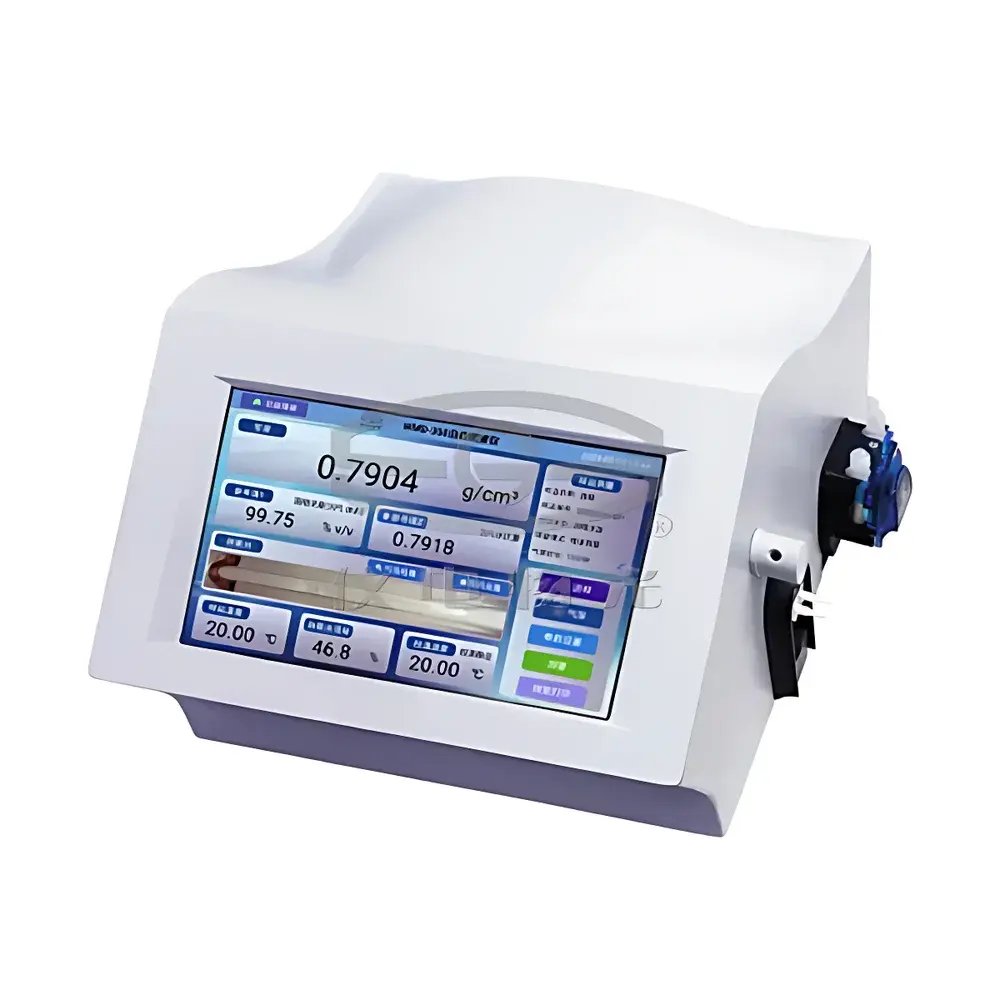
YDWG WMD-350 Automated Oscillating U-Tube Density Meter
| Brand | YDWG |
|---|---|
| Origin | Shanghai, China |
| Model | WMD-350 |
| Instrument Type | Benchtop Laboratory Densimeter |
| Measurement Principle | Oscillating U-Tube Method |
| Sample Type | Liquids |
| Density Range | 0.0000–3.0000 g/cm³ |
| Density Accuracy | ±0.0008 g/cm³ |
| Density Repeatability | ±0.0003 g/cm³ |
| Resolution | 0.0001 g/cm³ |
| Temperature Control Range | 5–45 °C |
| Temperature Accuracy | ±0.2 °C |
| Temperature Stability | ±0.05 °C |
| Minimum Sample Volume | 2–3 mL |
| Integrated Atmospheric Pressure Sensor | Yes |
| Integrated Humidity Monitoring | Yes |
| Display | 10.1″ Android Touchscreen with HD Camera-Assisted Sample Viewing |
| Data Storage | 32 GB Internal |
| Connectivity | RS232, 3× USB, Ethernet (optional) |
| Compliance | ASTM D4052, ASTM D5002, ASTM D3505, ISO 12185, GB/T 29617, GB/T 2013, SH/T 0604, SN/T 2383, IP 559 |
Overview
The YDWG WMD-350 Automated Oscillating U-Tube Density Meter is a precision benchtop instrument engineered for high-accuracy liquid density determination across research, quality control, and regulatory-compliant laboratories. It operates on the well-established oscillating U-tube principle: a precisely fabricated borosilicate glass U-shaped tube is filled with the sample and electromagnetically excited to resonate at its natural frequency. Since the resonant frequency is inversely proportional to the square root of the sample’s mass—and thus its density—the instrument calculates density via real-time frequency measurement calibrated against reference standards (dry air and distilled water). This method eliminates operator-dependent variables inherent in pycnometers, hydrometers, or hydrostatic weighing, delivering traceable, reproducible results compliant with ISO 12185 and ASTM D4052. The WMD-350 integrates active environmental compensation—measuring ambient pressure and internal humidity—to correct for barometric and condensation-induced drift, ensuring metrological integrity across diverse lab environments.
Key Features
- Automated peristaltic sampling system with adjustable pump speed and aspiration time, minimizing manual handling and improving throughput.
- Dual environmental monitoring: integrated digital barometer and internal humidity sensor prevent thermal lensing and condensation on temperature-sensitive optical and vibrational components.
- Peltier-based thermostatic control with ±0.05 °C stability and ±0.2 °C absolute accuracy over 5–45 °C, enabling precise density measurement at standardized temperatures (e.g., 15 °C, 20 °C, 25 °C).
- Optimized mechanical design of the U-tube assembly reduces residual stress in the glass cell, enhancing long-term calibration stability and linearity across the full 0.0000–3.0000 g/cm³ range.
- 10.1-inch Android-powered capacitive touchscreen with integrated HD camera for real-time visual verification of sample fill level, bubble detection, and meniscus positioning—critical for method validation and troubleshooting.
- Multi-mode measurement engine supporting density (g/cm³, kg/m³), relative density (vs. water at 4 °C/20 °C/25 °C), API gravity, alcohol content (ethanol % v/v), and industry-specific profiles (pharmaceutical, petrochemical, food & beverage).
Sample Compatibility & Compliance
The WMD-350 accommodates a broad spectrum of liquid samples—including volatile organics, viscous glycols, corrosive acids/bases (with appropriate wetted-material compatibility verification), edible oils, alcoholic beverages, and aqueous pharmaceutical solutions—provided viscosity remains below 20,000 mPa·s and vapor pressure permits stable U-tube filling. Its 2–3 mL sample requirement significantly reduces reagent consumption and waste generation versus traditional volumetric methods. Regulatory compliance is embedded in architecture: user management supports four-tier access control (operator, supervisor, QA, administrator); electronic signatures and optional 21 CFR Part 11–compliant audit trail ensure data integrity for GLP/GMP environments; all calibrations are documented with timestamped entries, reference materials, and deviation logs. The instrument meets requirements outlined in GB/T 29617, ASTM D4052, ISO 12185, and SH/T 0604 for routine and accredited testing.
Software & Data Management
The embedded Android OS hosts a dedicated density analysis application with intuitive workflow navigation, customizable report templates (PDF/Excel), and secure local storage (32 GB). Data export is supported via USB mass storage, RS232 serial output (for legacy LIMS integration), and optional Ethernet/Wi-Fi connectivity. All measurements include metadata: date/time, operator ID, temperature setpoint and actual reading, atmospheric pressure, humidity, calibration status, and raw frequency values. Batch reporting allows statistical evaluation (mean, SD, RSD, min/max) across multiple runs. Optional printer interface supports thermal or dot-matrix printers for hard-copy SOP adherence. Firmware updates are performed via USB or network, preserving configuration and historical data.
Applications
- Beverage & Food: Sugar concentration (°Brix equivalence), juice authenticity, vegetable oil purity (GB 5526), syrup consistency, and thermal stability profiling.
- Alcoholic Beverages: Ethanol quantification per GB/T 10345, GB/T 4928, and GB/T 15038; batch consistency in wine, beer, and spirits production.
- Petrochemicals: API gravity calculation (ASTM D1250), diesel/gasoline blending verification, crude assay support (ASTM D5002), and additive concentration monitoring.
- Pharmaceuticals: Excipient density verification, bulk drug substance characterization, and formulation density tracking per USP and ICH Q5C guidelines.
- Chemicals: Concentration determination of urea, ethylene glycol, caustic soda, ammonium hydroxide, and surfactants using preloaded calibration curves.
- Academic & Reference Labs: Fundamental fluid property studies, inter-laboratory comparison exercises, and method transfer validation under ISO/IEC 17025.
FAQ
What standards does the WMD-350 comply with?
It conforms to ISO 12185, ASTM D4052, ASTM D5002, ASTM D3505, GB/T 29617, GB/T 2013, SH/T 0604, and multiple Chinese national food and petrochemical standards.
Can the instrument measure high-viscosity liquids?
Yes—within limits. Samples up to ~20,000 mPa·s may be measured with extended settling time; however, optimal performance is achieved below 5,000 mPa·s. Viscosity correction algorithms are not applied; users should verify fill completeness via camera feed.
Is external calibration required before each use?
No. A two-point calibration (dry air and distilled water) is recommended daily or per shift change. Full recalibration is only necessary after maintenance, relocation, or when drift exceeds ±0.0005 g/cm³.
How is temperature uniformity ensured across the U-tube?
The Peltier module cools/heats a thermally bonded aluminum block surrounding the entire U-tube assembly. Temperature sensors are placed at both tube ends and the block surface, enabling closed-loop PID control with spatial uniformity better than ±0.1 °C.
Does the system support networked data backup?
Yes—via optional Ethernet interface, measurement data and audit logs can be streamed to a centralized file server or LIMS using standard SMB/CIFS protocols.



