
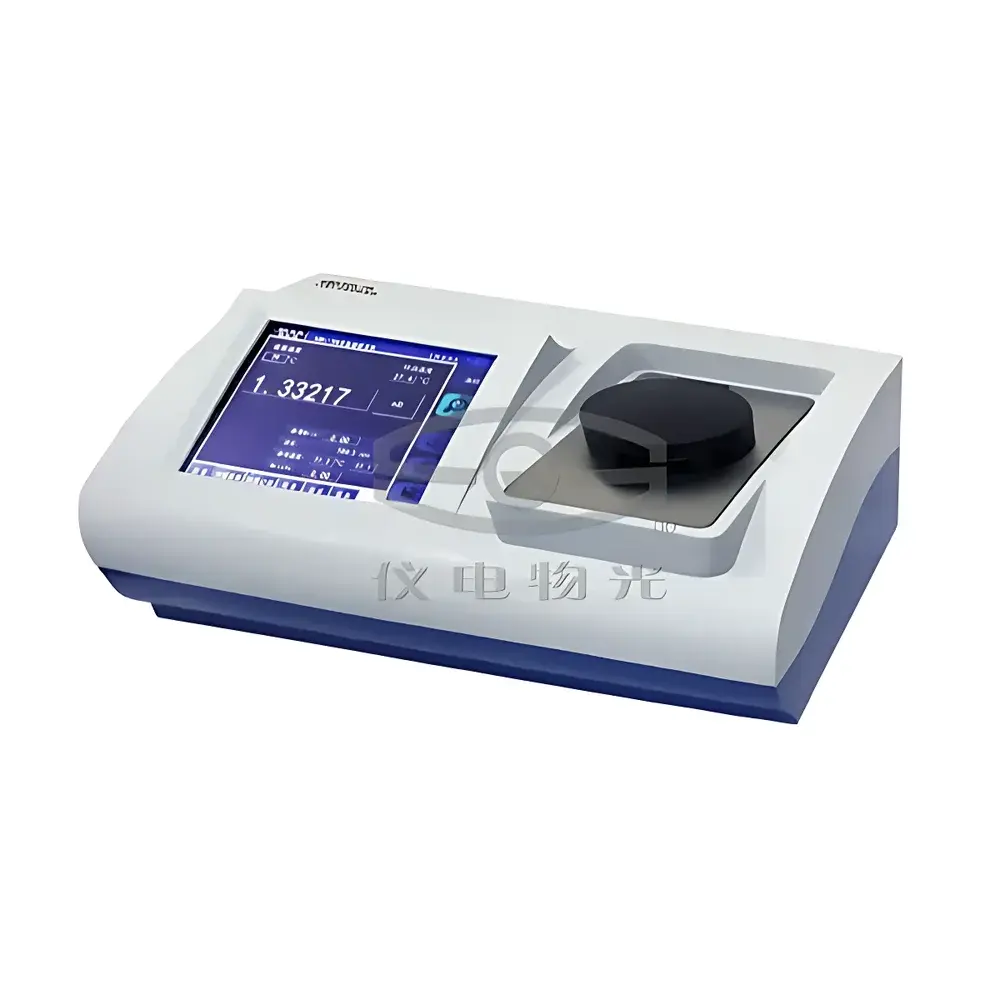
YDWG SGW®-756 Automated Temperature-Controlled Refractometer
| Brand | YDWG |
|---|---|
| Origin | Shanghai, China |
| Model | SGW®-756 |
| Instrument Type | Benchtop Refractometer |
| Temperature Control | Yes (Peltier) |
| Digital Display | Yes |
| Measurement Range | nD 1.30000–1.70000 |
| Resolution | nD 0.00001 |
| Accuracy | nD ±0.0002 |
| Precision | nD ±0.00001 |
| Temperature Control Range | 5–85 °C |
| Temperature Stability | ±0.02 °C |
| Prism Material | Sapphire |
| Data Storage | 16 GB internal |
| Interface | USB, RS-232, Ethernet, optional Wi-Fi |
| OS Compatibility | Windows-based embedded system |
| Compliance | GB/T 12143-2008, GB/T 18963-2012, GB/T 21730-2008, GB/T 10786-2006, GB/T 14454.4-2008, GB/T 5527-2010, GB/T 6488-2022, GB/T 614-2021, USP <731>, FDA 21 CFR Part 11 (with audit trail option), GLP/GMP-ready |
Overview
The YDWG SGW®-756 Automated Temperature-Controlled Refractometer is a high-precision benchtop instrument engineered for accurate, repeatable, and traceable refractive index (nD) and Brix measurements across pharmaceutical, food & beverage, chemical, and flavor & fragrance industries. It operates on the principle of total internal reflection at the prism-sample interface, where a collimated LED light beam strikes the sample-prism boundary; the critical angle of incidence is detected by a high-resolution CCD sensor array and converted into refractive index values via calibrated optical algorithms. Integrated Peltier-based temperature control ensures thermal stability within ±0.02 °C across a 5–85 °C range—critical for eliminating thermal drift in thermosensitive liquids such as fruit juices, essential oils, syrups, and active pharmaceutical ingredients (APIs). With a measurement range spanning nD 1.30000–1.70000 and Brix 0–100%, the SGW®-756 supports both fundamental research and routine QC/QA workflows requiring compliance with pharmacopoeial and industrial standards.
Key Features
- High-stability sapphire measuring prism—chemically inert, scratch-resistant, and compatible with aggressive solvents including alcohols, ketones, and organic acids
- LED light source with >100,000-hour service life—zero warm-up time, no spectral drift, and minimal maintenance
- 8-inch full-color capacitive touchscreen interface—intuitive navigation, multilingual support (English, Chinese, Spanish), and real-time graphical display of temperature stabilization status
- Minimal sample requirement: only 0.5 mL per measurement—enabling non-destructive analysis and full sample recovery
- No moving mechanical parts in optical path—ensuring long-term metrological stability and reduced calibration frequency
- Embedded Windows-based operating system—supports direct connection to laboratory networks, LIMS integration, and peripheral devices (keyboard, mouse, generic printers)
- Four-tier user management architecture with role-based permissions, electronic signatures, and password policy enforcement
Sample Compatibility & Compliance
The SGW®-756 accommodates aqueous solutions, viscous liquids (e.g., honey, syrups), volatile organics (e.g., ethanol, limonene), and emulsions—provided surface tension permits uniform film formation on the sapphire prism. Its validated measurement modes cover 12 industry-specific parameters, including citrus juice solids (GB/T 21730-2008), apple juice purity (GB/T 18963-2012), vegetable oil adulteration screening (GB/T 5527-2010), and fragrance dilution verification (GB/T 14454.4-2008). The instrument meets national and international regulatory expectations: it is fully compliant with Chinese National Standards (GB/T series), United States Pharmacopeia (USP ), and supports 21 CFR Part 11 requirements when configured with optional audit trail software—including immutable timestamped records, operator identification, and change history for all critical parameters and results.
Software & Data Management
Data integrity is ensured through a secure, embedded database storing up to 100,000 measurement records locally on 16 GB flash memory. Each entry includes nD, Brix, temperature, user ID, timestamp, method ID, and raw CCD intensity profiles. Export options include CSV, PDF, and XML formats via USB or Ethernet. Network-enabled instruments support remote data retrieval using standard HTTP/HTTPS protocols and can be integrated into enterprise LIMS via HL7 or ASTM E1384-compliant interfaces. Audit trail functionality—when enabled—logs all user actions (login/logout, method modification, result deletion, calibration events) with cryptographic hashing to prevent tampering. All data exports retain full metadata, satisfying ALCOA+ principles (Attributable, Legible, Contemporaneous, Original, Accurate, Complete, Consistent, Enduring, Available).
Applications
- Pharmaceutical QC: Verification of excipient concentration (e.g., glycerol, propylene glycol), API solution density, and syrup formulation consistency per USP monographs
- Fruit juice authentication: Detection of water adulteration in orange and apple juices via deviation from reference nD-Brix correlations
- Flavor & fragrance quality control: Rapid assessment of essential oil purity and dilution ratios using preloaded terpene-index tables
- Chemical manufacturing: In-process monitoring of solvent blends, polymerization reaction progress, and catalyst concentration
- Food safety labs: Quantification of total soluble solids (TSS) in canned vegetables, soft drinks, and honey—aligned with GB/T 10786-2006 and GB/T 12143-2008
- Research laboratories: Temperature-dependent refractive index profiling for thermodynamic modeling of binary and ternary mixtures
FAQ
Does the SGW®-756 support GLP/GMP-compliant operation?
Yes—when equipped with audit trail software and operated under configured user roles, electronic signatures, and password policies, the instrument fulfills core GLP (OECD 1998) and GMP (ICH Q7) documentation requirements.
Can I customize calculation formulas beyond the 12 built-in methods?
Yes—the instrument allows import of user-defined polynomial or lookup-table-based conversion models via USB or network, with version-controlled storage and validation logging.
What is the calibration protocol for traceability?
Calibration uses NIST-traceable certified refractive index standards (e.g., distilled water at 20 °C, nD = 1.33300 ± 0.00002); automated two-point calibration is supported, and calibration certificates are exportable with full uncertainty budgets.
Is remote firmware update possible?
Yes—via secure HTTPS connection to authorized YDWG servers; updates preserve all user configurations and historical data.
How does the sapphire prism compare to traditional BK7 glass in corrosive applications?
Sapphire exhibits Mohs hardness of 9, near-zero chemical reactivity with strong acids/bases, and negligible thermal expansion—making it suitable for repeated cleaning with acetone, chloroform, or 10% NaOH without degradation of optical performance.




