
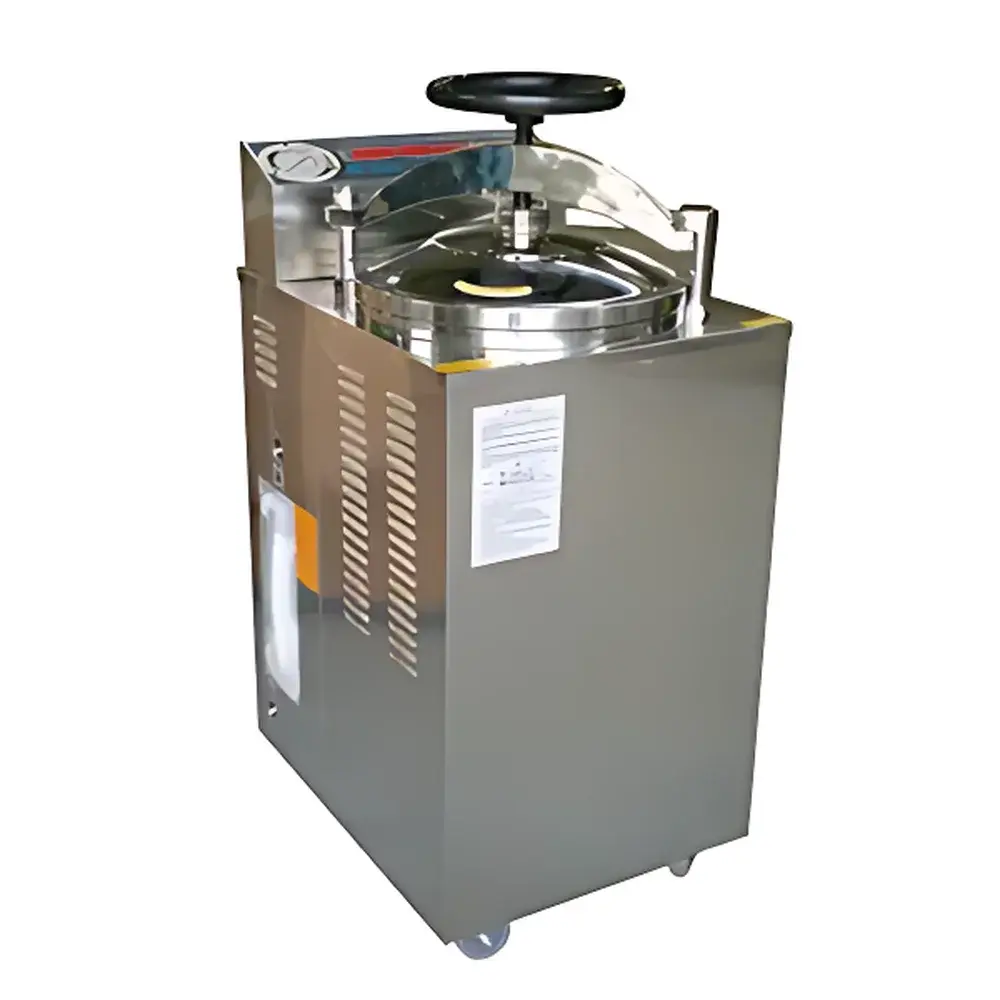
Brookfield YXQ-LS-75G Vertical Steam Sterilizer
| Brand | Brookfield (BOXUN) |
|---|---|
| Origin | Shanghai, China |
| Model | YXQ-LS-75G |
| Instrument Type | Vertical |
| Max Temperature | 135 °C |
| Max Pressure | 0.22 MPa |
| Chamber Dimensions | Ø400 × 720 mm |
| Chamber Volume | 75 L |
| External Dimensions | 485 × 605 × 1190 mm |
| Sterilization Power | 3.5 kW |
| Drying Power | 0.8 kW |
| Voltage/Frequency | 220 V ±10%, 50 Hz ±2% |
| Sterilization Timer | 4–120 min |
| Drying Timer | 30–240 min |
| Safety Design Pressure/Temperature | 0.25 MPa / 138 °C |
| Basket Size | Ø360 × 280 mm × 2 pcs |
| Material | SUS304 stainless steel chamber, door, and baskets |
Overview
The Brookfield YXQ-LS-75G Vertical Steam Sterilizer is a fully automated, gravity-displacement and pre-vacuum compatible laboratory-grade autoclave engineered for reliable thermal sterilization of heat-stable materials under saturated steam conditions. It operates on the fundamental principle of moist heat sterilization—leveraging pressurized saturated steam at elevated temperatures (up to 135 °C) to achieve microbial inactivation through protein denaturation and nucleic acid disruption. Designed for routine use in biomedical laboratories, pharmaceutical quality control units, academic research facilities, and agricultural microbiology labs, this unit complies with core sterilization process requirements outlined in ISO 17665-1:2019 (Sterilization of health care products — Moist heat — Part 1: Requirements for the development, validation and routine control of a sterilization process for medical devices) and aligns with GLP-compliant operational workflows.
Key Features
- Vertical orientation with compact footprint (485 × 605 × 1190 mm), optimized for space-constrained lab environments without compromising 75 L effective chamber volume
- SUS304 stainless steel construction throughout chamber, door, and dual-tier baskets—resistant to corrosion from repeated exposure to condensate, alkaline cleaning agents, and saline solutions
- Integrated safety interlock system featuring handwheel-operated quick-release door with mechanical pressure lock; door remains sealed until chamber pressure drops to atmospheric level
- Microprocessor-based controller with real-time monitoring of temperature, pressure, and cycle phase; automatic cold air purge prior to sterilization ensures uniform steam penetration
- Dual-stage operation capability: independent sterilization and drying cycles, with programmable timing (sterilization: 4–120 min; drying: 30–240 min)
- Redundant safety protections including overtemperature cutoff (138 °C design limit), low-water-level detection, auto-pressure relief at 0.25 MPa, and dry-run prevention circuitry
- Self-sealing silicone gasket with autogenous expansion under pressure, minimizing maintenance and ensuring long-term sealing integrity
- Onboard audible alarm and automatic shutdown upon cycle completion; optional RS232 interface supports external data logging
Sample Compatibility & Compliance
The YXQ-LS-75G accommodates a broad range of load types—including wrapped/unwrapped surgical instruments, glassware (flasks, pipettes, Petri dishes), textile dressings, liquid media (in vented containers), and porous polymer components—provided they are classified as steam-permeable and non-heat-sensitive per ISO 11140-1. Load configuration must adhere to validated packing density guidelines to prevent steam channeling or cold spot formation. The unit meets essential electrical safety requirements per IEC 61010-1 and incorporates design elements supporting compliance with FDA 21 CFR Part 11 when paired with validated third-party electronic record systems. Optional printer integration enables hard-copy cycle documentation for audit readiness in GMP-regulated environments.
Software & Data Management
While the embedded controller does not feature a graphical user interface or cloud connectivity, its firmware provides traceable cycle execution logs—including start time, peak temperature/pressure timestamps, dwell duration, and fault codes—with retention limited to the most recent 10 cycles. For regulated applications requiring extended audit trails, the RS232 port allows connection to external PCs running validated data acquisition software compliant with ALCOA+ principles (Attributable, Legible, Contemporaneous, Original, Accurate, Complete, Consistent, Enduring, Available). Optional thermal printer output satisfies minimum documentation requirements for ISO 13485-certified medical device manufacturing QA departments.
Applications
- Routine sterilization of reusable surgical tools and diagnostic equipment in hospital central sterile supply departments (CSSD)
- Preparation of microbiological growth media and agar plates in academic and industrial microbiology labs
- Decontamination of biohazardous waste streams prior to disposal (in accordance with local biosafety level protocols)
- Validation of sterilization parameters during process qualification studies per ISO 11134
- Thermal processing of veterinary vaccine carriers and animal feed supplements requiring terminal sterilization
- Support of USP <1211> sterility assurance requirements for non-injectable pharmaceutical excipients
FAQ
What is the maximum allowable working pressure and temperature for routine operation?
The rated operating limits are 0.22 MPa and 135 °C. The safety-rated design limits (for pressure vessel certification) are 0.25 MPa and 138 °C.
Does the unit support vacuum-assisted air removal?
It employs gravity displacement with automatic cold air purge; no integrated vacuum pump is included, though pre-vacuum compatibility can be achieved via external manifold integration.
Can liquid media be sterilized without boil-over?
Yes—when loaded in vented containers and using the “slow exhaust” mode, the controller modulates pressure release to minimize turbulence and container rupture risk.
Is the sterilizer suitable for sterilizing wrapped instrument sets?
Yes, provided packaging materials are validated for steam permeability (e.g., medical-grade nonwoven wraps or rigid containers meeting ISO 11607-1) and loading follows manufacturer-recommended density guidelines.
What maintenance intervals are recommended for long-term reliability?
Daily: chamber inspection, gasket cleaning, drain filter check. Quarterly: safety valve calibration verification and door seal integrity test. Annually: full pressure vessel inspection per local regulatory authority requirements.



