
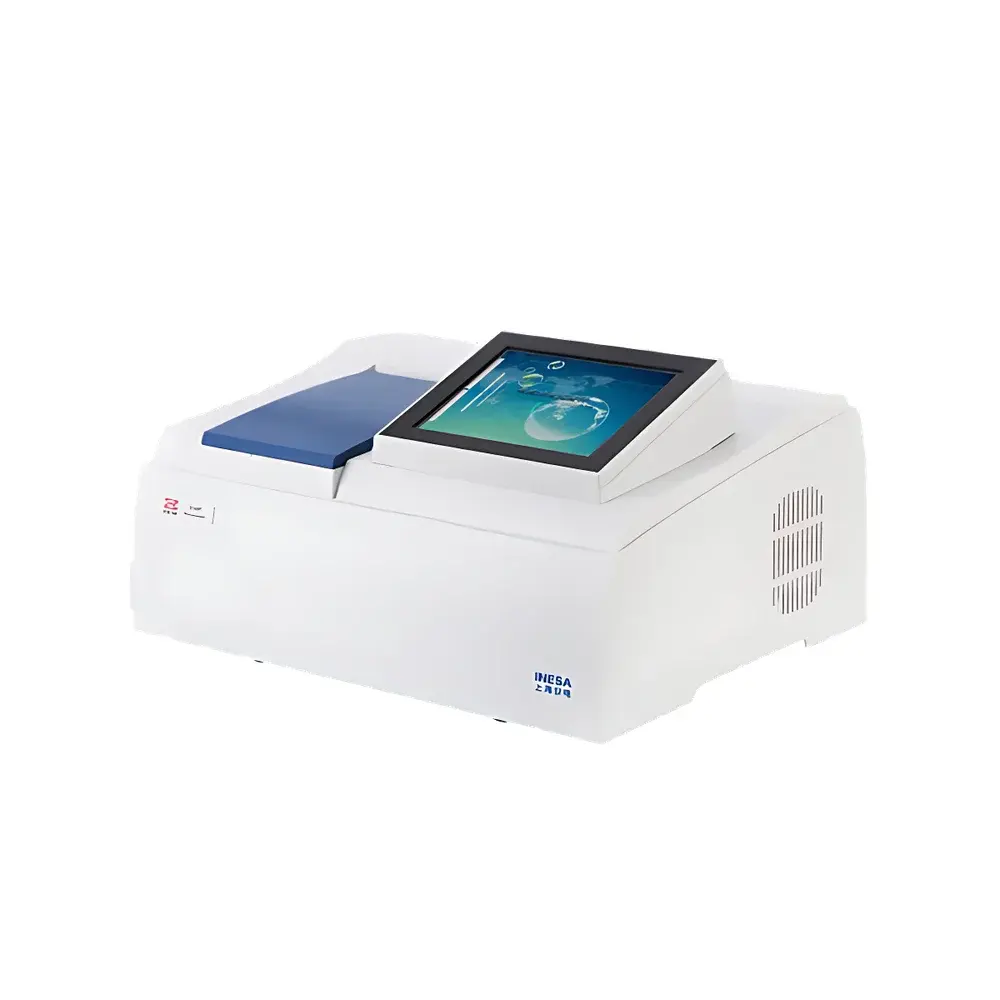
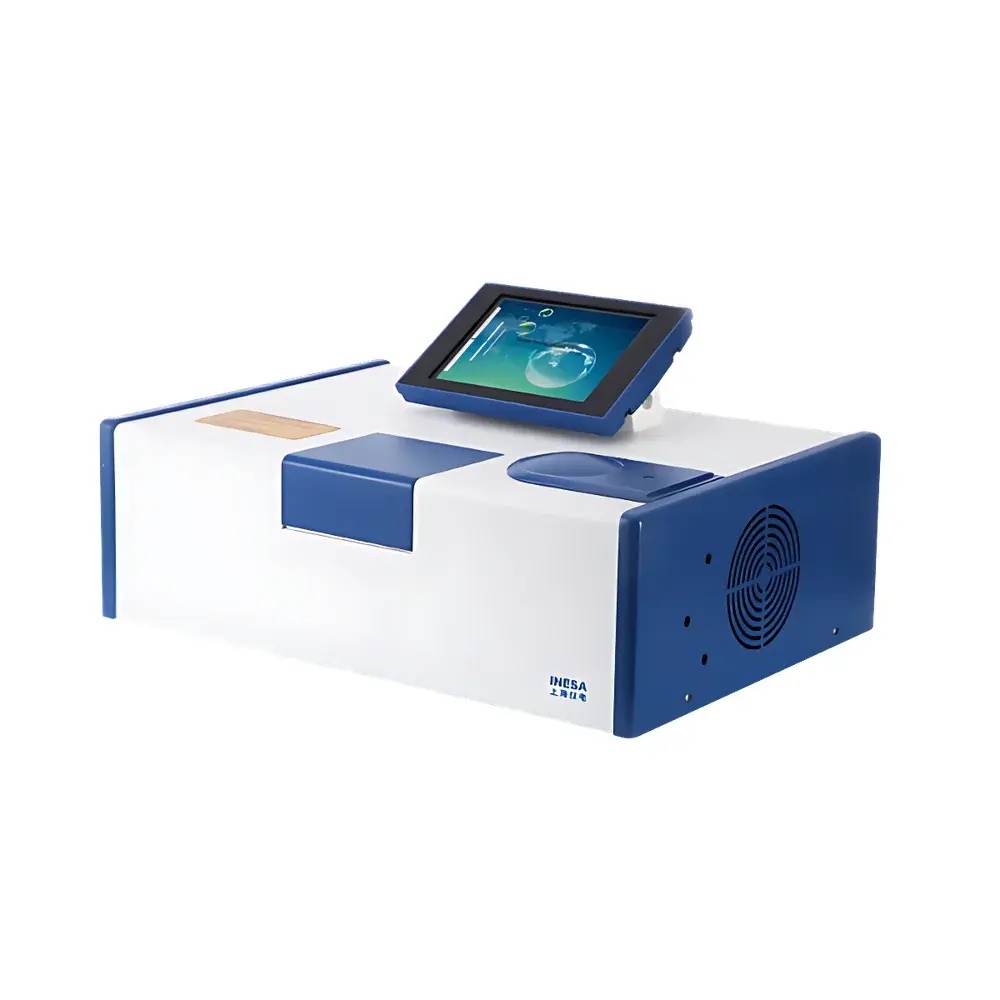
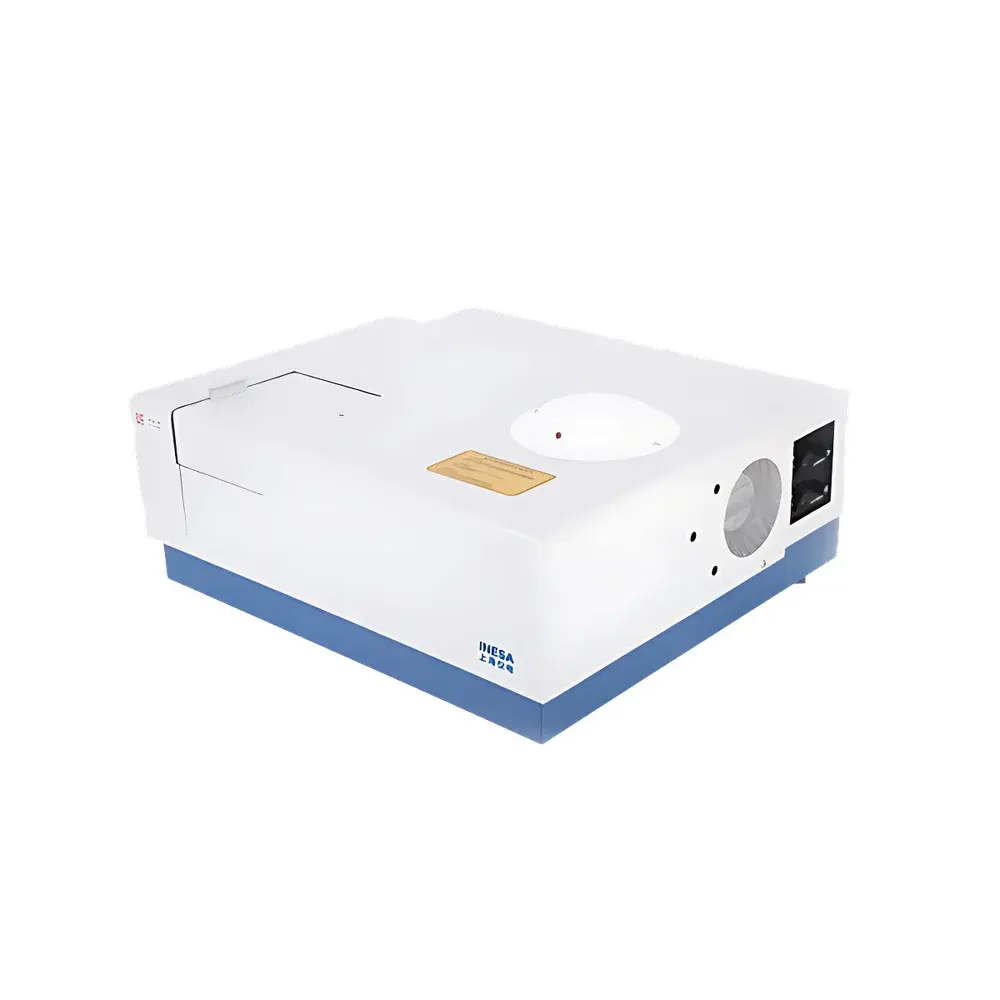
Shanghai INESA 930F / 960 / 9700CRT Fluorescence Spectrophotometer
| Brand | INESA |
|---|---|
| Origin | Shanghai, China |
| Model Series | 930F, 960, 9700CRT |
| Price Range | USD 2,200 – 12,600 (FOB Shanghai) |
| Type | Filter-based and CRT-display-equipped benchtop fluorescence spectrophotometer |
| Detector | PMT (Photomultiplier Tube) |
| Excitation & Emission Wavelength Range | 200–760 nm (standard configuration) |
| Spectral Bandwidth | 2–10 nm (adjustable per model) |
| Wavelength Accuracy | ±2.0 nm |
| Intensity Reproducibility | ≤±1.5% RSD |
Overview
The Shanghai INESA 930F, 960, and 9700CRT series fluorescence spectrophotometers are benchtop analytical instruments engineered for quantitative and qualitative analysis of fluorescent compounds in solution-phase samples. These systems operate on the principle of photoluminescence: a sample is irradiated with monochromatic excitation light, and the resulting emitted fluorescence—typically redshifted due to the Stokes shift—is isolated by an emission monochromator and measured by a high-gain photomultiplier tube (PMT) detector. Unlike UV-Vis absorption spectrophotometers, fluorescence instrumentation delivers significantly higher sensitivity—often two to three orders of magnitude greater—enabling detection of analytes at sub-nanomolar concentrations. The 930F serves as an entry-level filter-based system optimized for routine assays; the 960 integrates dual monochromators for enhanced spectral selectivity and stray-light rejection; the 9700CRT features a cathode-ray tube (CRT) display and analog signal processing architecture, reflecting legacy design conventions common in mid-20th-century spectroscopic instrumentation still maintained for specific educational or archival validation workflows.
Key Features
- Triple-model platform architecture: 930F (filter-based, fixed-wavelength excitation), 960 (double monochromator, programmable excitation/emission scanning), and 9700CRT (CRT-display analog output, manual wavelength adjustment)
- Excitation and emission wavelength coverage from 200 nm to 760 nm—spanning deep UV through visible range—compatible with common fluorophores including quinine sulfate, fluorescein, rhodamine B, and dansyl derivatives
- Adjustable spectral bandwidth (2–10 nm) to balance resolution and signal-to-noise ratio based on sample matrix complexity
- High-stability xenon arc lamp (960/9700CRT) or tungsten-deuterium source (930F) with calibrated intensity output traceable to NIM (National Institute of Metrology, China)
- Optical path designed for minimal polarization artifacts and consistent beam geometry across measurement modes (fluorescence intensity, synchronous scan, excitation-emission matrix (EEM))
- Robust mechanical construction with vibration-damped optical bench and temperature-stabilized PMT housing to ensure long-term signal stability
Sample Compatibility & Compliance
These instruments accept standard 10 mm square quartz or low-fluorescence glass cuvettes (pathlengths: 1–10 mm). Liquid samples—including aqueous buffers, organic solvents (e.g., methanol, acetonitrile), and micellar solutions—are routinely analyzed. Solid powders may be evaluated via front-face or diffuse reflection accessories (optional). While not certified to IEC 61010-1 or ISO/IEC 17025 out-of-the-box, the hardware architecture complies with fundamental electrical safety and electromagnetic compatibility requirements for laboratory use in Class II environments. Data acquisition supports manual recording or analog voltage output (0–1 V or 0–10 V) compatible with third-party chart recorders or DAQ systems used in GLP-regulated teaching labs or method transfer settings.
Software & Data Management
The 930F operates without embedded software—data acquisition is performed manually or via external analog-to-digital converters. The 960 includes proprietary Windows-compatible control software enabling wavelength scanning, kinetic measurements, and basic spectral overlay. The 9700CRT provides real-time analog waveform display only; no digital storage or export functionality is integrated. For regulatory environments requiring audit trails, users typically interface these instruments with validated third-party data acquisition platforms compliant with FDA 21 CFR Part 11 (e.g., LabArchives ELN or custom LabVIEW applications with electronic signature modules). All models support calibration verification using NIST-traceable fluorescent reference standards (e.g., quinine sulfate in 0.1 M H2SO4).
Applications
- Quantitative determination of vitamins (e.g., B1, B2, B6), amino acids (e.g., tryptophan, tyrosine), and polycyclic aromatic hydrocarbons (PAHs) in environmental water extracts
- Protein conformation studies via intrinsic tryptophan fluorescence and extrinsic probes (e.g., ANS, SYPRO Orange)
- Pharmaceutical quality control: assay of fluoroquinolone antibiotics (ciprofloxacin, levofloxacin) and vitamin D analogs
- Educational laboratories: demonstration of Jablonski diagrams, inner-filter effects, quantum yield estimation, and solvent polarity effects on emission maxima
- Food safety testing: detection of melamine adulteration via fluorescence quenching assays
FAQ
What is the primary difference between the 930F, 960, and 9700CRT models?
The 930F uses interference filters for excitation selection and is intended for single-wavelength quantitation. The 960 employs dual grating monochromators for full excitation/emission spectral mapping. The 9700CRT retains analog circuitry and CRT visualization, prioritizing operational transparency over digital automation.
Can these instruments perform time-resolved fluorescence measurements?
No—none of the three models incorporate pulsed excitation sources or time-gated detection electronics required for lifetime analysis.
Is USB or RS-232 connectivity available?
Only the 960 offers optional RS-232 interface; the 930F and 9700CRT lack digital communication ports.
Are quartz cuvettes included with purchase?
Standard delivery includes one pair of 10 mm pathlength quartz cuvettes; additional cuvettes or specialized cells (e.g., microvolume, thermostatted) are available as accessories.
Does INESA provide factory calibration certificates?
Yes—each unit ships with a manufacturer’s calibration report verifying wavelength accuracy and photometric linearity against internal reference materials; NIST-traceable certification is available upon request at additional cost.




