
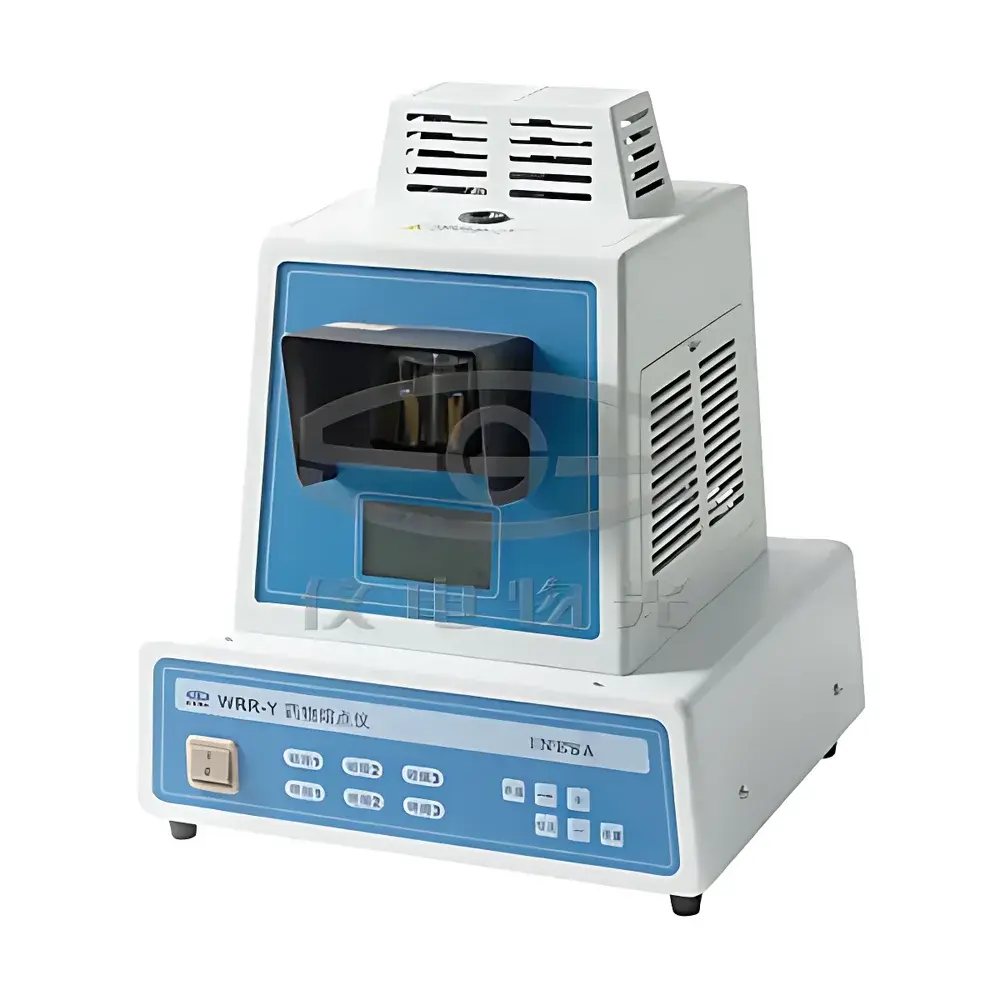
YDWG WRR-Y Pharmaceutical Melting Point Apparatus
| Brand | YDWG |
|---|---|
| Origin | Shanghai, China |
| Model | WRR-Y |
| Temperature Range | 40–90 °C (with water bath) / 60–280 °C (with silicone oil bath) |
| Heating Rates | 0.5, 1.0, 1.5, 3.0 °C/min (selectable) |
| Temperature Repeatability | ±0.3 °C at 1.0 °C/min |
| Temperature Accuracy | ±0.4 °C ≤200 °C |
| Capillary Dimensions | OD 1.4 mm, ID 1.0 mm, L 120 mm |
| Sample Capacity | 3 capillaries simultaneously |
| Temperature Resolution | 0.1 °C |
| Display | LCD |
| Interface | RS232/USB |
| Power Supply | 220 V ±10%, 50 Hz, 200 W |
| Dimensions | 270 × 310 × 400 mm |
| Net Weight | 11 kg |
Overview
The YDWG WRR-Y Pharmaceutical Melting Point Apparatus is a manually operated, dual-medium capillary melting point instrument engineered for precise and reproducible determination of melting onset and completion temperatures in solid pharmaceutical substances. It operates on the classical capillary tube method defined in pharmacopoeial standards—including the Chinese Pharmacopoeia (ChP), United States Pharmacopeia (USP ), and European Pharmacopoeia (Ph. Eur. 2.2.14)—where solid samples are loaded into standardized glass capillaries and heated under controlled thermal gradients. The apparatus employs either purified water or high-stability silicone oil as the heat transfer medium, enabling broad operational flexibility: water supports low-temperature applications (40–90 °C) with enhanced thermal uniformity and reduced oxidation risk, while silicone oil extends the upper range to 280 °C for high-melting APIs, excipients, and polymorphic forms. Temperature is monitored via a calibrated platinum resistance sensor (PT100-class equivalent), digitally displayed with 0.1 °C resolution, and regulated through a proportional-integral (PI) heating control algorithm to minimize overshoot and ensure linear ramp fidelity within ±10% of set rate.
Key Features
- Dual-heat-transfer capability: switch seamlessly between water (40–90 °C) and silicone oil (60–280 °C) baths without hardware modification—optimized for both routine QC screening and high-temperature stability studies.
- Four discrete, user-selectable heating rates (0.5, 1.0, 1.5, 3.0 °C/min) aligned with pharmacopoeial recommendations for method validation and comparability testing.
- Triple-capillary viewing stage with side-by-side optical alignment, allowing simultaneous observation and independent assessment of three samples—critical for statistical evaluation of batch homogeneity and outlier detection.
- High-contrast magnified viewing system with adjustable LED illumination and anti-glare lens housing, facilitating unambiguous visual identification of meniscus formation, sintering, and complete liquefaction—even for deeply colored or opaque compounds.
- Robust thermal architecture: aluminum alloy heating block with embedded sensor array ensures axial temperature uniformity across all three capillary positions (<±0.2 °C deviation at 150 °C).
- Compliant digital interface: RS232 and USB ports support bidirectional communication with LIMS or validated laboratory software for audit-trail generation per FDA 21 CFR Part 11 requirements when paired with appropriate configuration controls.
Sample Compatibility & Compliance
The WRR-Y accommodates standard pharmacopoeial capillaries (1.4 mm OD × 1.0 mm ID × 120 mm L) filled to a consistent 3 mm sample height—ensuring reproducible heat conduction and minimizing superheating artifacts. It is validated for use with crystalline small-molecule active pharmaceutical ingredients (APIs), hydrates, solvates, co-crystals, and polymeric excipients such as PEG, HPMC, and stearic acid. Instrument performance meets ChP General Chapter 0612, USP , and Ph. Eur. 2.2.14 criteria for melting point apparatus qualification, including verification of temperature accuracy (±0.4 °C ≤200 °C), repeatability (≤0.3 °C at 1.0 °C/min), and ramp linearity. Optional RD-TH32-SC thermal printer enables GLP-compliant hardcopy record generation with timestamp, operator ID, and method parameters.
Software & Data Management
While the WRR-Y operates primarily in standalone visual mode, its integrated RS232/USB interface enables connection to external PCs running validated data acquisition software. Compatible platforms include YDWG’s proprietary MPControl Suite (v3.2+), which provides real-time temperature logging, automatic melt-point annotation (onset, clear point), statistical summary (mean, SD, RSD), and export to CSV/PDF formats. All electronic records support full audit trail functionality—including user login, parameter changes, and result modifications—with time-stamped entries traceable to individual analysts. When deployed in GMP environments, the system can be configured to comply with 21 CFR Part 11 requirements through electronic signatures, role-based access control, and immutable archive storage protocols.
Applications
- Quality control release testing of raw materials and finished dosage forms per ICH Q5A and Q6A guidelines.
- Polymorph screening and thermal stability profiling during preformulation development.
- Verification of identity and purity in API manufacturing, particularly where eutectic behavior or decomposition onset must be distinguished from true melting.
- Educational laboratories requiring ISO/IEC 17025-aligned instrumentation for student training in classical physicochemical characterization techniques.
- Regulatory submission support: data generated on the WRR-Y is accepted by NMPA, FDA, and EMA for inclusion in CMC sections of IND/NDA dossiers when accompanied by full instrument qualification (IQ/OQ/PQ) documentation.
FAQ
Is the WRR-Y compliant with USP and Ph. Eur. 2.2.14?
Yes—the instrument satisfies all mandatory criteria for thermometer calibration, heating rate accuracy, capillary geometry, and visual observation conditions specified in both monographs.
Can it be used for decomposition point determination?
It is not designed for formal decomposition analysis; however, experienced operators may observe discoloration, bubbling, or charring events coincident with temperature rise—these qualitative indicators should be documented separately and confirmed using TGA or DSC.
What maintenance is required for long-term accuracy?
Annual recalibration against NIST-traceable reference standards (e.g., indium, caffeine, potassium ferrocyanide) is recommended, along with periodic cleaning of the optical path and replacement of degraded silicone oil every 12–18 months.
Does the unit support automated video capture of melt transitions?
No—video recording requires third-party microscope-camera integration; the WRR-Y provides only real-time visual observation and digital temperature logging.
Is GLP-compliant data export possible without additional software?
Basic CSV export is supported via USB; however, full GLP compliance—including electronic signatures and audit trails—requires implementation of validated third-party or YDWG-supplied MPControl Suite with appropriate IT infrastructure controls.



