
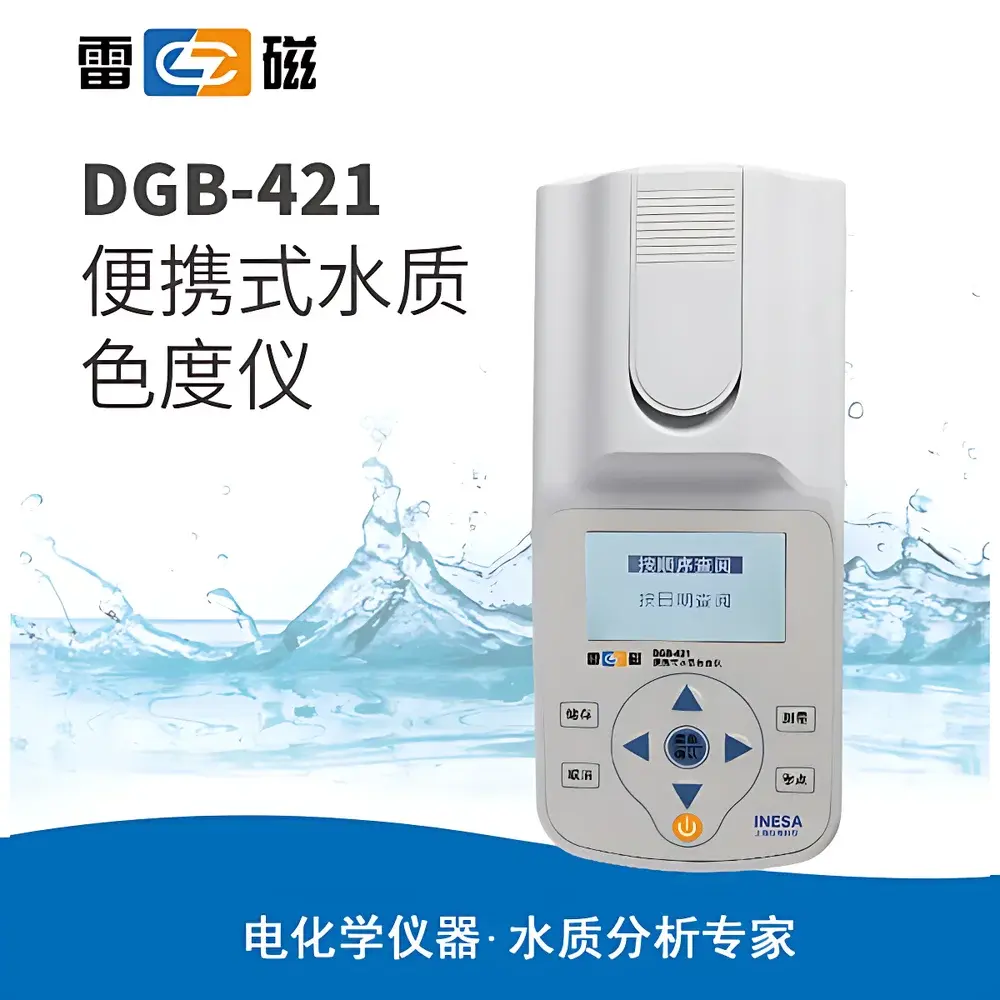
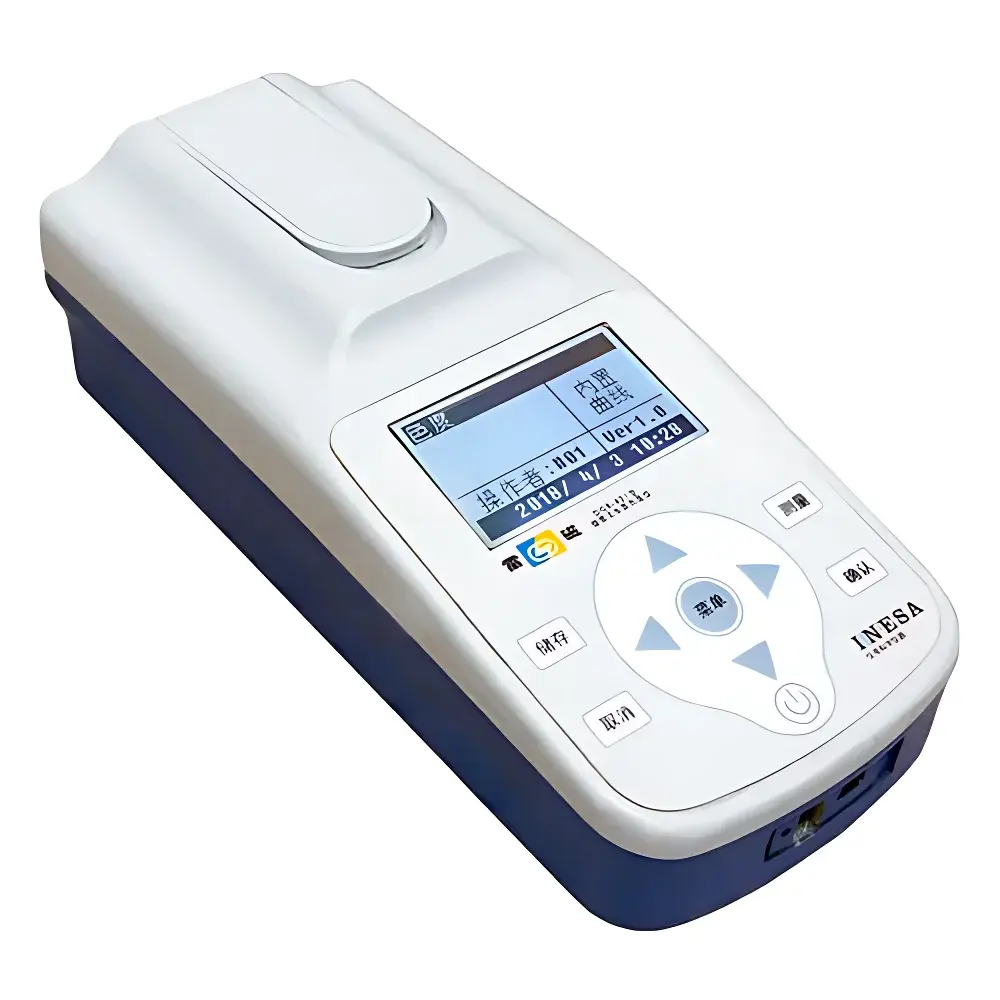
Leichi DGB-421 Portable Water Colorimeter
| Brand | Leichi |
|---|---|
| Origin | Shanghai, China |
| Manufacturer Type | Authorized Distributor |
| Country of Origin | China |
| Model | DGB-421 |
| Price | USD 320 (FOB Shanghai) |
| Measurement Range | 0–50 PCU (Platinum-Cobalt Units) |
| Accuracy | ±5% or ±1 PCU (whichever is greater) |
| Repeatability | ≤3.0% RSD |
| Light Source | High-intensity, long-life LED |
| Calibration Method | Platinum-Cobalt Standard (GB 5750.4-2006) |
| Units Supported | PCU, Hazen, Pt-Co, mg Pt/L |
| Calibration Options | Preloaded standard curve + 2-point user calibration |
| Data Storage | 200 measurement records with timestamp, operator ID, and calibration status |
| Power Supply | 4 × AA alkaline batteries or 5 V DC via micro-USB |
| Environmental Rating | IP65 |
| Dimensions (L×W×H) | 220 × 100 × 80 mm |
| Weight | 0.8 kg |
| Compliance | GB/T 5750.4–2006, ISO 7887:2011 (Water quality — Examination of colour), GLP data integrity features (audit trail enabled) |
Overview
The Leichi DGB-421 Portable Water Colorimeter is a field-deployable optical instrument engineered for rapid, standardized assessment of true color in potable water, wastewater, and process streams using the platinum-cobalt (Pt-Co) method. It operates on the principle of spectrophotometric comparison against a stable, factory-characterized LED light source emitting at a defined visible wavelength band (approx. 455 nm), optimized to match human visual perception under standardized illuminant C conditions. The device quantifies color as Platinum-Cobalt Units (PCU), directly traceable to the national standard GB/T 5750.4–2006—identical in technical basis to ISO 7887:2011 and ASTM D1209. Unlike absorbance-based instruments requiring reagent addition or complex sample digestion, the DGB-421 performs direct visual-matching simulation via fixed-pathlength (10 mm) cuvette geometry and calibrated photodetector response, eliminating interferences from turbidity when samples are pre-filtered (0.45 µm). Its design targets routine compliance monitoring where regulatory reporting requires PCU, Hazen, or Pt-Co values—not spectral reflectance or CIE L*a*b* coordinates.
Key Features
- Compliance-certified Pt-Co color measurement per GB/T 5750.4–2006 and ISO 7887:2011, with NIST-traceable calibration validation documentation available upon request
- Fixed-wavelength LED optical system with thermal stabilization, delivering <1.5% intensity drift over 8-hour continuous operation at 25°C
- No consumables required: eliminates dependency on liquid Pt-Co standards, reducing operational cost and chemical handling risk
- Two-point user calibration mode supports traceable adjustment using certified reference standards (e.g., 10 PCU and 40 PCU solutions)
- GLP-compliant data logging: each stored record includes measurement value, date/time stamp, battery voltage, calibration status flag, and optional operator ID input
- Dual-power architecture: operates continuously for ≥120 hours on four AA alkaline cells; micro-USB port enables real-time power supply or data export without battery removal
- Ruggedized enclosure rated IP65—tested to withstand 3-minute water jet exposure (6.3 mm nozzle, 12.5 L/min) and complete dust ingress protection
Sample Compatibility & Compliance
The DGB-421 accepts standard 10 mm pathlength glass or quartz cuvettes (12.5 mm external diameter). Samples must be clarified by membrane filtration (0.45 µm pore size) prior to analysis to isolate true color from turbidity-related scattering. It is validated for use with cold, ambient, or refrigerated aqueous matrices having pH 5.0–9.0 and temperature stability within ±2°C during measurement. Regulatory alignment includes full support for drinking water testing under China’s GB 5749–2022, US EPA Method 180.1 (adapted), and EU Directive 98/83/EC Annex I parametric values for color. Instrument firmware implements mandatory GLP audit trail requirements—including immutable timestamps, calibration history retention, and user action logging—ensuring data integrity for ISO/IEC 17025-accredited laboratories.
Software & Data Management
Data export is performed via USB interface using vendor-provided Leichi DataLink software (Windows 10/11 compatible). The software parses binary log files into CSV format with column headers: “Record_ID”, “PCU_Value”, “Date_UTC”, “Time_UTC”, “Battery_V”, “Cal_Status”, “Operator_ID”. No cloud connectivity or proprietary drivers are required. All internal memory operations enforce write-once semantics: records cannot be edited or deleted post-acquisition. Firmware version 2.3+ supports configurable auto-archiving intervals and password-protected administrator mode for calibration parameter modification.
Applications
- Drinking water treatment: raw intake screening, coagulation efficiency verification, final distribution system monitoring
- Pharmaceutical water systems: Purified Water (PW) and Water for Injection (WFI) color verification per USP and EP 2.2.2
- Food & beverage QC: clarity assessment of bottled water, beer, fruit juices, and syrups
- Environmental field surveys: surface water color mapping in watershed studies and eutrophication monitoring
- Hospital utility management: dialysis water color validation per AAMI/ISO 13959
- Industrial boiler feedwater: early detection of organic degradation products or resin leachates
FAQ
Does the DGB-421 require annual recalibration by an accredited lab?
No. The instrument’s LED source and detector are factory-calibrated for life; however, users must perform daily zeroing with deionized water and verify accuracy weekly using certified Pt-Co reference standards (e.g., 20 PCU). Full recalibration is only necessary if physical damage occurs or after firmware updates affecting optical gain.
Can it measure colored solutions beyond 50 PCU?
No. The optical dynamic range is strictly limited to 0–50 PCU per GB/T 5750.4. Samples exceeding this range must be diluted with color-free water (e.g., Milli-Q) and results multiplied by the dilution factor.
Is USB power delivery compatible with USB-C host ports?
Yes—via standard USB-A to micro-USB cable. No USB-C adapter is needed; the device draws <120 mA at 5 V DC.
How is data security ensured during transfer?
All communication uses HID-class USB protocol with no driver installation. Data packets are unencrypted but contain no PII; encryption is implemented only at enterprise-level software layer (optional Leichi LabSuite add-on).




