
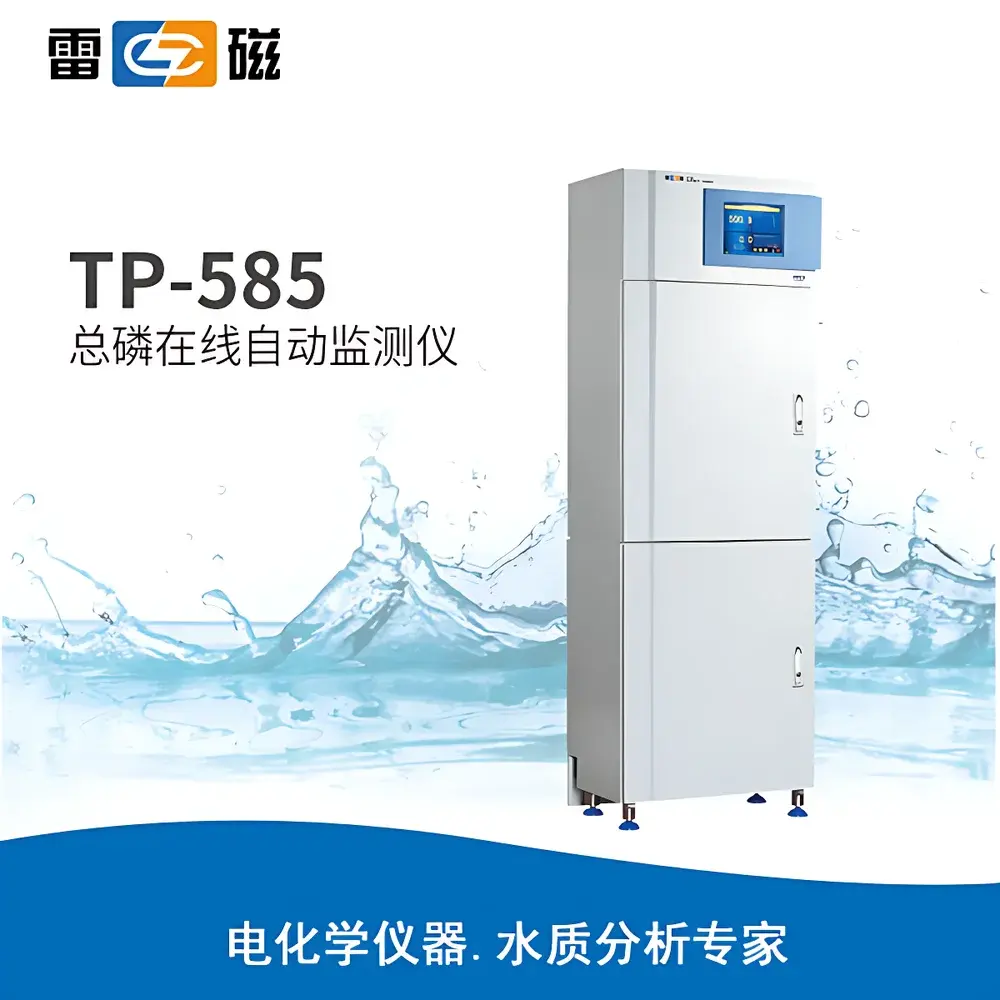
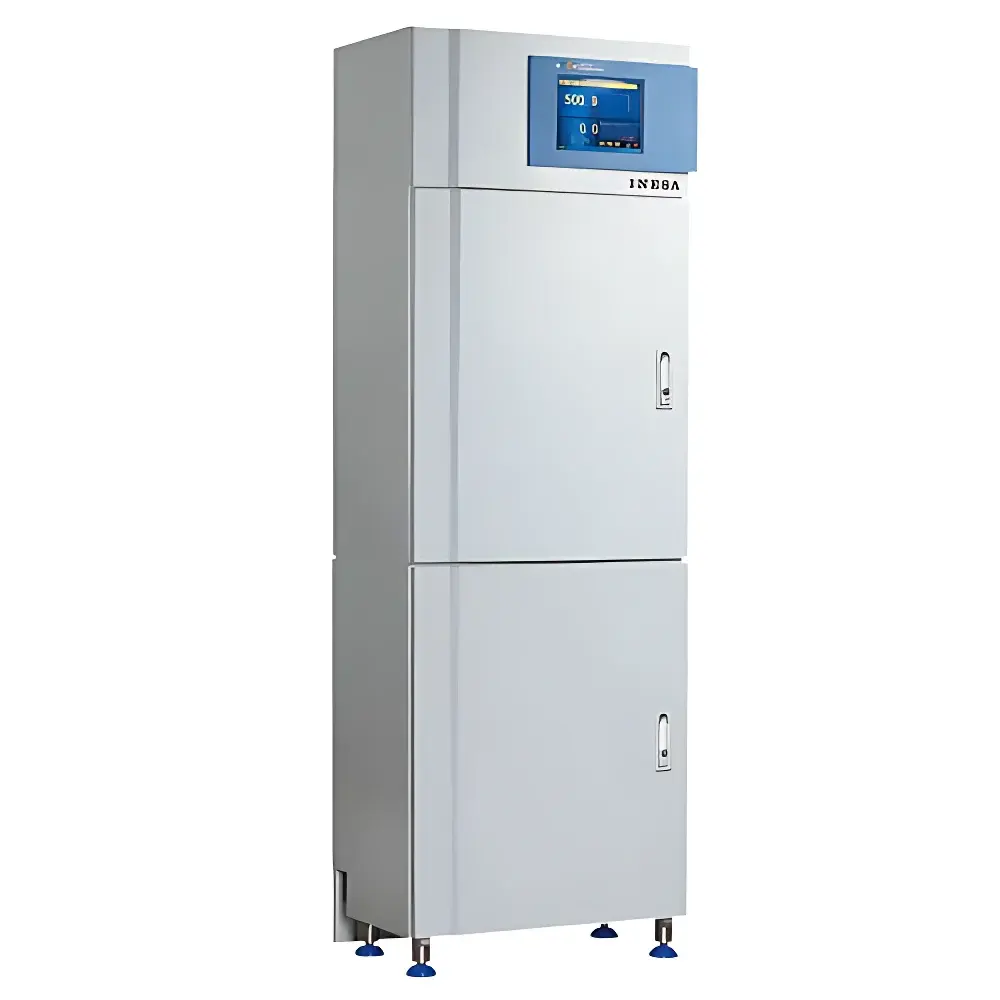
Leici TP-585 Total Phosphorus Online Automatic Monitor
| Brand | Leici |
|---|---|
| Origin | Shanghai, China |
| Model | TP-585 |
| Measurement Parameter | Total Phosphorus |
| Instrument Type | Online Analyzer |
| Measurement Range | 0–50 mg/L |
| Accuracy | ±10% of reading |
| Repeatability | ≤±10% |
| Minimum Measurement Cycle | 40 min (adjustable from 5–120 min) |
| Digestion Time | Configurable |
| Sampling Interval | 20–9999 min (programmable) or on-the-hour mode |
| Calibration Interval | 1–99 days (user-defined) |
| Maintenance Interval | ~30 min per month |
| Analog Output | 1 × 4–20 mA (optional 2 channels) |
| Communication Interface | RS232 or RS485 |
| Digital I/O | 1–6 relay outputs (220 VAC / 2 A) |
| Operating Environment | +5 to +28 °C, ≤99% RH (non-condensing) |
| Power Supply | AC 220 V ±10%, 50 Hz ±1%, 5 A |
| Dimensions | 1430 × 500 × 403 mm |
| MTBF | ≥720 h |
| Data Retention | Non-volatile memory preserves settings and logs during power loss |
| Display & Control | Integrated touch screen interface |
| Self-Diagnostic Capability | Real-time fault detection with alarm prompts |
| Auto-Cleaning | Integrated sampling line cleaning function |
| Valve System | Multi-port corrosion-resistant valve assembly |
| Tubing | Imported modified PTFE transparent tubing (ID >1.5 mm) |
Overview
The Leici TP-585 Total Phosphorus Online Automatic Monitor is an industrial-grade, fully automated water quality analyzer engineered for continuous, unattended measurement of total phosphorus (TP) in aqueous matrices. Total phosphorus encompasses all organic and inorganic phosphorus species—both dissolved and particulate—present in a water sample. As a critical eutrophication indicator, TP concentration directly correlates with ecological risk in natural and engineered water systems; elevated levels promote algal blooms, hypoxia, and trophic imbalance. The TP-585 implements a standardized colorimetric method based on the molybdenum blue reaction following high-temperature acid digestion, ensuring complete oxidation of organic phosphorus and hydrolysis of condensed phosphates into orthophosphate prior to quantification. This principle aligns with widely accepted regulatory frameworks including ISO 6878:2004 and EPA Method 365.3, enabling traceable compliance in environmental monitoring applications.
Key Features
- Integrated digestion and colorimetric detection in a single flow cell—eliminates inter-stage transfer errors and improves analytical reproducibility.
- Corrosion-resistant multi-position selection valve constructed from chemically inert materials, rated for >500,000 actuation cycles under continuous operation.
- Custom-engineered modified PTFE transparent tubing (inner diameter >1.5 mm) minimizes clogging from suspended solids, biofilm, or crystalline precipitates commonly encountered in wastewater and surface water streams.
- Programmable automatic line-cleaning protocol using pressurized air or reagent flush, activated at user-defined intervals to suppress microbial growth and biofouling in intake lines.
- Intelligent power-loss recovery: Upon restoration of AC supply, the system autonomously executes a purge sequence to evacuate residual reagents and digested sample, then resumes scheduled measurement without manual intervention.
- Embedded real-time self-diagnostic engine continuously monitors optical path integrity, pump performance, valve positioning, temperature stability, and reagent depletion—triggering actionable alerts via on-screen display and relay outputs.
- Non-volatile flash memory retains calibration coefficients, historical measurements, event logs, and system configurations during extended power outages or maintenance cycles.
Sample Compatibility & Compliance
The TP-585 is validated for use with municipal wastewater influent/effluent, surface water (rivers, lakes, reservoirs), groundwater, drinking water treatment plant process streams, and industrial discharge points. It demonstrates robustness against common interferents—including chloride (<2000 mg/L), sulfate (<1000 mg/L), nitrate (<50 mg/L), and moderate turbidity (500 mg/L) may exhibit slight negative bias due to incomplete digestion kinetics; this behavior is documented in internal validation reports and aligns with ISO 6878 guidance on matrix-specific method verification. The instrument supports GLP-compliant operation through audit-trail-enabled calibration logging, user-access-level controls, and timestamped event records—facilitating readiness for regulatory inspections under national environmental protection statutes and ISO/IEC 17025-accredited laboratory environments.
Software & Data Management
The TP-585 operates on an embedded Linux-based control platform with a 7-inch capacitive touch screen providing intuitive navigation across measurement status, calibration history, maintenance schedules, and diagnostic dashboards. All operational parameters—including cycle timing, digestion duration, calibration frequency, and alarm thresholds—are configurable via GUI without external software. Data export is supported via USB mass storage or serial communication (RS232/RS485) using Modbus RTU protocol for integration into SCADA, DCS, or LIMS platforms. Analog outputs (4–20 mA) are linearly scaled to the full 0–50 mg/L range with NIST-traceable zero/span verification capability. Optional relay outputs support automated actions such as reagent top-up alerts, maintenance reminders, or upstream flow diversion commands.
Applications
- Real-time monitoring of TP at wastewater treatment plant influent and effluent points for process optimization and regulatory reporting (e.g., China’s GB 18918-2002, EU Urban Wastewater Treatment Directive).
- Long-term trend analysis in lake and reservoir management programs targeting early warning of eutrophication onset.
- Compliance verification at industrial discharge outlets subject to local environmental permits (e.g., phosphorus limits in textile, food processing, or fertilizer manufacturing effluents).
- Source water surveillance for drinking water utilities to inform coagulant dosing strategies and assess watershed loading dynamics.
- Research-grade deployment in field laboratories conducting nutrient flux studies across hydrological gradients.
FAQ
What digestion method does the TP-585 employ?
The instrument uses high-temperature (≥120 °C), high-pressure acid digestion with potassium persulfate in sulfuric medium, followed by ammonium molybdate–ascorbic acid color development—consistent with ISO 6878 and EPA 365.3.
Can the TP-585 be integrated into existing plant SCADA systems?
Yes, via standard RS485 Modbus RTU or optional analog 4–20 mA output with configurable scaling and HART compatibility.
How often does the system require preventive maintenance?
Scheduled maintenance is recommended monthly (~30 minutes), primarily involving tubing inspection, reagent replacement, and optical window cleaning.
Is remote firmware update supported?
Firmware updates are performed locally via USB drive; remote update over network is not implemented for security and regulatory stability reasons.
Does the TP-585 meet requirements for certified environmental monitoring in China?
It complies with HJ/T 103–2003 (Technical Specifications for Online Monitoring Instruments of Total Phosphorus in Water) and is listed in the China Environmental Protection Industry Association’s Recommended Equipment Catalogue for Water Pollution Source Monitoring.
Related Products







