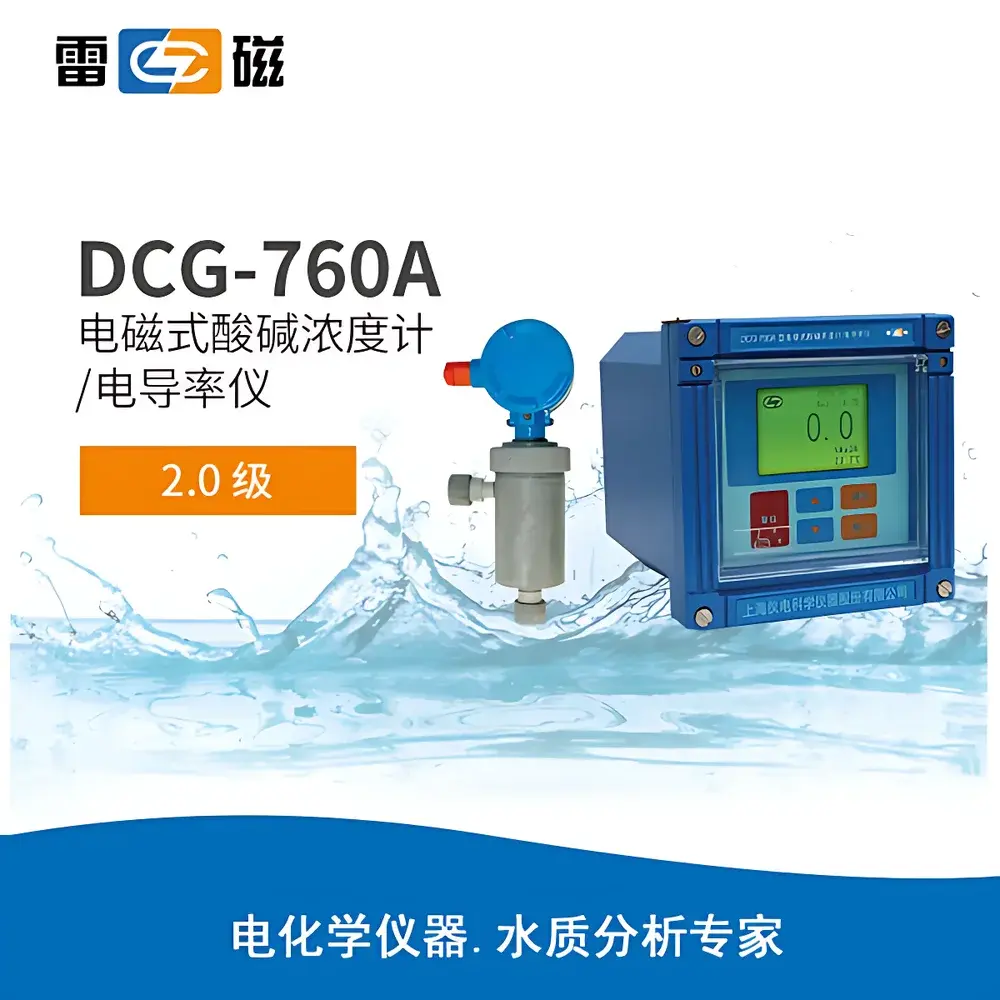
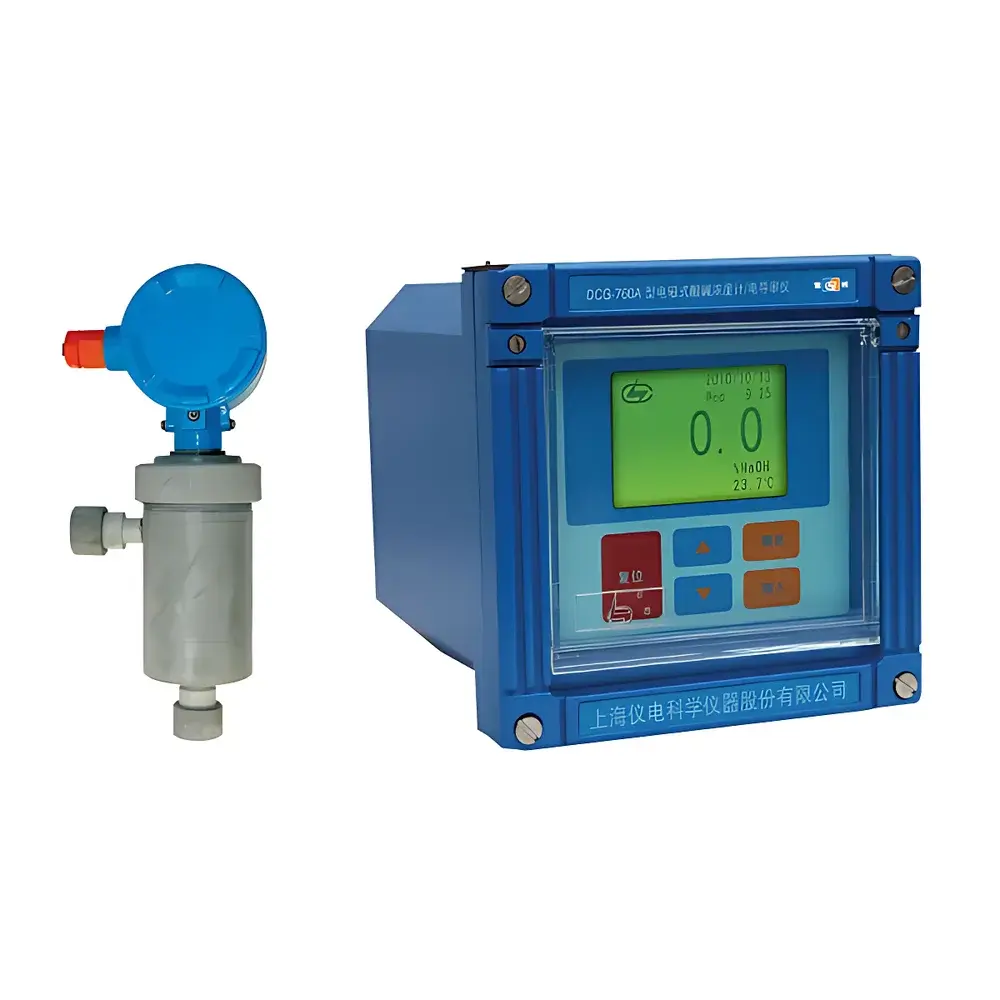
Leichi DCG-760A Electromagnetic Acid/Alkali Concentration Meter & Online Conductivity Analyzer
| Brand | Leichi |
|---|---|
| Origin | Shanghai, China |
| Model | DCG-760A |
| Conductivity Range | 0–1000 mS/cm |
| Temperature Range | −10.0 to 120.0 °C |
| Basic Instrument Error | ±2.0% FS (Conductivity), ±0.3% HCl/NaOH (Concentration), ±0.5 °C (Temp, 0–60 °C) |
| Resolution | 0.1% (Concentration), 0.1/1 mS/cm (Conductivity), 0.1 °C (Temperature) |
| Temperature Compensation Range | 5.0–45.0 °C (Reference: 25.0 °C) |
| Output | Isolated 4–20 mA DC (Configurable Upper/Lower Limits) |
| Enclosure Rating | IP65 |
| Dimensions | 144 × 144 × 150 mm |
| Weight | ~2 kg |
Overview
The Leichi DCG-760A is an industrial-grade electromagnetic acid/alkali concentration meter and online conductivity analyzer engineered for continuous, non-invasive monitoring in demanding process environments. Unlike contact-type conductivity sensors—prone to electrode polarization, fouling, and drift—the DCG-760A employs Faraday’s law of electromagnetic induction to measure solution conductivity without direct electrical contact between the sensor and the medium. This principle eliminates polarization errors and ensures stable, long-term performance in high-conductivity applications such as concentrated hydrochloric acid (HCl) or sodium hydroxide (NaOH) streams. The instrument is specifically calibrated for two critical industrial chemistries: HCl (0–10.0 % w/w) and NaOH (0–10.0 % w/w), with temperature-compensated algorithms traceable to standard reference solutions per ISO 7888 and ASTM D1125. Its robust design supports uninterrupted operation in power generation (boiler feedwater, condensate polishing), petrochemical refining, pharmaceutical water-for-injection (WFI) loop monitoring, and wastewater neutralization control.
Key Features
- Electromagnetic sensing technology—zero electrode polarization, no electrolyte leakage, and immunity to coating or corrosion in aggressive chemical streams
- Dual-mode measurement: simultaneous or selectable display of conductivity (mS/cm) and derived concentration (% HCl or % NaOH)
- High-resolution graphical LCD with real-time dual-parameter readout (temperature + conductivity/concentration)
- Integrated microprocessor-based electronics enabling automatic temperature compensation (ATC) using a Pt1000 RTD input; compensation range: 5.0–45.0 °C (25.0 °C reference)
- Programmable 4–20 mA isolated analog output with user-defined scaling for integration into DCS, PLC, or SCADA systems
- Configurable high/low limit alarms with relay dry-contact outputs for process interlock or pump control
- Non-volatile memory with power-fail retention—maintains calibration constants and setpoints during AC interruption
- IP65-rated front-panel enclosure suitable for wall- or panel-mounting in humid, dusty, or splash-prone industrial zones
Sample Compatibility & Compliance
The DCG-760A is compatible with conductive aqueous solutions across a wide thermal and chemical spectrum: from chilled cooling tower water (−10.0 °C) to hot caustic cleaning agents (up to 120.0 °C). It is validated for use with HCl and NaOH solutions within specified concentration ranges; extended use with other strong electrolytes (e.g., H2SO4, KOH) requires application-specific verification and recalibration. The system complies with IEC 61000-6-2 (immunity) and IEC 61000-6-4 (emissions) for industrial electromagnetic compatibility. While not certified to SIL or ATEX standards out-of-the-box, its signal integrity and fail-safe alarm logic support integration into safety-related subsystems under end-user risk assessment per IEC 61511. For regulated environments (e.g., pharmaceutical utilities), the device supports manual audit trails and meets foundational requirements for data integrity under FDA 21 CFR Part 11 when paired with compliant logging infrastructure.
Software & Data Management
The DCG-760A operates as a standalone field instrument with no embedded firmware update capability via USB or Ethernet; configuration and calibration are performed locally via membrane keypad and on-screen prompts. All operational parameters—including measurement mode, temperature coefficient (β), output scaling, alarm thresholds, and ATC settings—are stored in EEPROM with write-protection logic to prevent accidental overwrite. Calibration verification follows a two-point method using NIST-traceable KCl standards (e.g., 1413 µS/cm and 12.88 mS/cm) or certified HCl/NaOH reference solutions. While the unit does not feature built-in data logging or cloud connectivity, its 4–20 mA output is fully compatible with third-party historian systems (e.g., OSIsoft PI, Emerson DeltaV) that enforce time-stamped acquisition, change tracking, and electronic signature workflows aligned with GLP/GMP documentation practices.
Applications
- Power plants: Real-time monitoring of condensate purity, demineralizer effluent, and hydrazine dosing loops
- Petrochemical refineries: Continuous control of amine regeneration sump strength and sulfuric acid alkylation catalyst concentration
- Pharmaceutical manufacturing: Verification of conductivity excursions in purified water (PW) and water-for-injection (WFI) distribution systems per USP and EP 2.2.38
- Chemical processing: Closed-loop feedback control of neutralization reactors using HCl/NaOH titrant streams
- Municipal wastewater: Effluent pH adjustment via conductivity-derived alkalinity estimation prior to discharge
- Food & beverage: Monitoring of CIP (clean-in-place) solution concentration and rinse water recovery thresholds
FAQ
Does the DCG-760A require periodic electrode replacement?
No—its electromagnetic sensor (DCGF-100A transmitter) contains no electrodes, membranes, or electrolytes. Maintenance is limited to periodic visual inspection of the flow cell and verification of sensor coil resistance per manufacturer guidelines.
Can the instrument measure conductivity outside the listed ranges (e.g., >1000 mS/cm)?
Operation beyond 1000 mS/cm is not supported. Signal saturation and reduced linearity occur above this upper limit; alternative high-range electromagnetic transmitters with custom coil geometry are recommended for molten salt or brine applications.
Is temperature compensation applied to concentration readings?
Yes—concentration calculation incorporates both measured temperature and empirically derived thermal expansion coefficients for HCl and NaOH, ensuring accuracy across the full operating range (−10.0 to 120.0 °C).
What is the recommended calibration frequency in continuous operation?
Calibration verification is advised every 7–14 days in critical applications (e.g., pharmaceutical WFI), or quarterly in stable utility water systems—aligned with internal quality protocols and ISO/IEC 17025 traceability requirements.
Does the unit support Modbus RTU or other digital communication protocols?
No—the DCG-760A provides only analog 4–20 mA output. Digital interface options require external protocol converters or replacement with Leichi’s DCG-760B series (Modbus RS-485 enabled).
Related Products