
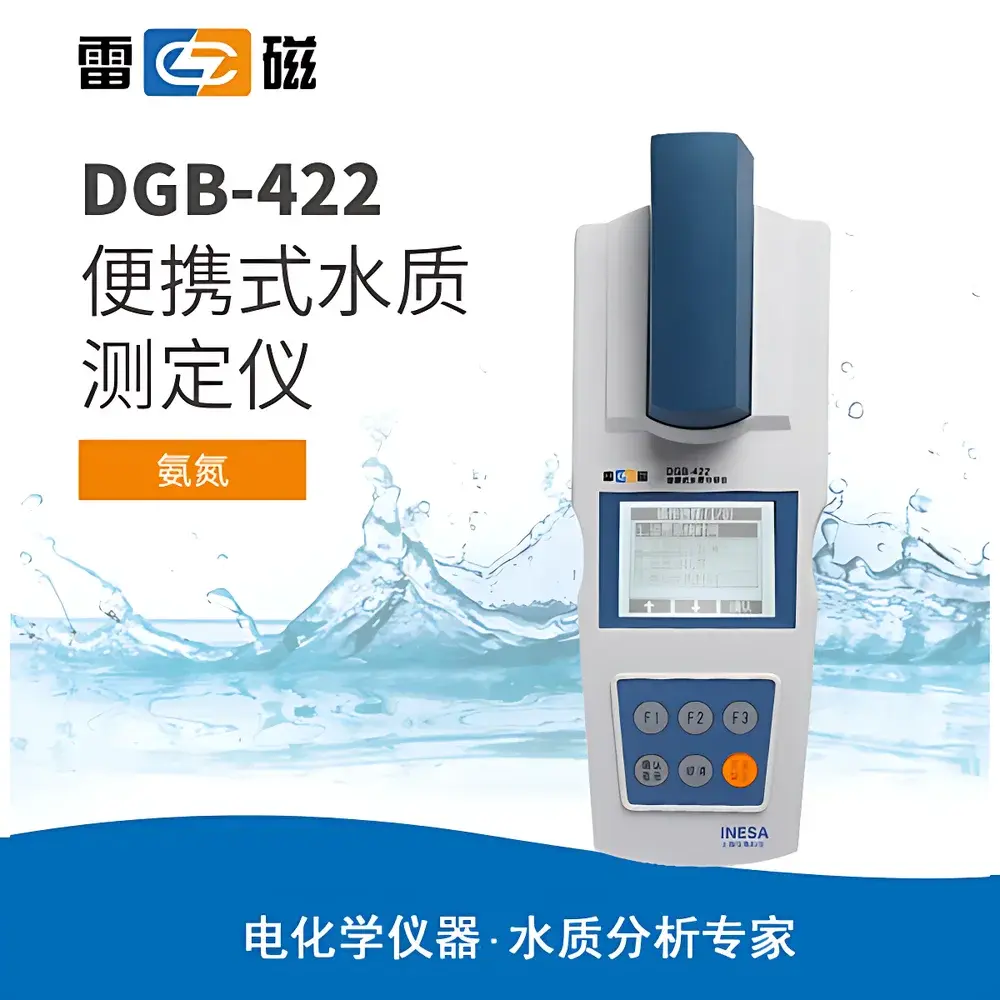
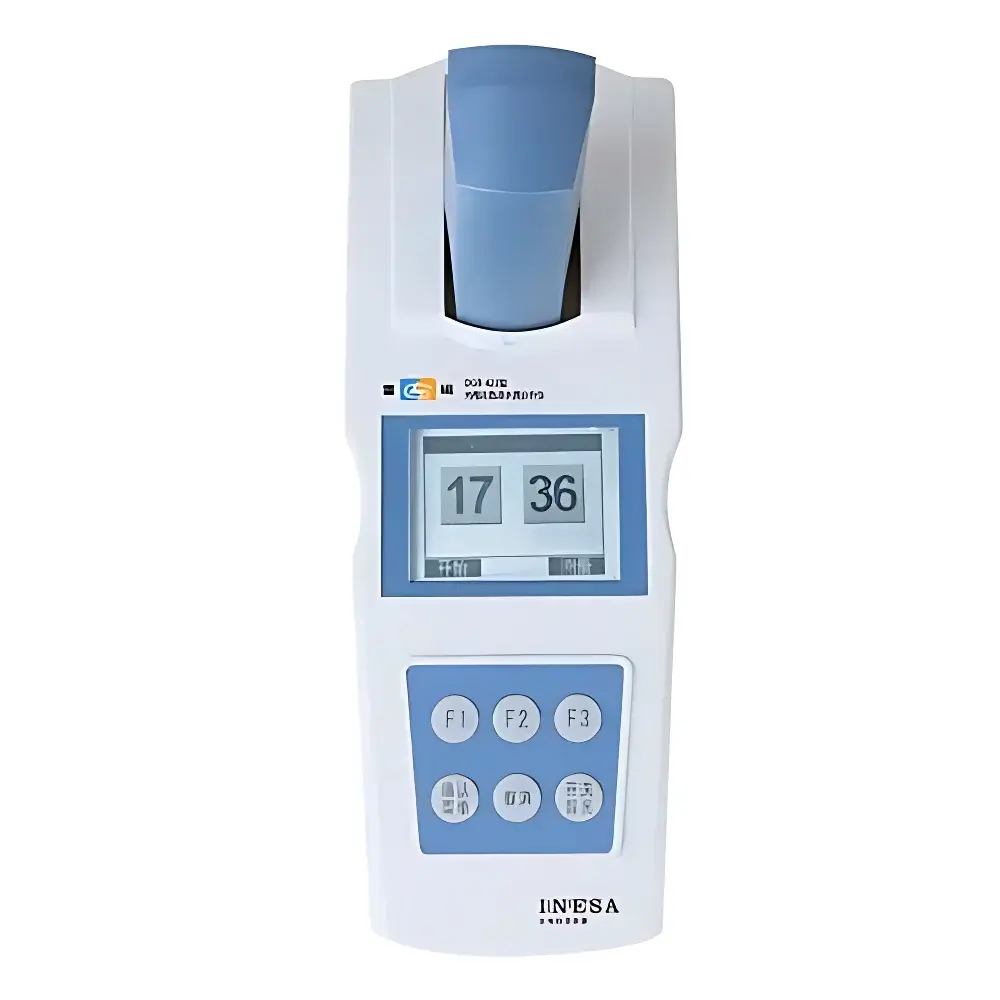
Leici DGB-422 Portable Water Quality Analyzer
| Brand | Leici |
|---|---|
| Origin | Shanghai, China |
| Manufacturer Type | Authorized Distributor |
| Country of Origin | China |
| Model | DGB-422 |
| Instrument Type | Portable |
| Measurement Principle | Colorimetric Method (LED-based Photometry) |
| Measurement Range | 0.000–500.0 mg/L (Ammonia Nitrogen) |
| Accuracy | ±5 mg/L |
| Display | Backlit LCD with Adjustable Contrast & Timeout |
| Protection Rating | IP65 |
| Power Supply | 4 × AA Alkaline Batteries or USB 5V DC |
| Dimensions | 220 × 85 × 50 mm |
| Weight | ~0.4 kg |
| Operating Environment | 5–35 °C, 0–85% RH (non-condensing) |
| Cuvette Format | 16 mm OD × 100 mm, 10 mL capacity |
| Calibration | Up to 5-point user-defined calibration |
| Data Management | GLP-compliant storage, recall, deletion, and print export via USB |
| Supported Parameters | Ammonia Nitrogen, Total Hardness (Ca²⁺/Mg²⁺), Urea, Total Phosphorus, COD (Permanganate Index), Residual Chlorine, Total Chlorine, Chlorine Dioxide, Aluminum, etc. |
Overview
The Leici DGB-422 Portable Water Quality Analyzer is a field-deployable, LED-based photometric instrument engineered for rapid, reliable quantification of key water quality parameters—including ammonia nitrogen, total hardness, and urea—in diverse aqueous matrices. It operates on the colorimetric principle: analyte-specific reagents react with target species to form colored complexes whose absorbance is measured at precisely selected wavelengths (e.g., 470 nm for hardness and urea). Unlike broadband light sources, the DGB-422 integrates narrow-band LEDs matched to the absorption maxima of common chromogenic reactions—minimizing spectral interference and enhancing measurement stability under variable ambient lighting. Its compact architecture (220 × 85 × 50 mm, ~0.4 kg), rugged IP65-rated enclosure, and dual-power capability (AA batteries or USB 5V) enable uninterrupted operation in outdoor sampling campaigns, wastewater treatment plant inspections, swimming pool maintenance, and emergency response scenarios. Designed for compliance with routine environmental monitoring workflows, it supports both on-site screening and laboratory-grade verification without requiring optical bench setup or external spectrometer integration.
Key Features
- LED photometric engine with wavelength-specific emission (e.g., 470 nm), eliminating need for mechanical filters or monochromators
- Integrated cuvette holder accepting standard 16 mm OD × 100 mm glass or plastic tubes (10 mL volume), enabling direct sample measurement without transfer errors
- Backlit LCD display with adjustable contrast and programmable backlight timeout—optimized for readability in low-light or high-glare field conditions
- On-device GLP-compliant data management: timestamped results, up to 1,000 stored measurements, user ID tagging, and audit-ready export via USB interface
- Five-point customizable calibration protocol supporting traceable accuracy across extended concentration ranges
- Intelligent auto-hold function locks stable readings automatically; eliminates subjective endpoint judgment
- Dual power architecture: 4 × AA alkaline cells (typical >1,200 measurements per set) or continuous USB 5V operation—ideal for extended deployments or lab bench use
- Firmware-upgradable platform permitting future parameter expansion (e.g., total phosphorus, chlorine dioxide) through validated application modules
Sample Compatibility & Compliance
The DGB-422 is validated for analysis of surface water, municipal and industrial wastewater, reclaimed water for landscape irrigation, potable water, and recreational swimming pool water. It complies with foundational methodological frameworks referenced in ISO 7888 (hardness), ISO 11732 (ammonia nitrogen by Nesslerization or salicylate), and APHA Standard Methods 4500-NH₃ F (ammonia) and 2340 C (total hardness). While not certified to EPA or ISO 17025 as a standalone system, its performance characteristics—±5 mg/L absolute accuracy for ammonia nitrogen (0.000–500.0 mg/L range), ≤3% RSD repeatability for urea—align with field-screening requirements outlined in US EPA Guidance for Field Measurements (EPA/600/R-19/024). The device meets IEC 60529 IP65 ingress protection for dust resistance and low-pressure water jets, ensuring operational integrity during rain, splashing, or humid environments.
Software & Data Management
Data acquisition and reporting conform to Good Laboratory Practice (GLP) principles. Each measurement record includes date/time stamp, operator ID (configurable), parameter name, raw absorbance, calculated concentration, calibration curve identifier, and pass/fail status against user-defined QC limits. Stored data can be exported in CSV format via USB connection to Windows/Linux PCs for integration into LIMS or statistical analysis tools (e.g., Excel, R, Python pandas). The built-in memory retains full traceability—including calibration history, firmware version, and battery voltage logs—for internal QA audits. No proprietary software installation is required; the device appears as a mass-storage device upon USB connection. Firmware updates are delivered as signed binary files, preserving cryptographic integrity and rollback capability.
Applications
- Field verification of ammonia nitrogen levels in effluent discharge points prior to regulatory reporting
- Routine hardness monitoring in boiler feedwater systems and cooling tower circuits to prevent scale formation
- Urea concentration assessment in swimming pools and spas where chloramine formation poses air quality concerns
- Emergency response testing following agricultural runoff or sewage overflows impacting drinking water intakes
- Educational laboratories conducting quantitative environmental chemistry experiments with standardized reagent kits
- Third-party inspection agencies performing pre-commissioning checks on decentralized wastewater treatment units
FAQ
What reagent kits are compatible with the DGB-422 for ammonia nitrogen measurement?
The instrument is designed for use with Leici-certified ammonia nitrogen reagent sets based on the salicylate-hypochlorite method (ASTM D1426-15 compliant). Reagent lot numbers must be entered manually to apply batch-specific calibration offsets.
Does the DGB-422 support ISO/IEC 17025-accredited testing?
While the hardware meets key metrological prerequisites (stability, repeatability, traceable calibration), formal accreditation requires documented validation per ISO/IEC 17025:2017 Clause 7.2–7.8—including uncertainty budgeting, interlaboratory comparison, and analyst competency assessment—performed by the end-user’s quality unit.
Can measurement data be synchronized with cloud-based environmental monitoring platforms?
Native cloud sync is not implemented; however, exported CSV files may be ingested into platforms such as ArcGIS Field Maps, EQuIS, or custom REST APIs via middleware scripting.
Is the 470 nm LED source replaceable by the user?
No. The LED module is factory-aligned and sealed within the optical path housing. Replacement requires return-to-factory service and recalibration.
How is photometric drift compensated during extended field use?
The system performs automatic dark-current correction before each measurement cycle using the cuvette blank, and thermal stabilization circuitry maintains LED output consistency across the 5–35 °C operating range.
Related Products







