
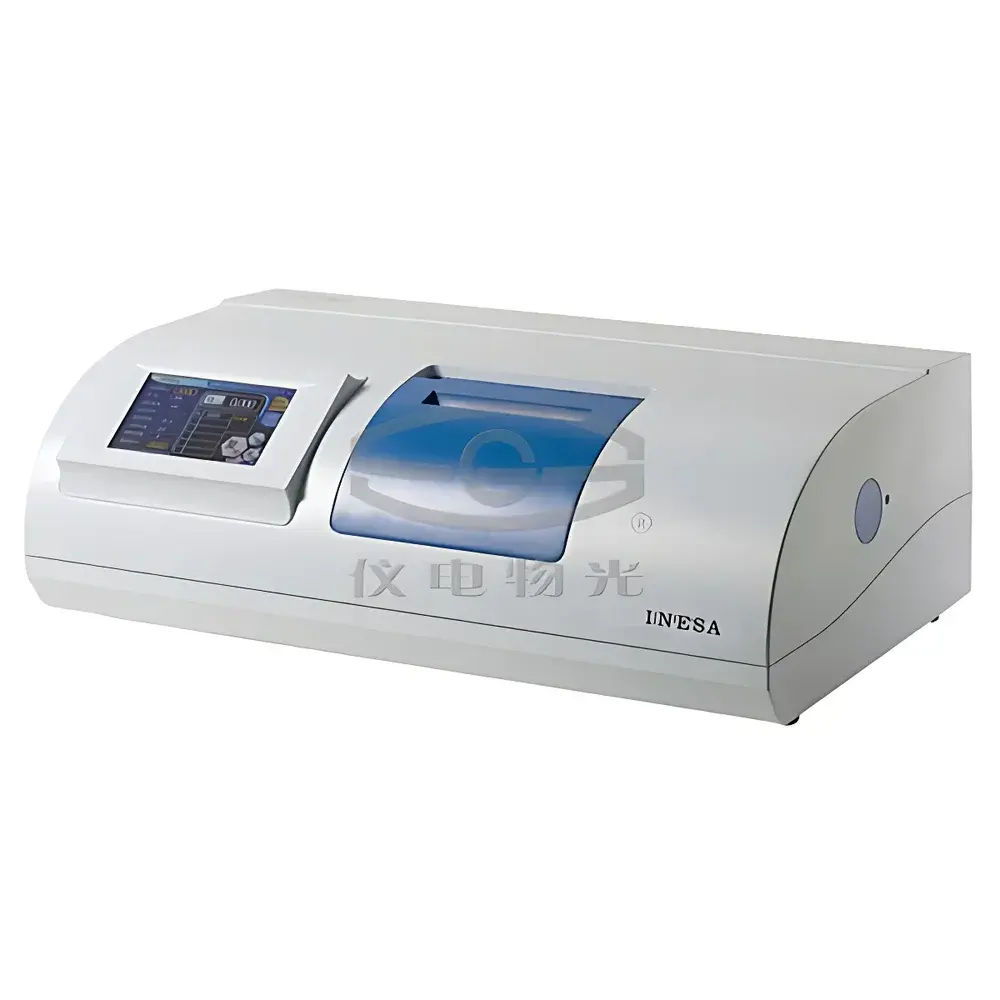
YDWG SGW®-1 Automatic Polarimeter
| Brand | YDWG |
|---|---|
| Origin | Shanghai, China |
| Manufacturer Type | Authorized Distributor |
| Product Category | Domestic (PRC-manufactured) |
| Model | SGW®-1 |
| Pricing | Upon Request |
| Instrument Type | Automatic Polarimeter |
| Temperature Control | Not Equipped |
| Digital Display | Yes |
| Light Source | High-Efficiency LED |
| Optical Path Length Compatibility | 100 mm & 200 mm cells |
| Measurement Range | ±45° (optical rotation), ±120°Z (saccharimetric scale) |
| Minimum Resolution | 0.001° (optical rotation), 0.01°Z (sugar scale) |
| Accuracy | ±(0.05° + 0.03% of reading) for optical rotation |
| Repeatability (Std. Dev. δ) | ≤0.002° |
| Wavelength | 589.3 nm (Na D-line equivalent, stabilized via LED + interference filter) |
| Display | 7-inch color TFT touchscreen |
| Interface | RS232 and USB |
| Power Supply | 220 V ±10%, 50 Hz ±1 Hz, 150 W |
| Dimensions (L×W×H) | 710 × 400 × 240 mm |
| Net Weight | 28 kg |
| Accuracy Class | 0.02 |
Overview
The YDWG SGW®-1 Automatic Polarimeter is a precision optical instrument engineered for quantitative measurement of optical rotation in chiral substances—principally used in pharmaceutical quality control, fine chemical synthesis validation, food & beverage sugar content analysis, and academic research on optically active compounds. It operates on the fundamental principle of polarimetry: linearly polarized light passes through a sample solution containing asymmetric molecules (e.g., sugars, amino acids, alkaloids), inducing a rotation of the plane of polarization proportional to concentration, path length, wavelength, temperature, and molecular structure. The SGW®-1 employs a stabilized high-luminance LED source coupled with an interference filter to deliver a narrow-band output centered at 589.3 nm—functionally equivalent to the sodium D-line—ensuring spectral consistency without the hazards or maintenance burden of sodium vapor lamps. Its fully automated measurement cycle includes six sequential readings per sample, followed by real-time calculation of mean value and root-mean-square deviation (RMS), supporting GLP-compliant data integrity requirements.
Key Features
- High-stability LED light source with >100,000-hour operational lifetime and minimal thermal drift—eliminating lamp replacement cycles and warm-up delays.
- Four integrated measurement modes: optical rotation (α), specific rotation ([α]), concentration (g/100 mL), and saccharimetric scale (°Z), enabling direct reporting aligned with pharmacopoeial and industrial standards (e.g., USP , Ph. Eur. 2.2.7).
- 7-inch full-color capacitive touchscreen interface with intuitive icon-driven navigation—supporting multilingual UI (English default), parameter configuration, and on-device data review.
- Dual-cell compatibility: accommodates standard 100 mm and 200 mm path-length sample tubes, allowing flexibility across low- and high-sensitivity applications.
- Deep-sample capability: optimized optical design enables reliable measurements even at low transmittance (≥1% transmission), critical for colored or turbid solutions such as caramelized syrups or botanical extracts.
- Robust mechanical architecture with vibration-dampened base and precision-aligned optical train—ensuring long-term stability and measurement reproducibility (δ ≤ 0.002°).
Sample Compatibility & Compliance
The SGW®-1 is validated for use with aqueous and organic solvent-based solutions of optically active analytes including sucrose, glucose, fructose, lactose, levulinic acid, camphor derivatives, and synthetic chiral intermediates. It meets the functional accuracy requirements of ISO 13871:2000 (Optical methods — Polarimeters) and supports audit-ready documentation when paired with compliant peripheral devices (e.g., RS232-connected thermal printers with timestamped output). While the instrument does not incorporate active temperature regulation, its thermal mass and ambient-stable LED source minimize short-term drift under controlled laboratory conditions (20–25°C, <60% RH). For regulatory submissions requiring traceable environmental monitoring, external calibrated thermometers may be employed alongside manual temperature correction per ICH Q5C guidelines.
Software & Data Management
Data acquisition and reporting are managed natively via the embedded firmware; no proprietary PC software is required for routine operation. All measurement records—including date/time stamp, operator ID (manually entered), cell type, mode selected, raw readings (n = 6), mean, RMS, and pass/fail status against user-defined tolerance limits—are stored internally (≥1,000 records) and exportable via USB flash drive in CSV format. RS232 connectivity permits integration into LIMS environments using standard ASCII command protocols (e.g., “READ?”, “PRINT”). Optional thermal or dot-matrix printers (RD-TH32 SC or CK NT-T24S) generate hard-copy reports compliant with FDA 21 CFR Part 11 Annex 11 expectations when configured with audit-trail-enabling firmware and access-controlled user accounts.
Applications
- Pharmaceutical QC: identity testing and assay of chiral APIs (e.g., ibuprofen, chloramphenicol, ephedrine) per USP monographs.
- Sugar industry: rapid Brix/saccharimetric analysis of cane juice, beet extract, invert syrup, and high-fructose corn syrup.
- Food authenticity verification: detection of adulteration in honey, maple syrup, and fruit concentrates via specific rotation deviation.
- Academic research: kinetic studies of enzymatic hydrolysis (e.g., sucrose → glucose + fructose) and racemization reactions.
- Essential oil characterization: quantification of enantiomeric excess in limonene, carvone, or pinene fractions.
FAQ
Does the SGW®-1 comply with pharmacopoeial wavelength requirements?
Yes—the integrated LED + interference filter delivers a spectrally narrow output peaking at 589.3 nm (FWHM < 2 nm), satisfying the spectral purity criteria of USP , EP 2.2.7, and JP 2.07 for sodium D-line equivalence.
Can temperature corrections be applied during analysis?
While the instrument lacks built-in Peltier temperature control, it supports manual input of measured bath temperature; users may apply standardized correction formulas (e.g., [α]²⁵D = αt / (l × c) × 100) post-acquisition using exported CSV data.
Is calibration traceable to national standards?
The factory calibration is performed using NIST-traceable quartz control plates (±0.01° uncertainty); users receive a calibration certificate with serial-numbered reference artifacts and documented uncertainty budgets.
What maintenance is required beyond routine cleaning?
No optical alignment or lamp replacement is needed. Recommended quarterly verification using certified quartz standards and annual recalibration by an ISO/IEC 17025-accredited service provider ensure ongoing metrological validity.





