
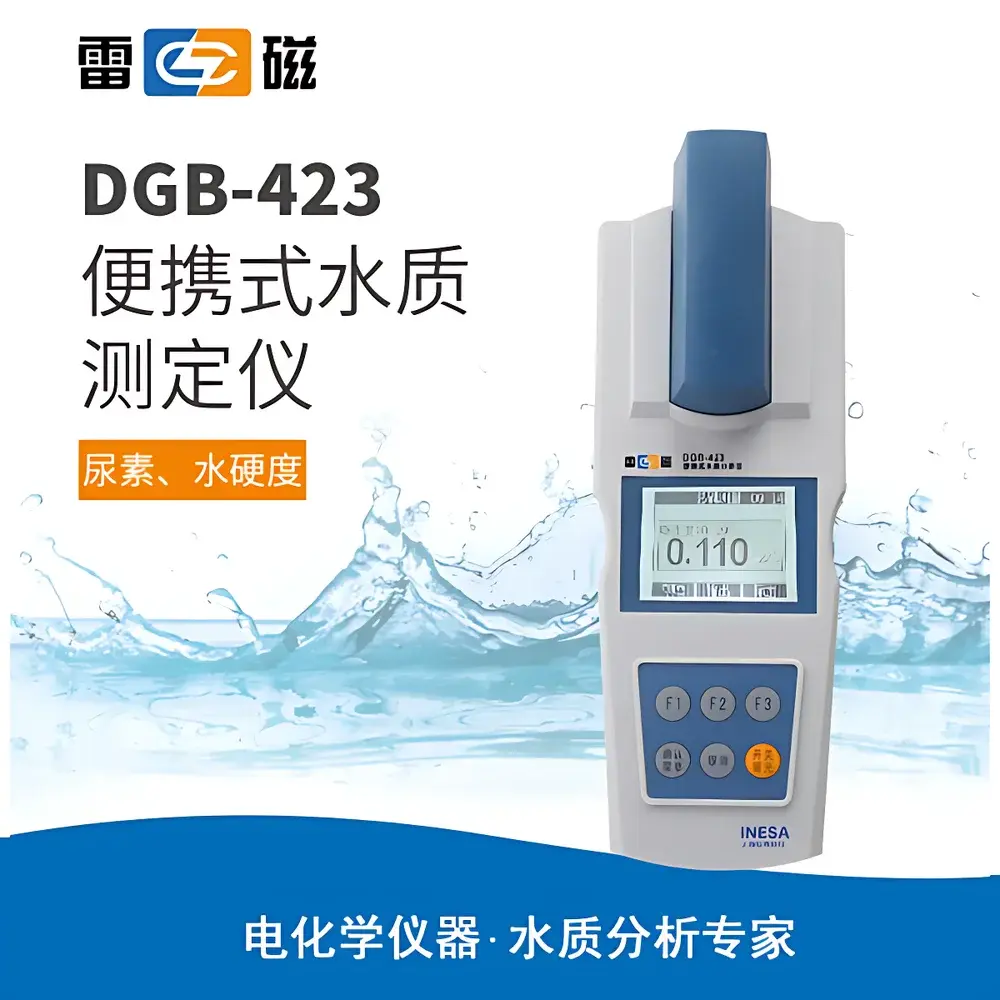
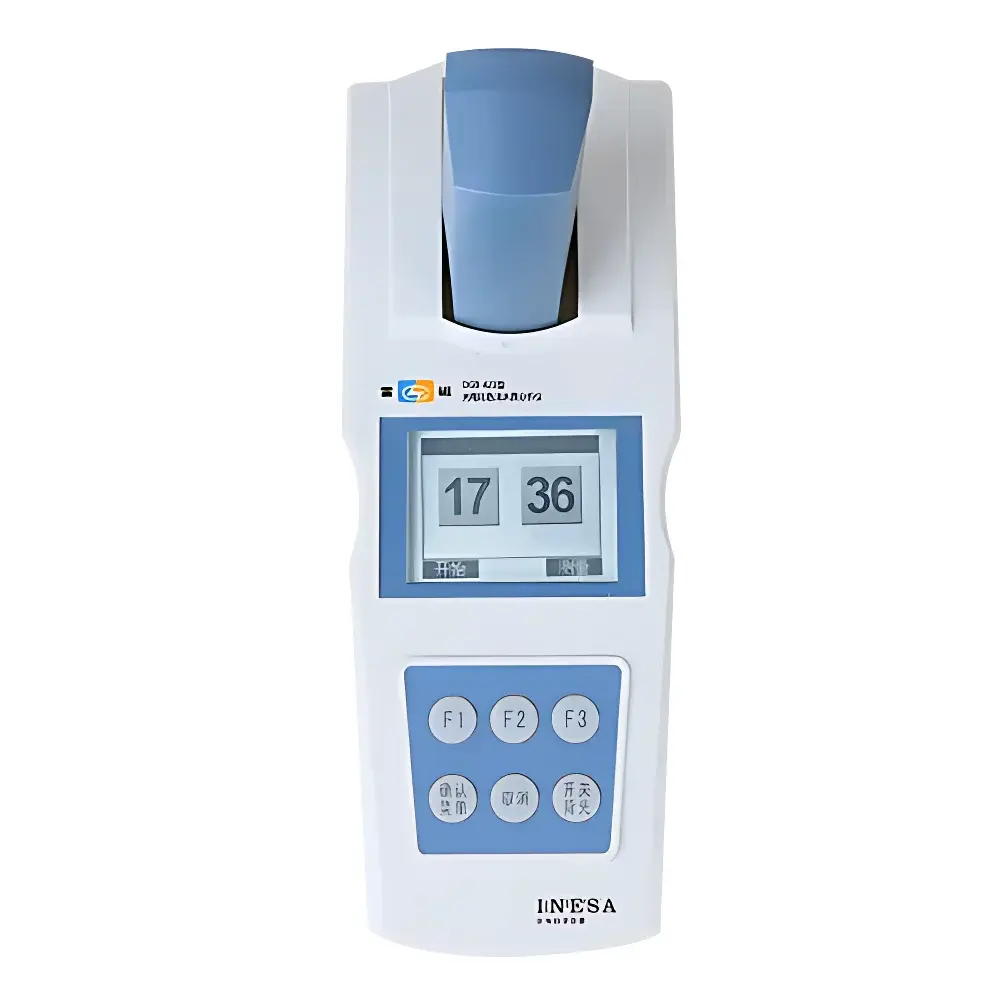
LeiCi DGB-423 Portable Water Quality Analyzer
| Brand | LeiCi |
|---|---|
| Model | DGB-423 |
| Measurement Parameter | Ammonia-Nitrogen (NH₃-N) |
| Method | Nesslerization Spectrophotometry |
| Light Source | 420 nm LED |
| Range | 0.000–4.000 mg/L |
| Accuracy | ±10% FS |
| Repeatability | ≤3% RSD |
| Sample Vessel | 16 mm OD × 100 mm glass cuvette (10 mL) |
| Dimensions | 220 × 85 × 50 mm |
| Weight | 0.4 kg |
| Operating Environment | 5–35 °C, 0–85% RH |
| Power Supply | 4 × AA alkaline batteries or USB 5 V DC |
| Display | Backlit LCD with adjustable contrast and backlight timeout |
| Protection Rating | IP65 |
| Calibration | Up to 5-point user-defined calibration |
| Data Management | GLP-compliant storage, review, deletion, and print export via USB |
| Firmware Upgradeable | Yes |
| Compliance | Supports audit-trail-ready data handling per GLP requirements |
Overview
The LeiCi DGB-423 Portable Water Quality Analyzer is a compact, field-deployable spectrophotometric instrument engineered for rapid, on-site quantification of ammonia-nitrogen (NH₃-N) in diverse aqueous matrices. It operates on the Nesslerization principle—a well-established colorimetric method standardized in ISO 7150-1 and APHA 4500-NH₃—where ammonia reacts with Nessler’s reagent under alkaline conditions to form a yellow-brown colloidal complex. The analyzer employs a stable, narrow-band 420 nm LED light source optimized for peak absorbance detection of this complex, eliminating spectral drift associated with traditional tungsten-halogen lamps. Unlike benchtop spectrophotometers requiring cuvette alignment and external calibration, the DGB-423 integrates factory-loaded calibration curves and uses standardized 10 mL glass cuvettes (16 mm OD × 100 mm) as both reaction vessel and measurement cell—minimizing cross-contamination risk and procedural variability. Its lightweight (0.4 kg), rugged IP65-rated housing, and dual-power architecture (AA batteries or USB 5 V DC) enable uninterrupted operation during extended field campaigns, emergency response deployments, or routine plant-floor QC checks without dependency on AC infrastructure.
Key Features
- LED-based photometric engine with fixed 420 nm emission wavelength ensures long-term optical stability and eliminates warm-up time or lamp replacement cycles.
- Backlit LCD display with user-adjustable contrast and programmable backlight timeout enhances readability under variable ambient lighting—from shaded riverbanks to sunlit industrial rooftops.
- Integrated Nesslerization chemistry support: pre-optimized reagent protocols and built-in curve libraries eliminate manual curve generation while maintaining traceability to certified reference materials.
- Up to five-point user calibration capability enables performance verification across the full 0.000–4.000 mg/L NH₃-N range, supporting compliance with ISO/IEC 17025 method validation requirements.
- GLP-compliant data management: each stored result includes timestamp, operator ID (optional), calibration status, cuvette ID (if logged), and environmental conditions (temperature/humidity)—all exportable via USB to secure laboratory information systems.
- Dual power mode with intelligent low-battery warning and auto-shutdown (configurable timeout) preserves measurement integrity during intermittent use and extends field battery life beyond 20 hours.
- Firmware upgrade path via USB allows future expansion to additional parameters—including total phosphorus, chlorine species, and chemical oxygen demand—without hardware modification.
Sample Compatibility & Compliance
The DGB-423 is validated for direct analysis of untreated or filtered samples from surface water, municipal wastewater effluent, reclaimed water for landscape irrigation, potable water distribution systems, swimming pool recirculation lines, and hospital wastewater streams. Sample turbidity up to 50 NTU does not interfere with NH₃-N quantification when paired with standard filtration (e.g., 0.45 µm membrane). All measurements adhere to the metrological framework defined in ISO/IEC 17025:2017 for testing laboratories, with documented uncertainty budgets covering photometric noise, reagent lot variability, and operator technique. Instrument firmware supports electronic signature capture and audit-trail logging aligned with FDA 21 CFR Part 11 expectations for regulated environments. No regulatory submission documentation is pre-certified; however, the platform provides the technical foundation required for internal validation against US EPA Method 350.1, ISO 7150-1, and China’s HJ 535-2009.
Software & Data Management
Data acquisition and reporting are managed through an embedded real-time operating system with non-volatile memory capable of storing ≥1000 measurement records. Each entry contains: date/time stamp (RTC-backed), parameter ID, measured value, unit, calibration ID, operator code (user-configurable), and environmental metadata. USB connectivity supports direct transfer to Windows/Linux PCs using standard CDC ACM class drivers—no proprietary software installation required. Exported CSV files include column headers compatible with LIMS integration (e.g., LabWare, STARLIMS) and statistical process control (SPC) tools. Firmware updates are delivered as signed binary packages verified at boot to ensure system integrity. All data modification events (delete, overwrite, calibration reset) are immutably logged with timestamps and source identifiers, satisfying GLP requirement 5.2.5 for data traceability and change control.
Applications
- Field verification of ammonia removal efficiency in activated sludge and MBR treatment trains.
- Routine monitoring of influent/effluent compliance at decentralized wastewater facilities lacking lab infrastructure.
- Emergency spill response screening for agricultural runoff or fertilizer transport incidents.
- Swimming pool and spa facility daily NH₃-N checks to assess chloramine formation potential.
- Drinking water utility source water surveillance during algal bloom events.
- Educational laboratory exercises demonstrating colorimetric assay fundamentals and method validation protocols.
FAQ
What sample pretreatment is required prior to analysis?
No centrifugation or distillation is needed. For highly turbid or colored samples (>50 NTU or intense humic staining), optional 0.45 µm membrane filtration is recommended to minimize scattering interference.
Can the instrument be calibrated with user-prepared standards?
Yes—up to five concentration points spanning the 0.000–4.000 mg/L range may be entered manually using traceable NH₄Cl reference solutions certified to ISO Guide 35.
Is the device suitable for regulatory reporting?
It meets technical prerequisites for method use under ISO 7150-1 and APHA 4500-NH₃ but requires site-specific validation per local regulatory authority protocols before submission of compliance data.
How is measurement uncertainty estimated?
The instrument reports repeatability (≤3% RSD) and accuracy (±10% FS) per manufacturer specifications; users must supplement with in-house intermediate precision studies and reagent uncertainty assessments per ISO/IEC 17025 Clause 7.6.
Does the USB interface support real-time data streaming?
No—USB is configured for batch file transfer only. Real-time telemetry requires external IoT gateway integration via analog output (not provided on DGB-423).
Related Products







