
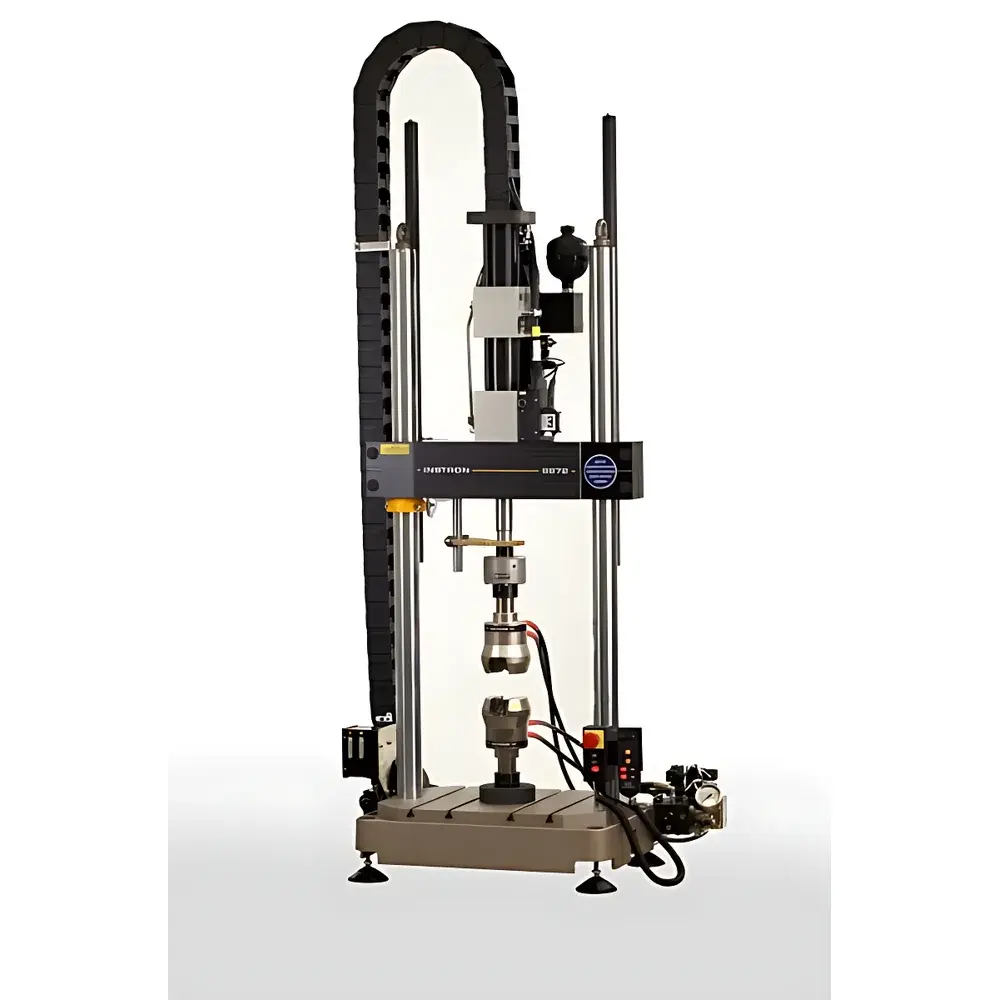
Instron 8872 Electro-Hydraulic Servo Fatigue Testing System
| Brand | Instron |
|---|---|
| Origin | United Kingdom |
| Manufacturer | Instron Corporation |
| Type | Electro-Hydraulic Servo Fatigue Testing Machine |
| Maximum Test Load | ±25 kN |
| Frame Weight | 287 kg |
| Footprint | < 0.4 m² |
| Actuator Stroke | 100 mm |
| Actuator Mounting | Upper Crosshead |
| Frame Configuration | Dual-Column, High-Stiffness, Precision-Aligned |
| Load Cell Technology | Patented Dynacell™ |
| Controller | Instron 8800MT Digital Controller |
| Compatible Power Unit | 3520 Series Hydraulic Power Supply |
| Software Platform | WaveMatrix (dynamic), Bluehill (static), Fracture Mechanics Add-on |
Overview
The Instron 8872 Electro-Hydraulic Servo Fatigue Testing System is a compact, benchtop-scale materials testing platform engineered for high-fidelity static and dynamic mechanical characterization under controlled force, displacement, and strain conditions. Based on closed-loop electro-hydraulic servo control architecture, the system employs a double-acting hydraulic actuator mounted on the upper crosshead—enabling precise application of bidirectional loads up to ±25 kN with sub-millisecond response latency. Its dual-column, high-stiffness frame ensures minimal parasitic bending and axial misalignment, critical for reproducible fatigue life assessment, cyclic tensile/compression testing, and crack growth analysis per ASTM E647, ISO 12106, and ASTM D3479. Designed specifically for laboratories with spatial constraints, the 8872 occupies less than 0.4 m² of floor space while maintaining structural rigidity suitable for biomedical device validation, polymer fatigue screening, metallic component endurance testing, and advanced composite qualification.
Key Features
- Patented Dynacell™ integrated load cell technology delivering high-frequency bandwidth (>2 kHz), low inertia, and minimal phase lag—essential for accurate force feedback in high-cycle fatigue (HCF) and ultrasonic fatigue regimes.
- Hydraulically driven, vertically adjustable crosshead with manual mechanical locking—enabling rapid specimen gage length optimization without recalibration or realignment.
- Static-pressure bearing actuator design offering exceptional resistance to off-axis loading and moment-induced wear—extending service life during torsional-coupled or non-axial test configurations.
- Instron 8800MT digital controller featuring adaptive PID tuning algorithms, amplitude-based waveform control, real-time overload protection, and 19-bit analog-to-digital resolution across full sensor range.
- Modular hardware interface supporting seamless integration of environmental chambers (−70 °C to +350 °C), video extensometers (sub-pixel resolution), wedge-action and pneumatic grips, acoustic emission sensors, and safety interlock systems.
- Compliance with ISO 7500-1 Class 0.5 accuracy requirements for force measurement and ISO 4965 Class 0.5 for displacement transducers—validated through third-party calibration certificates traceable to NPL (UK) standards.
Sample Compatibility & Compliance
The 8872 accommodates specimens ranging from miniature orthopedic implants (e.g., bone screws, stents, suture anchors) to macro-scale aerospace fasteners and elastomeric seals. Its T-slot base facilitates rigid mounting of custom fixtures and multi-axis load trains. The system supports standardized test geometries per ASTM F2118 (fatigue of orthopaedic biomaterials), ISO 5832-3 (titanium alloys), and ISO 1099 (metallic materials—fatigue testing). All controller firmware and software modules comply with FDA 21 CFR Part 11 requirements for electronic records and signatures when configured with audit trail logging, user access controls, and electronic signature workflows. Full GLP/GMP documentation packages—including IQ/OQ/PQ protocols—are available upon request for regulated medical device and pharmaceutical packaging validation.
Software & Data Management
WaveMatrix 3 dynamic test software provides intuitive waveform definition (sine, trapezoidal, block, random spectrum), real-time FFT spectral monitoring, cycle counting (Rainflow, Level Crossing), and automated pass/fail criteria based on hysteresis loop area, stiffness degradation, or peak load drift. Bluehill Universal serves as the unified static test interface—supporting ISO 6892-1 tensile protocols, creep rupture analysis, and modulus determination via tangent or secant methods. Both platforms generate timestamped, XML-structured data files compliant with ASTM E1434 and ISO/IEC 17025 reporting requirements. Raw channel data (load, displacement, strain, temperature) is archived at user-selectable sampling rates up to 10 kHz, with metadata embedding for full traceability—including operator ID, calibration certificate IDs, environmental chamber setpoints, and power unit oil temperature logs.
Applications
- Fatigue life prediction of cardiovascular stents under pulsatile loading profiles simulating physiological heart rates (1–2 Hz).
- Cyclic compression testing of hydrogels and soft tissue scaffolds per ISO 13314 for viscoelastic recovery and permanent set evaluation.
- High-cycle fatigue characterization of additively manufactured Ti-6Al-4V lattice structures used in load-bearing implants.
- Dynamic tensile testing of thermoplastic polyurethane (TPU) films for wearable electronics encapsulation integrity.
- Fracture mechanics testing (da/dN vs. ΔK) using compact tension (CT) and single-edge notched bend (SENB) specimens under R-ratio control.
- Creep-fatigue interaction studies on nickel-based superalloys for turbine blade applications under combined thermal-mechanical loading.
FAQ
What is the maximum recommended test frequency for the 8872 at full ±25 kN load amplitude?
The system achieves stable sinusoidal control up to 100 Hz at reduced load amplitudes (±5 kN); at full scale, optimal performance is maintained up to 25 Hz with proper hydraulic power unit sizing (e.g., 3520-10HP configuration) and oil temperature stabilization.
Can the 8872 be upgraded to support closed-loop strain control using an external extensometer?
Yes—the 8800MT controller accepts analog inputs from LVDTs, clip-on extensometers, and digital video extensometers; strain-controlled tests are fully supported with automatic gauge length compensation and zero-drift correction algorithms.
Is the Dynacell™ load cell calibrated separately from the actuator assembly?
Each Dynacell™ is factory-calibrated as a complete transducer-integrated actuator module, with individual NIST-traceable calibration certificates provided. Field recalibration requires only the load cell—not the entire actuator head.
Does the system meet ISO 14971 risk management requirements for medical device testing?
While the 8872 itself is not a medical device, its hardware architecture, software validation documentation, and compliance with IEC 62304 (for embedded controller firmware) and ISO 13485-aligned manufacturing processes enable direct integration into risk-managed test protocols per ISO 14971 Annex C.



