
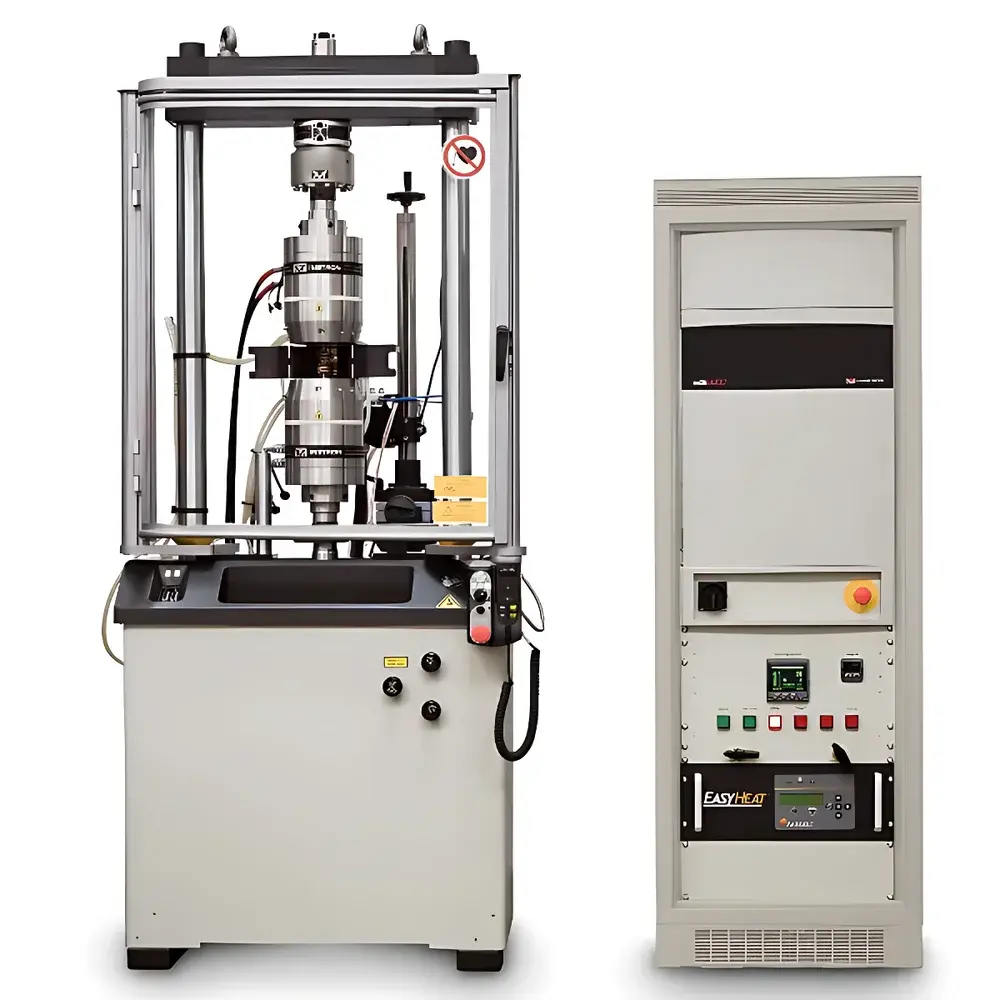
Instron TMF Series Thermal-Mechanical Fatigue Testing System
| Brand | Instron |
|---|---|
| Origin | United Kingdom |
| Manufacturer Type | Original Equipment Manufacturer (OEM) |
| Product Category | Imported Instrument |
| Model | TMF |
| Instrument Type | Thermal-Mechanical Fatigue Tester |
| Compliance Standards | ASTM E2368, ISO 12111 |
Overview
The Instron TMF Series Thermal-Mechanical Fatigue Testing System is an integrated, high-precision platform engineered for the simultaneous application of controlled mechanical strain/stress and cyclic thermal loading to metallic and advanced alloy specimens. It operates on the principle of coupled thermomechanical cycling—where temperature gradients are induced via high-frequency induction heating while axial load or displacement is precisely applied through a servo-controlled actuator. This dual-domain control enables replication of real-world service conditions experienced by critical components in gas turbine engines, aerospace hot-section parts, and power-generation systems—environments characterized by out-of-phase thermal and mechanical loads, dwell periods, and complex waveform profiles. Unlike conventional fatigue testers, the TMF system incorporates synchronized thermal management, dynamic load fidelity, and metrologically traceable strain measurement under elevated temperatures—ensuring physical relevance and experimental rigor across research, qualification, and regulatory testing workflows.
Key Features
- Multicoil induction head with independent coil zoning for precise axial and radial temperature gradient control—enabling uniform heating and programmable thermal profiles up to 1100 °C (dependent on specimen geometry and atmosphere)
- Side-insertion high-temperature extensometers (5 mm, 12.5 mm, and 25 mm gauge lengths) mounted on rigid, repeatable brackets; designed for minimal contact force and sub-micron resolution at temperatures exceeding 800 °C
- Modular cooling architecture: external air-jet shroud with multi-directional nozzles for turbulent convective cooling; internal air-cooling clamps for tubular specimens—both engineered to suppress thermal transients without introducing signal noise into extensometer output
- 8862 electromechanical test frame with low-speed precision servo actuation (0.0001–50 mm/min), eliminating hydraulic infrastructure while maintaining ±0.5% load accuracy and <0.1% strain linearity over full stroke
- Adjustable induction coil alignment stage with dual-axis micrometer-driven positioning—ensuring optimal electromagnetic coupling and reproducible thermal response across sequential tests
Sample Compatibility & Compliance
The TMF system accommodates standard cylindrical, notched, and hollow tubular specimens per ASTM E2368 Annex A1 and ISO 12111 Clause 7. Specimen geometries range from 2.5 mm to 12.7 mm diameter, with optional custom fixtures for non-standard configurations. All thermal and mechanical boundary conditions—including heating rate (up to 100 °C/s), cooling rate (up to 50 °C/s), dwell duration (0.1 s to 24 h), and phase offset between thermal and mechanical cycles—are programmable and auditable. The system supports GLP/GMP-aligned data integrity protocols, including electronic signatures, audit trails, and 21 CFR Part 11–compliant user access controls when configured with optional validation packages. Calibration certificates for load cells, extensometers, and thermocouples are traceable to NPL (UK) and NIST standards.
Software & Data Management
Instron’s dedicated TMF software provides a unified interface for method definition, real-time execution monitoring, and post-test analysis—all within a single validated environment. It automates the four-phase TMF cycle: (1) ramp-to-temperature, (2) thermal dwell, (3) mechanical loading/unloading, and (4) synchronized cooldown—without requiring manual intervention or third-party scripting. Built-in modules include dynamic modulus calculation (storage/loss modulus), automatic specimen parameter derivation (cross-sectional area, gauge length), waveform visualization (strain vs. temperature, stress vs. time), and export-ready ASCII/CSV outputs compatible with MATLAB, Python, and commercial FE postprocessors. Recent enhancements include DCPD (Direct Current Potential Drop) integration for crack growth monitoring in notched specimens, digital I/O triggering for high-speed imaging systems, and extended dwell capability for creep-dominated materials.
Applications
This system is routinely deployed in materials development laboratories, OEM engineering centers, and independent certification bodies for: accelerated life modeling of Ni-based superalloys (e.g., IN718, RR1000); evaluation of thermal barrier coating (TBC) interfacial durability; qualification of additive-manufactured components subjected to thermal cycling; and validation of constitutive models used in thermoelastic-plastic finite element simulations. Its ability to replicate in-phase, out-of-phase, and isothermal fatigue regimes—combined with strict adherence to ASTM and ISO test protocols—makes it suitable for generating data referenced in FAA Advisory Circular AC 33.15 and EASA CS-E requirements.
FAQ
What temperature range does the TMF system support?
Standard operation spans ambient to 1100 °C using Type S thermocouples; extended-range configurations (to 1300 °C) are available with customized coil design and inert atmosphere control.
Can the system perform both strain-controlled and stress-controlled TMF tests?
Yes—dual-control modes are fully supported, with closed-loop feedback from extensometers or load cells, enabling seamless transitions between control variables during a single test sequence.
Is the software compliant with FDA 21 CFR Part 11?
When deployed with Instron’s Validation Services Package (VSP), the TMF software meets 21 CFR Part 11 requirements for electronic records and signatures—including role-based access, audit trail generation, and secure electronic signature capture.
How is thermal uniformity verified across the gauge length?
Using embedded thermocouple arrays and infrared pyrometry calibration; Instron provides a documented thermal mapping procedure aligned with ASTM E220 for furnace uniformity assessment.
Does the system support vacuum or controlled-atmosphere testing?
Yes—integrated chamber options include inert gas purging (Ar/N₂), low-pressure vacuum (<10⁻² mbar), and reactive gas environments (e.g., O₂-doped air) with leak-tight sealing and pressure regulation.
Related Products



