
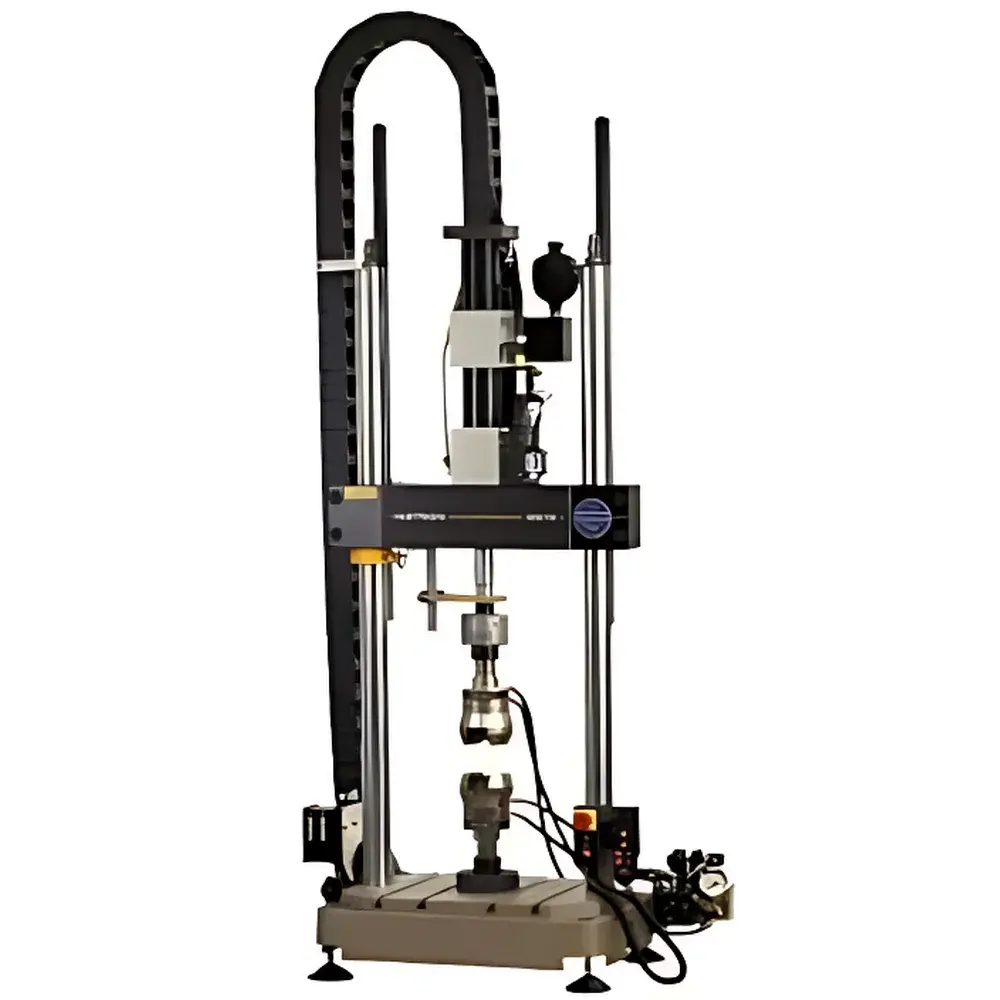
Instron 8800 Series Electromechanical-Hydraulic Servo Fatigue Testing Systems
| Brand | Instron |
|---|---|
| Origin | USA |
| Manufacturer Type | Original Equipment Manufacturer (OEM) |
| Origin Category | Imported |
| Models | 8871, 8872, 8874, 8801 |
| Pricing | Available Upon Request |
Overview
The Instron 8800 Series electromechanical-hydraulic servo fatigue testing systems are precision-engineered platforms designed for high-fidelity dynamic mechanical characterization of advanced materials and components under controlled cyclic loading conditions. These systems operate on a hybrid actuation principle—combining high-bandwidth electrohydraulic servo control with robust mechanical frame architecture—to deliver exceptional force linearity, phase accuracy, and waveform fidelity across low-cycle fatigue (LCF), high-cycle fatigue (HCF), crack propagation (ΔK-controlled), and fracture toughness (KIc, J-integral) test regimes. Unlike purely electromechanical or high-frequency resonant systems, the 8800 platform maintains stable force control down to 0.01 Hz and up to 100 Hz (depending on configuration and specimen stiffness), enabling seamless transition between quasi-static and fully dynamic test protocols within a single hardware environment. All models integrate Instron’s proprietary inertial compensation algorithm in the dynamic load cell firmware, correcting for acceleration-induced force artifacts in real time—critical for maintaining measurement integrity during rapid load reversals or high-frequency sinusoidal waveforms.
Key Features
- Modular hydraulic power unit (HPU) architecture with scalable flow capacity (up to 30 L/min), supporting both benchtop (8871/8872) and floor-standing (8801) configurations
- Dual-range dynamic load cells with integrated inertial compensation: ±25 kN (8871/8872/8874) and ±100 kN (8801), traceable to NIST standards
- 8800 Digital Controller featuring 10 kHz closed-loop update rate, 24-bit ADC resolution, and deterministic real-time OS for sub-millisecond command-response latency
- Torsional capability (8874 model): ±100 N·m torque output synchronized with axial load, enabling coupled tension-torsion fatigue studies per ASTM E2207 and ISO 1352
- Integrated environmental compatibility: direct coupling with Instron’s 3119-600 series furnaces (−150 °C to +1700 °C), cryogenic chambers, and corrosion test enclosures
- Hardware-level safety interlocks including over-travel limit switches, pressure relief valves, and emergency stop circuitry compliant with ISO 13850 and IEC 61508 SIL2
Sample Compatibility & Compliance
The 8800 Series accommodates standardized specimens per ASTM E606 (strain-controlled LCF), ASTM E466 (force-controlled HCF), ASTM E647 (crack growth rate), and ISO 12106 (fatigue testing of metallic materials). Specimen geometries include compact tension (CT), middle-crack tension (M(T)), and round-bar smooth/notched configurations. The system supports extensometer integration (e.g., 2630 series clip-on or non-contact video extensometers) for strain measurement per ASTM E83 Class B-2 compliance. All controller firmware and software modules adhere to FDA 21 CFR Part 11 requirements for electronic records and signatures, including full audit trail logging, user access controls, and data integrity validation reports required for GLP/GMP-regulated laboratories.
Software & Data Management
WaveMatrix™ 3 dynamic test software serves as the core execution environment, offering preconfigured test methods for ASTM/ISO-compliant fatigue protocols, real-time FFT spectral analysis, and automated cycle counting via rainflow algorithm (ASTM E1049). Optional application-specific modules—including LCF3 for strain-controlled life prediction, Fracture Mechanics Suite (FMS) for da/dN vs. ΔK plotting, and Spectrum Analysis Toolkit for variable-amplitude loading—extend analytical depth without requiring third-party post-processing. Data export is native to HDF5 and ASCII formats; metadata embedding follows ISA-Tab conventions. Integration with Bluehill Universal enables unified static-dynamic workflow management, allowing users to define multi-step tests combining tensile preconditioning, hold periods, and subsequent fatigue cycling—all under a single method file with synchronized data timestamping.
Applications
These systems are routinely deployed in aerospace R&D labs for turbine disk material qualification (e.g., Ti-6Al-4V, Inconel 718), biomedical device validation (orthopedic implant fatigue per ISO 14801), additive manufacturing process development (LPBF AlSi10Mg fatigue anisotropy mapping), and nuclear component life assessment (zirconium alloy crack growth under simulated PWR coolant conditions). Their ability to maintain precise load/strain control across wide frequency ranges makes them suitable for viscoelastic polymer fatigue (e.g., polyetheretherketone under thermomechanical cycling), solder joint reliability testing (JEDEC JESD22-B111), and microelectromechanical systems (MEMS) structural durability evaluation.
FAQ
What distinguishes the 8874 from other models in the 8800 Series?
The 8874 is a table-model biaxial system engineered for combined axial-torsional fatigue testing, delivering ±25 kN axial force and ±100 N·m torque with phase synchronization accuracy better than ±0.5°.
Is the 8800 controller compatible with third-party sensors or environmental chambers?
Yes—the controller features open analog/digital I/O ports and supports IEEE 1451.4 TEDS sensor auto-recognition, enabling plug-and-play integration with calibrated transducers from major suppliers and OEM environmental chambers.
Can WaveMatrix software generate ISO 12106-compliant fatigue life S-N curves directly?
Yes—WaveMatrix includes automated S-N curve fitting per ISO 12106 Annex A, with Weibull distribution analysis, confidence interval calculation, and export-ready graphical templates aligned with ASTM E739 reporting guidelines.
Does the system support remote operation and monitoring in regulated environments?
Yes—via Instron Connect secure cloud gateway, enabling validated remote access with TLS 1.2 encryption, session logging, and role-based permissions consistent with 21 CFR Part 11 Subpart B requirements.



