
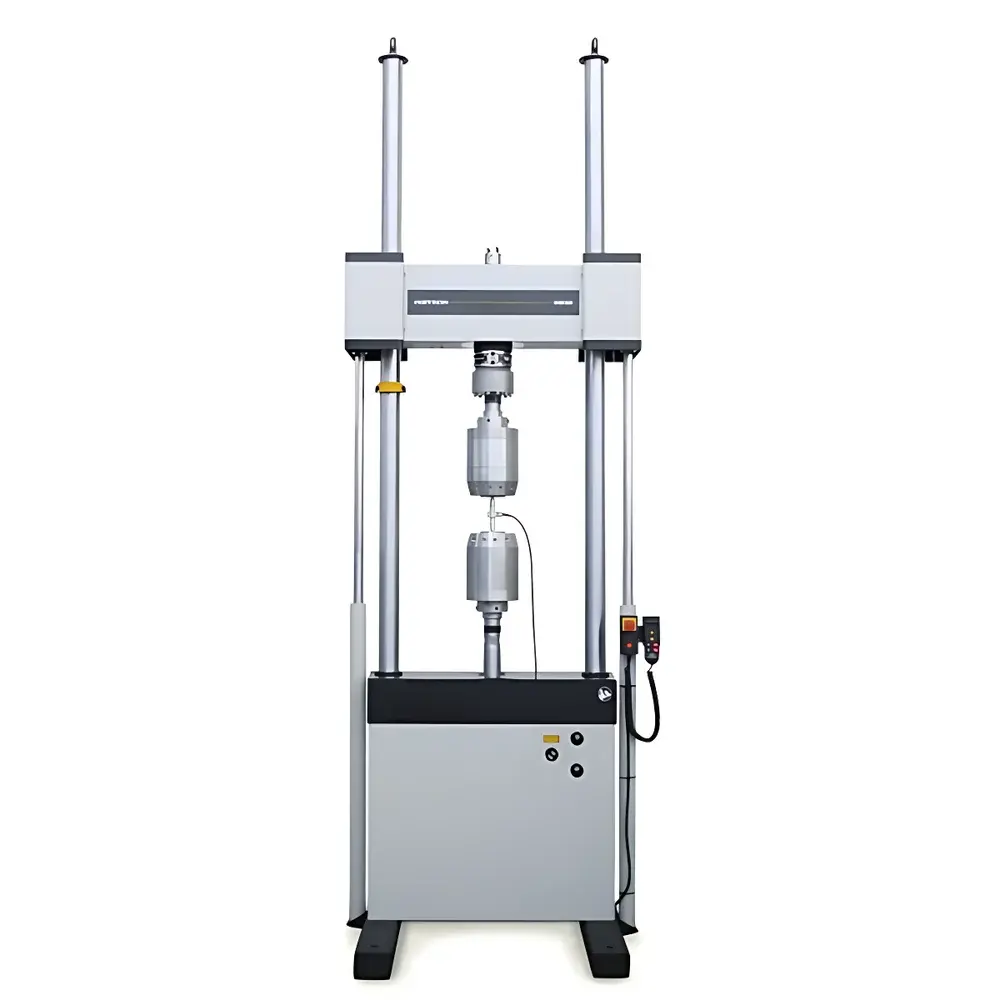
Instron 8802 Electro-Hydraulic Servo Fatigue Testing System
| Brand | Instron |
|---|---|
| Origin | United Kingdom |
| Manufacturer | Instron (UK) Ltd. |
| Type | Electro-Hydraulic Servo Fatigue Testing Machine |
| Maximum Test Load | ±250 kN |
| Frame Weight | 1330 kg |
| Footprint | < 1.2 m² |
| Stroke | 150 mm |
| Actuator Type | Dual-acting servo-hydraulic cylinder with hydrostatic bearings |
| Load Cell Technology | Dynacell™ |
| Controller | Instron 8800MT Digital Controller |
| Software Platform | WaveMatrix™ (dynamic), Bluehill® (quasi-static), LCF & Fracture Mechanics Add-ons |
| Compliance | ASTM E4, E8, E606, E647, ISO 1099, ISO 6892-1, USP <1089>, FDA 21 CFR Part 11 (with audit trail enabled) |
Overview
The Instron 8802 Electro-Hydraulic Servo Fatigue Testing System is a high-stiffness, dual-column, floor-standing test frame engineered for precision-controlled static, cyclic, and fatigue testing of metallic alloys, composites, polymers, and structural components. Based on proven Couette-flow hydraulic actuation and closed-loop servo control architecture, the system delivers traceable force application with minimal phase lag and high waveform fidelity—critical for low-cycle fatigue (LCF), high-cycle fatigue (HCF), crack growth rate (da/dN), and R-curve characterization per ASTM E647 and ISO 1099. Its compact footprint (<1.2 m²) and modular design eliminate requirements for reinforced foundations or elevated ceiling clearance, enabling rapid deployment in standard laboratory environments without structural retrofitting.
Key Features
- Dual-acting electro-hydraulic servo actuator rated for ±250 kN (±56 kip) peak load, incorporating hydrostatic bearing technology to suppress lateral deflection and maintain axial alignment under high side-load conditions—essential for LCF tests with large plastic strains.
- Rigid, precision-aligned twin-column frame with integrated crosshead adjustment: hydraulic-assisted vertical positioning and mechanical locking ensure repeatable gage length setup across test configurations.
- 150 mm (6 in) stroke capacity optimized for both high-frequency dynamic waveforms (up to 100 Hz with appropriate hydraulic power unit) and quasi-static monotonic loading protocols.
- Dynacell™ integrated load cell technology provides real-time force measurement with reduced inertial error, enhanced signal-to-noise ratio, and minimized thermal drift—enabling reliable data acquisition even during rapid load reversals.
- Patented stiffness-based auto-tuning algorithm within the 8800MT controller reduces PID parameter optimization time by up to 70% compared to manual tuning, improving throughput for multi-specimen test campaigns.
- Full compatibility with Instron’s 3520-series hydraulic power units (HPUs), including variable-displacement pump configurations for energy-efficient operation at partial-load conditions.
Sample Compatibility & Compliance
The 8802 accommodates specimens ranging from miniature notched coupons (per ASTM E606) to full-scale welded joints and aerospace fasteners. Standard mounting interfaces support tensile, compression, bending, and torsional fixtures—including wedge-grip, hydraulic grip, and pin-bearing assemblies. Optional environmental chambers (−70 °C to +350 °C), video extensometers (with sub-pixel resolution), and acoustic emission sensors extend applicability to thermomechanical fatigue (TMF) and damage evolution studies. The system meets mechanical calibration and verification requirements per ASTM E4 and ISO 7500-1, and supports GLP/GMP-compliant workflows when configured with Bluehill® software featuring 21 CFR Part 11 audit trails, electronic signatures, and role-based access control.
Software & Data Management
Control and analysis are unified through Instron’s 8800MT digital controller, offering 19-bit analog-to-digital resolution across all sensor channels and adaptive control algorithms that dynamically adjust gain and filtering based on specimen stiffness and loading rate. WaveMatrix™ software enables advanced waveform generation (sine, triangle, trapezoidal, block, random), harmonic analysis, and cycle counting per ASTM E1049. Bluehill® 3 provides intuitive test method definition, real-time curve overlay, and automated report generation compliant with ISO/IEC 17025 documentation standards. Dedicated add-on modules—such as the Low-Cycle Fatigue Toolkit and Fracture Mechanics Package—include preconfigured test sequences for ΔK-controlled crack growth, J-integral evaluation, and R-ratio modulation.
Applications
The 8802 serves as a core platform for materials qualification in aerospace (e.g., turbine disk alloys per AMS 2304), automotive (powertrain component endurance validation), biomedical (orthopedic implant fatigue per ISO 14801), and energy sectors (wind turbine blade root joint testing). It is routinely deployed for generating S–N curves, determining fatigue limit thresholds, evaluating mean stress effects via Goodman diagrams, and performing spectrum loading simulations replicating field service histories. Its robust architecture supports long-duration tests exceeding 10⁷ cycles with continuous data logging, metadata tagging, and seamless integration into enterprise LIMS or PLM systems via OPC UA or RESTful API.
FAQ
What is the maximum achievable frequency at full ±250 kN load amplitude?
Maximum closed-loop frequency depends on hydraulic power unit selection and specimen stiffness; with a 3520-10 HPU and typical steel specimens, stable operation up to 50 Hz is attainable.
Can the 8802 perform push-pull testing on threaded fasteners?
Yes—using Instron’s dedicated fastener test fixtures and preload control routines in Bluehill®, the system supports ISO 898-1 and ASTM F606 compliant bolt fatigue testing.
Is third-party calibration certification included with delivery?
Factory calibration per ISO 7500-1 is provided; NIST-traceable certificates and on-site verification services are available as optional add-ons.
Does the system support real-time strain control using extensometry?
Yes—via analog or digital inputs from contacting or non-contacting extensometers, the 8800MT controller executes closed-loop strain control with user-defined ramp rates and hold periods.
How is data integrity ensured during extended unattended tests?
All test data are written redundantly to internal SSD and external network storage; automatic recovery resumes interrupted tests from last valid checkpoint upon power restoration.



