
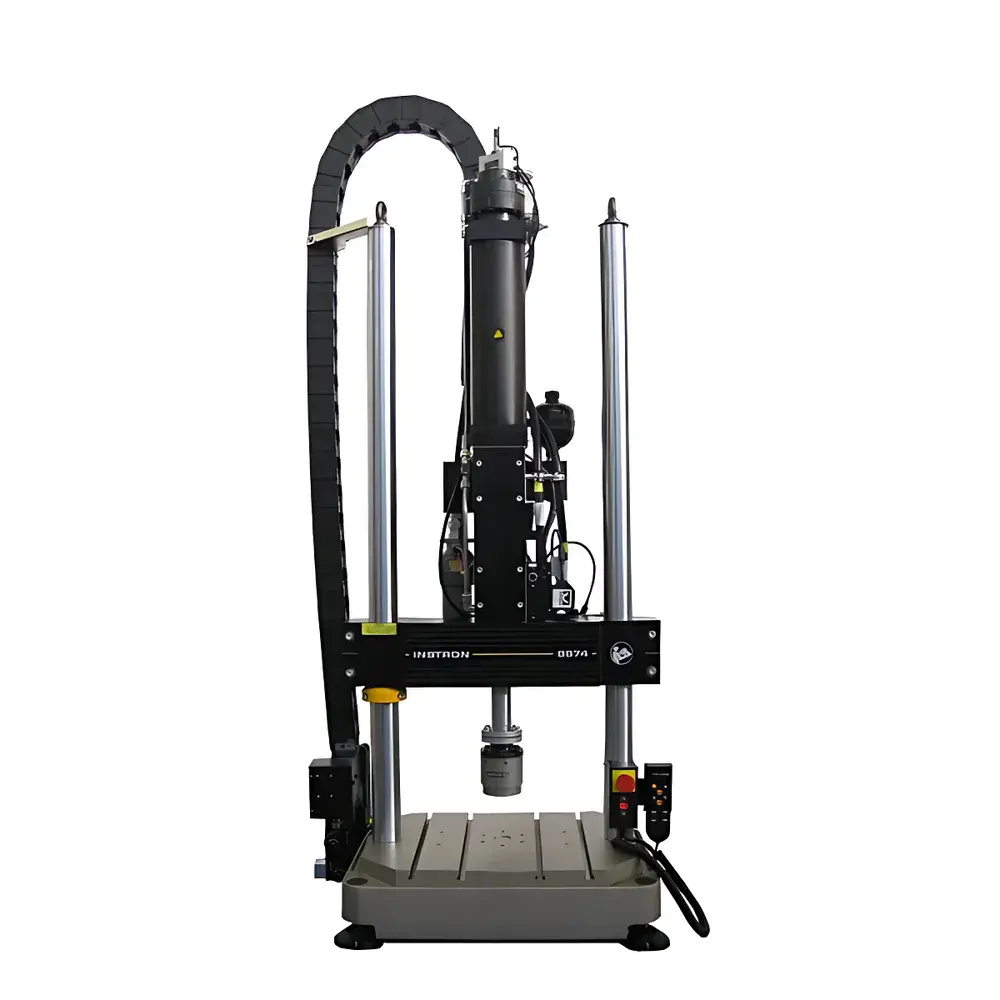
Instron 8874 Axial-Torsional Electro-Hydraulic Servo Fatigue Testing System
| Brand | Instron |
|---|---|
| Origin | United Kingdom |
| Manufacturer | Instron (UK) Ltd. |
| Type | Electro-hydraulic servo fatigue testing system |
| Model | 8874 |
| Maximum axial force | ±25 kN |
| Maximum torque | ±100 N·m |
| Axial stroke | 100 mm |
| Torsional range | ±130° |
| Frame stiffness | High-rigidity dual-column architecture |
| Footprint | < 0.4 m² |
| Frame weight | 287 kg |
| Controller | 8800MT dual-axis digital controller with 19-bit resolution |
| Load cell technology | Patented Dynacell™ integrated load cell |
| Actuator location | Upper crosshead-mounted bidirectional servo actuator |
| Crosshead adjustment | Hydraulic lift + manual locking |
| Compatible power unit | 3520 Series hydraulic power supply |
Overview
The Instron 8874 Axial-Torsional Electro-Hydraulic Servo Fatigue Testing System is a compact, high-precision benchtop platform engineered for multi-axial mechanical characterization under static, cyclic, and complex loading conditions. Based on proven electro-hydraulic servo actuation principles, the 8874 integrates coaxial axial and torsional actuation within a single, rigid dual-column frame—enabling true coupled loading states that replicate real-world service conditions in orthopedic implants, cardiovascular stents, composite laminates, and advanced metallic alloys. Its upper-mounted bidirectional actuator delivers synchronized control of both axial force (±25 kN) and torsional moment (±100 N·m), while the patented Dynacell™ load cell architecture embeds force and torque sensing directly at the actuator interface—minimizing inertial lag, eliminating parasitic bending moments, and ensuring traceable, high-fidelity data acquisition across wide frequency ranges (DC to ≥100 Hz, depending on specimen dynamics and hydraulic supply configuration). Designed for laboratory integration rather than floor-standing deployment, the system occupies less than 0.4 m²—making it suitable for controlled environments including ISO Class 7 cleanrooms and regulated biomedical test labs.
Key Features
- High-rigidity dual-column frame with precision-aligned actuator mounting—ensures minimal frame compliance and optimal load train alignment per ASTM E4 and ISO 7500-1 requirements
- Upper crosshead-mounted bidirectional electro-hydraulic servo actuator with integrated Dynacell™ load cell—provides simultaneous axial and torsional control with sub-millisecond response time
- 100 mm effective axial stroke and ±130° continuous torsional rotation—supports full-cycle fatigue testing of flexible components and rotating assemblies
- Hydraulically assisted crosshead positioning with manual mechanical lock—enables rapid, repeatable gage length setup without recalibration
- 8800MT dual-axis digital controller featuring adaptive PID tuning, amplitude-based waveform control, and real-time specimen protection algorithms
- 19-bit analog-to-digital resolution across full sensor range—ensuring high dynamic range and low-noise signal fidelity for low-amplitude fatigue studies
- Modular compatibility with environmental chambers (−70 °C to +300 °C), video extensometry systems (e.g., Bluehill® DIC), custom fixtures, and safety enclosures meeting ANSI B11.19 and IEC 60204-1 standards
Sample Compatibility & Compliance
The 8874 accommodates specimens ranging from miniature biomaterial coupons (e.g., 2 mm diameter polymer rods per ISO 5832-6) to larger structural components such as spinal fusion cages or turbine blade root sections. Fixture interfaces conform to ISO 26203-2 and ASTM F2118 for orthopedic implant testing, while torque transmission hardware meets ISO 14801 requirements for dental implant abutment fatigue evaluation. All controller firmware and software modules support audit trail logging, electronic signature workflows, and data integrity features aligned with FDA 21 CFR Part 11 and EU Annex 11 expectations. System validation documentation—including IQ/OQ protocols, metrological traceability certificates (NPL/UKAS-accredited), and mechanical verification reports per ISO 7500-1 Class 0.5—is available upon request for GMP/GLP-regulated applications.
Software & Data Management
The 8874 operates natively with Instron’s WaveMatrix™ 3 dynamic testing software—supporting user-defined multiaxial waveforms (e.g., out-of-phase sine, block loading, spectrum fatigue), real-time FFT analysis, and hysteresis loop tracking. For static and quasi-static protocols, Bluehill® Universal provides intuitive method scripting, automatic compliance correction, and export-ready reporting compliant with ASTM E8/E9/E21 formats. Optional modules include Fracture Mechanics Suite (for J-integral and ΔK calculations per ASTM E1820/E647), Strain-Controlled Low-Cycle Fatigue (LCF) templates, and MATLAB®/Python API integration via Instron’s OpenLab SDK. All acquired data are stored in vendor-neutral HDF5 format with embedded metadata (test parameters, calibration IDs, environmental conditions), enabling long-term archival and third-party analytics interoperability.
Applications
- Fatigue life assessment of nitinol cardiovascular stents under pulsatile torsion-axial coupling per ISO 25539-2
- Cyclic torsional stability testing of orthopedic bone screws and intramedullary nails (ASTM F1712)
- Multiaxial creep-fatigue interaction studies in thermoplastic polyimides and carbon-fiber-reinforced PEEK
- Dynamic shear modulus and damping characterization of viscoelastic biomaterial hydrogels
- High-cycle fatigue screening of additively manufactured Ti-6Al-4V lattice structures under combined loading
- Validation of finite element models for implant-bone interface stress transfer using experimentally derived boundary conditions
FAQ
What hydraulic power unit is required to operate the 8874?
The 8874 is designed for integration with Instron’s 3520 Series hydraulic power supplies—available in 10 L/min and 20 L/min configurations—selected based on desired maximum frequency, stroke rate, and number of simultaneously controlled axes.
Can the system perform true proportional axial-torsional loading (e.g., constant phase angle)?
Yes—the 8800MT controller supports fully programmable multiaxial waveform generation, including synchronized sine waves with adjustable phase offset, elliptical trajectories, and custom time-history inputs.
Is the Dynacell™ load cell calibrated separately from the actuator?
No—Dynacell™ is a monolithic, factory-integrated transducer; its calibration certificate covers combined axial/torsional sensitivity, cross-talk error (<0.2% FS), and thermal drift performance over the rated operating temperature range.
Does the system meet ISO 17025 requirements for accredited testing laboratories?
When deployed with documented calibration procedures, uncertainty budgets, and validated test methods, the 8874 platform satisfies technical competence criteria outlined in ISO/IEC 17025:2017 Clause 6.4 (Equipment) and Clause 7.2 (Method Validation).



