
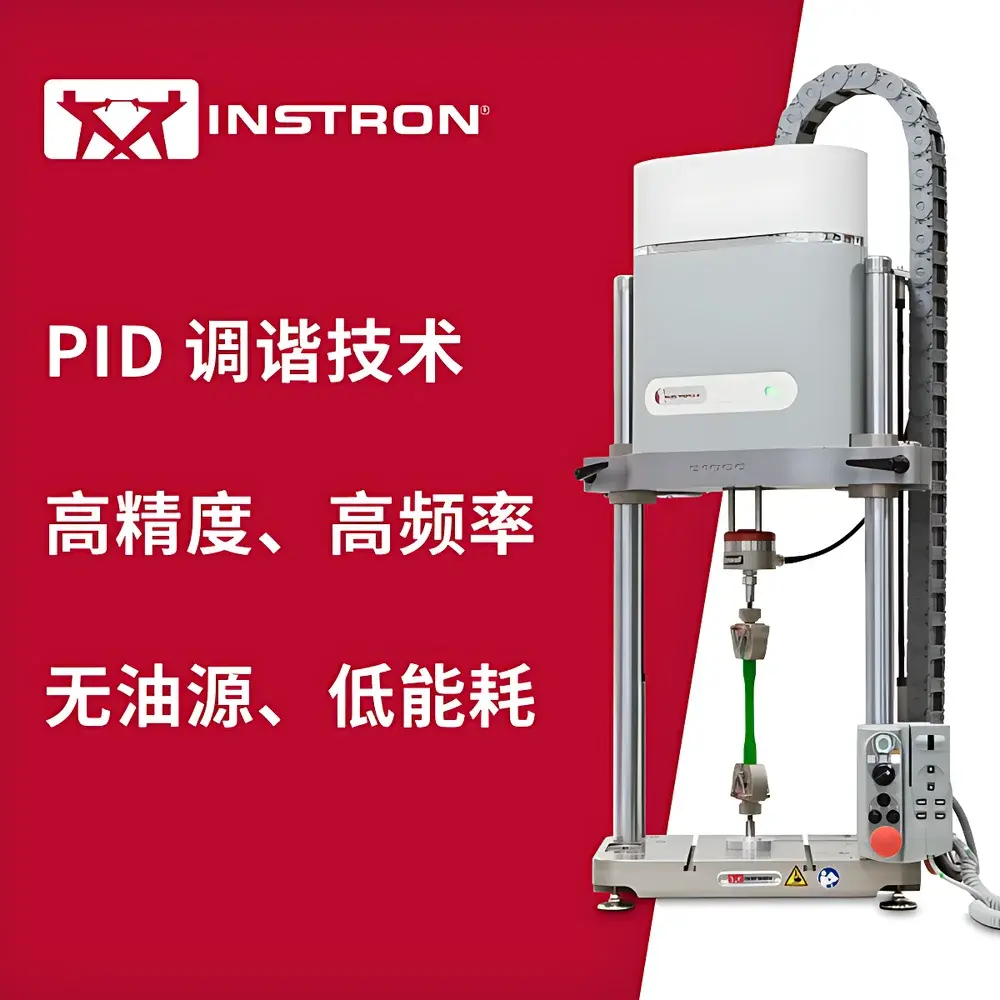
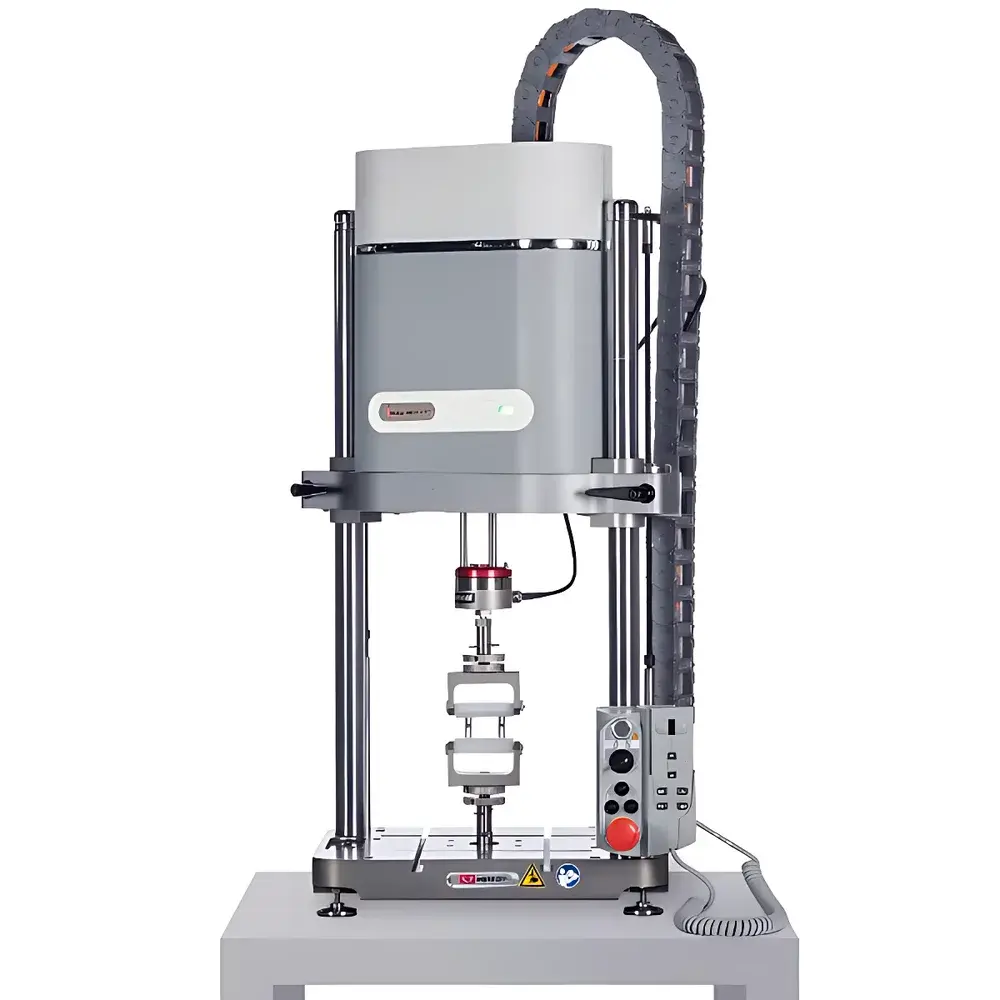
Instron ElectroPuls® E1000 All-Electric Dynamic and Static Fatigue Testing System
| Brand | Instron |
|---|---|
| Origin | United Kingdom |
| Manufacturer Type | Original Equipment Manufacturer (OEM) |
| Origin Category | Imported |
| Model | E1000 |
| Quotation | Upon Request |
| Instrument Type | Electromechanical Fatigue Testing System |
| Frequency Range | Up to 100 Hz |
| Frame Weight | 92 kg |
Overview
The Instron ElectroPuls® E1000 is a high-performance, all-electric dynamic and static fatigue testing system engineered for precision mechanical characterization of materials and components under cyclic loading conditions. Unlike hydraulic or servo-pneumatic systems, the E1000 employs a patented linear motor actuation architecture—eliminating hydraulic fluids, compressed air, and external cooling circuits. This design enables clean-room compatibility, reduced maintenance overhead, and inherently stable force control across both static tensile/compression tests and high-frequency fatigue regimes. Its core measurement principle relies on closed-loop digital control of displacement, load, and strain, synchronized via high-resolution optical encoders and Instron’s proprietary Dynacell™ dynamic load cell technology. The system operates within a rigid dual-column frame with optimized stiffness-to-mass ratio, ensuring minimal frame compliance and high signal fidelity during low-amplitude, high-cycle fatigue (HCF) or thermomechanically coupled tests.
Key Features
- All-electric actuation using a high-bandwidth linear motor—no hydraulic oil, pneumatic supply, or external chiller required
- Dynacell™ dynamic load cell with integrated signal conditioning for real-time force feedback and minimized inertial error
- Stiffness-based tuning algorithm for automatic compensation of system compliance, enhancing test repeatability across varying specimen geometries and fixture configurations
- Electrically driven crosshead with manual locking handle and position memory—enabling rapid, repeatable test space adjustment
- Optical encoder–based displacement measurement with dedicated positioning channel for specimen alignment and end-of-test detection
- Compact footprint: frame occupies < 0.15 m² (1.6 ft²) of benchtop space—ideal for space-constrained laboratories and shared instrumentation facilities
- Integrated status LED panel indicating operational state (Standby, Running, Emergency Stop, Fault)
- T-slot base platform supporting modular fixture integration—including custom jigs, environmental chambers, liquid baths, and video extensometry systems
Sample Compatibility & Compliance
The E1000 accommodates specimens ranging from miniature biomedical implants (e.g., orthopedic screws, stents) to structural polymer composites and metallic coupons per ASTM E466, E606, and ISO 1099 standards. Its ±1000 N dynamic load capacity and ±710 N static capacity support axial tension-compression testing at frequencies up to 100 Hz—sufficient for resonant fatigue screening, spectrum loading simulation, and creep-fatigue interaction studies. The system complies with ISO/IEC 17025 requirements for test equipment calibration traceability and supports GLP/GMP audit trails when configured with Bluehill® Universal or WaveMatrix 2 software. All firmware and controller logic are designed to meet IEC 61508 functional safety guidelines for laboratory-grade electromechanical systems.
Software & Data Management
Control and data acquisition are managed through Instron’s Console software—a deterministic, real-time operating environment built on deterministic Windows subsystems. Console provides synchronized multi-channel sampling (load, displacement, strain, temperature), customizable test profiles (sine, triangle, block, random), and automated pass/fail evaluation against user-defined thresholds. For regulatory environments, optional FDA 21 CFR Part 11 compliance packages enable electronic signatures, audit trail logging, and role-based access control. The E1000 natively integrates with Bluehill® Universal for quasi-static characterization and WaveMatrix 2 for advanced dynamic analysis—including S-N curve generation, hysteresis loop quantification, and modulus degradation tracking over cycle count. All raw data is stored in vendor-neutral .xml or .csv formats, ensuring long-term archival integrity and third-party analytics interoperability.
Applications
- Fatigue life assessment of additively manufactured metal and polymer parts per ASTM F3049 and ISO/ASTM 52900
- Cyclic mechanical testing of cardiovascular devices (stents, heart valves) under physiological waveforms
- Thermo-mechanical fatigue (TMF) coupling studies when paired with environmental chambers (-70°C to +300°C)
- High-cycle fatigue screening of aerospace fasteners and composite laminates
- Dynamic modulus and damping characterization of viscoelastic polymers and elastomers
- Calibration validation of strain gauges, piezoresistive sensors, and fiber Bragg grating (FBG) transducers
FAQ
What power supply requirements does the E1000 have?
The system operates on standard single-phase AC (100–240 V, 50/60 Hz) with peak current draw ≤16 A—no three-phase or dedicated circuitry needed.
Can the E1000 perform sub-ambient or elevated temperature testing?
Yes—when integrated with compatible environmental chambers or liquid baths, it supports testing from –70°C to +300°C; thermal management is handled via regulated forced-air cooling.
Is the E1000 compliant with FDA 21 CFR Part 11 for regulated pharmaceutical or medical device labs?
Yes—when equipped with the validated software package, including electronic signature workflows, audit trail generation, and user access controls.
How is system alignment maintained during off-axis loading scenarios?
The unique bearing system in the actuator head allows controlled angular deflection while preserving axial load path integrity—critical for testing non-idealized geometries such as threaded implants or asymmetric joints.
What is the maximum test stroke and how is it utilized during setup?
The system offers 60 mm of total stroke; optical encoder resolution enables precise positioning for specimen gripping, preload application, and zeroing—without mechanical limit switches.



