
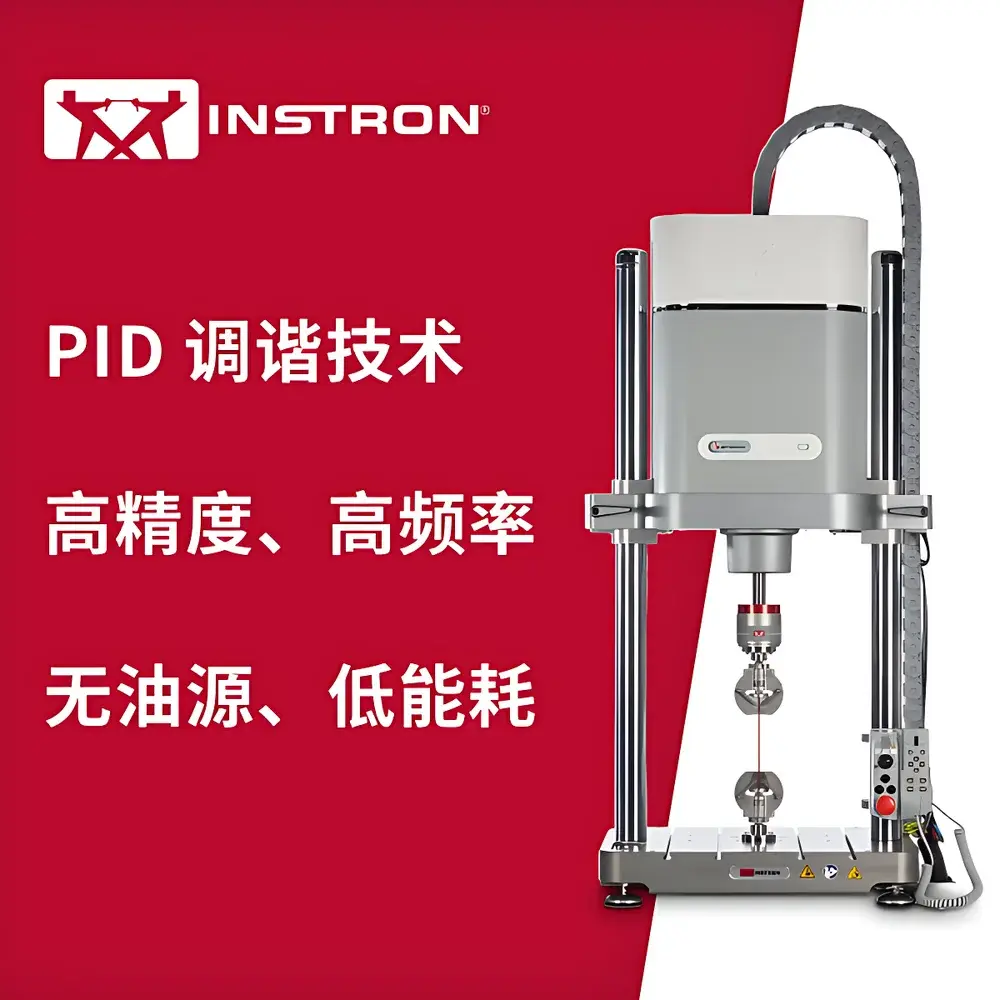
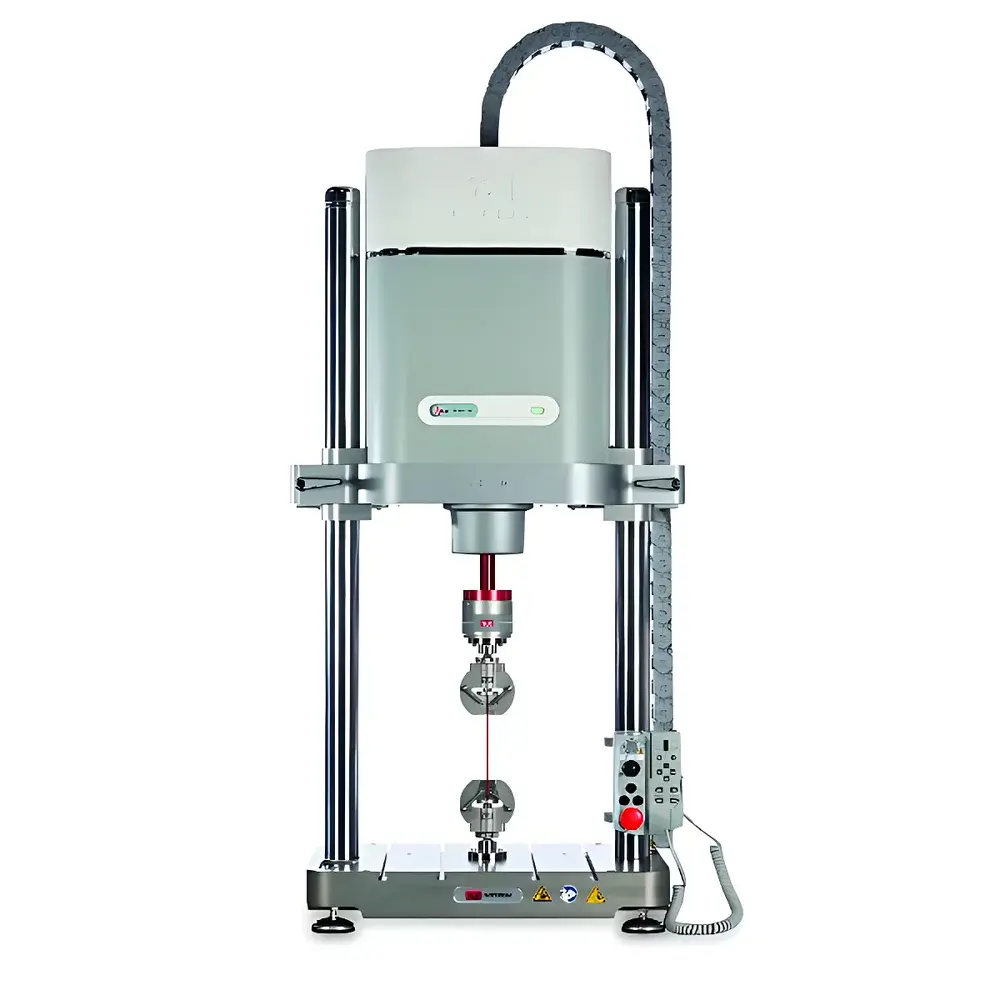
Instron ElectroPuls® E3000 All-Electric Dynamic and Static Fatigue Testing System
| Brand | Instron |
|---|---|
| Origin | United Kingdom |
| Manufacturer Type | Original Equipment Manufacturer (OEM) |
| Product Origin | Imported |
| Model | E3000 |
| Frequency Range | 100 Hz |
| Frame Weight | 240 kg |
| Power Supply | Single-phase AC |
| Maximum Dynamic Axial Load | ±3000 N |
| Maximum Static Axial Load | ±2100 N |
| Test Stroke | 60 mm |
| Footprint | < 0.3 m² (3.2 ft²) |
| Cooling Method | Temperature-Controlled Air Cooling |
| Frame Architecture | High-Stiffness Dual-Column with Top-Mounted Actuator |
| Actuator Technology | Direct-Drive Linear Motor |
| Load Sensing | Dynacell™ Dynamic Load Cell |
| Position Feedback | Optical Encoder with Dedicated Position Channel |
| Control System | Instron Digital Controller with Stiffness-Based Tuning Algorithm |
| Software Platform | Console™ (system control), Bluehill® Universal (static testing), WaveMatrix 3 (dynamic/fatigue testing) |
| Compliance | Designed for GLP/GMP environments |
Overview
The Instron ElectroPuls® E3000 is a high-performance, all-electric dynamic and static fatigue testing system engineered for precision mechanical characterization of materials and components under cyclic, quasi-static, and transient loading conditions. Unlike traditional hydraulic or servo-pneumatic systems, the E3000 employs a direct-drive linear motor actuator—eliminating hydraulic fluids, compressed air, and external cooling circuits. This architecture delivers clean, quiet, and energy-efficient operation while maintaining exceptional force fidelity, displacement resolution, and phase accuracy across its full frequency range up to 100 Hz. The system operates on standard single-phase AC power, making it suitable for integration into standard laboratory environments without infrastructure modifications. Its dual-column, top-mounted actuator frame provides high structural stiffness and precise axial alignment—critical for minimizing parasitic bending moments during high-cycle fatigue tests. The E3000 is fundamentally designed for reproducible, traceable, and auditable testing in regulated R&D, quality assurance, and failure analysis workflows.
Key Features
- Direct-drive linear motor actuation enabling zero fluid contamination, minimal maintenance, and rapid response dynamics
- Dynacell™ dynamic load cell technology with integrated thermal compensation and low-inertia design for reduced phase lag and improved signal-to-noise ratio
- Stiffness-based tuning algorithm—patented Instron control methodology that automatically optimizes closed-loop performance based on specimen and fixture compliance
- Optical encoder with dedicated position channel for sub-micron displacement resolution and repeatable sample positioning
- Electrically actuated crosshead with manual locking handle and intuitive height adjustment—enabling fast test setup and consistent gage length control
- Top-mounted actuator and diagonal dual-column frame geometry facilitate unobstructed access to the test zone for fixture installation, specimen mounting, and in-situ instrumentation
- T-slot base plate (60 mm pitch) supporting modular integration of custom fixtures, environmental chambers, liquid baths, video extensometers, and digital image correlation (DIC) systems
- Integrated status LED indicators providing real-time visual feedback on operational state: Standby, Running, Emergency Stop, or Fault
- Temperature-regulated air-cooling system maintaining actuator and controller thermal stability during extended high-frequency duty cycles
Sample Compatibility & Compliance
The E3000 accommodates a broad spectrum of specimen geometries—from miniature metallic coupons and polymer films to composite laminates, biomedical implants, and microelectromechanical systems (MEMS). Its 60 mm stroke and ±3000 N dynamic load capacity support standardized fatigue protocols per ASTM E466, ASTM E606, ISO 1099, and ISO 12106. The system’s mechanical design conforms to ISO 7500-1 Class 1 accuracy requirements for force measurement and ISO 23718 for displacement verification. When configured with Bluehill® Universal and validated WaveMatrix 3 software, the E3000 meets regulatory expectations for data integrity in pharmaceutical, aerospace, and medical device development—including 21 CFR Part 11 compliance through role-based access control, electronic signatures, and immutable audit trails. All hardware interfaces adhere to IEC 61000-6-2/6-4 EMC standards and are CE-marked for use in EU laboratories operating under GLP or GMP frameworks.
Software & Data Management
System-level operation is managed via Console™ software—a purpose-built interface developed from Instron’s human factors research on laboratory workflow efficiency. Console provides synchronized control of actuator motion, data acquisition, and peripheral devices (e.g., environmental chambers, extensometers) with real-time graphical monitoring of force, displacement, strain, and cycle count. For static tensile, compression, and flexure testing, Bluehill® Universal offers ISO/IEC 17025-compliant reporting templates, automatic calculation of modulus, yield strength, elongation, and fracture toughness parameters. WaveMatrix 3 enables advanced dynamic test sequencing—including block loading, spectrum fatigue, resonance tracking, and closed-loop strain-controlled cycling—with built-in S-N curve generation and statistical life prediction tools. Raw data is stored in vendor-neutral ASCII or HDF5 formats; metadata—including calibration certificates, operator ID, environmental logs, and instrument configuration—is embedded directly into each dataset to satisfy ALCOA+ principles (Attributable, Legible, Contemporaneous, Original, Accurate, Complete, Consistent, Enduring, Available).
Applications
- High-cycle fatigue evaluation of aerospace alloys (e.g., Ti-6Al-4V, AA7075) under stress-controlled or strain-controlled waveforms
- Biomechanical testing of orthopedic implants per ISO 14801 and ASTM F2193
- Viscoelastic characterization of elastomers and thermoplastics using dynamic mechanical analysis (DMA)-style protocols
- Reliability screening of solder joints, PCB assemblies, and MEMS packaging under thermal-mechanical cycling simulations
- Creep-fatigue interaction studies in nuclear-grade steels and ceramic matrix composites
- Development and validation of constitutive models for finite element analysis (FEA) input
- Quality conformance testing of automotive fasteners, springs, and suspension components per OEM-specific specifications (e.g., VW PV1285, GMW14872)
FAQ
What power supply requirements does the E3000 have?
The E3000 operates on standard single-phase AC power (100–240 VAC, 50/60 Hz) with no need for three-phase supply, hydraulic oil, compressed air, or external chiller units.
Can the E3000 perform both static and dynamic tests within the same platform?
Yes—the system supports seamless transition between static tensile/compression tests (via Bluehill® Universal) and high-frequency fatigue testing (via WaveMatrix 3), with shared calibration traceability and unified data management.
Is the E3000 compatible with environmental chambers?
Yes—its T-slot base and open-frame architecture allow direct mounting of commercially available temperature, humidity, or corrosive atmosphere chambers; all chamber communication interfaces are supported through Console™’s peripheral I/O module.
How is test data integrity ensured for regulatory submissions?
When deployed with validated software configurations, the E3000 provides full 21 CFR Part 11 compliance—including electronic signatures, user authentication, change history logging, and encrypted audit trails—aligned with FDA, EMA, and PMDA expectations for preclinical and manufacturing documentation.
What maintenance is required for long-term reliability?
The all-electric architecture eliminates fluid changes, filter replacements, and seal servicing; routine maintenance consists of periodic verification of load cell calibration, encoder alignment, and actuator bearing inspection—typically performed annually by certified Instron service engineers.



