
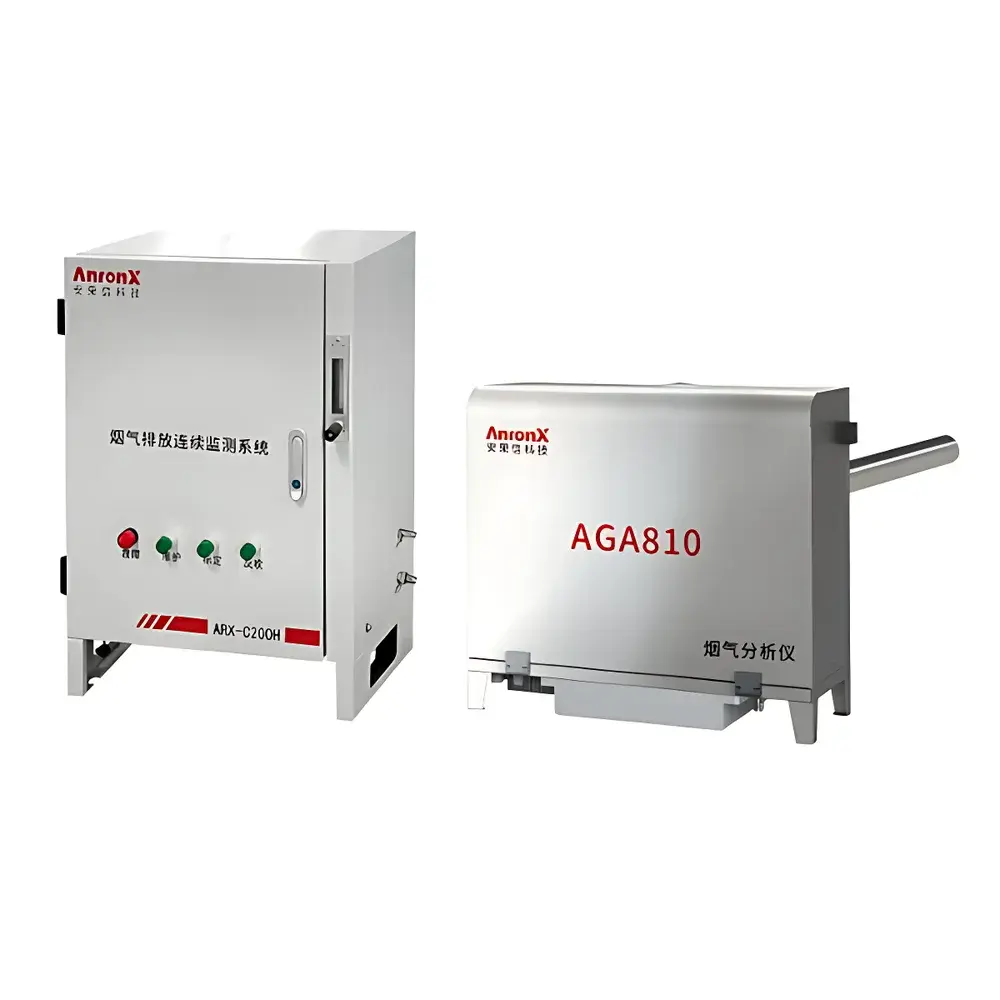
AnronX ARX-C200H Continuous Emission Monitoring System (CEMS)
| Brand | AnronX |
|---|---|
| Origin | Jiangsu, China |
| Manufacturer Type | Authorized Distributor |
| Country of Origin | China |
| Model | ARX-C200H |
| Instrument Type | Continuous Emission Monitoring System (CEMS) |
| Measurement Accuracy | ±2% F.S. |
| Response Time | ≤120 s |
| Measured Parameters | SO₂, NO, NO₂, O₂, NH₃, Particulate Matter (PM), Temperature, Pressure, Flue Gas Velocity, Relative Humidity |
Overview
The AnronX ARX-C200H Continuous Emission Monitoring System (CEMS) is an industrial-grade, in-situ extractive CEMS engineered for real-time, regulatory-compliant monitoring of flue gas emissions from stationary combustion sources. It operates on a dual-principle architecture: UV differential optical absorption spectroscopy (UV-DOAS) for gaseous pollutants and laser scattering (forward or backward) for particulate matter, integrated with ultrasonic velocity measurement and high-temperature parametric sensing. Designed specifically for harsh operating environments—including elevated temperatures (>150 °C), high dust loading, and variable moisture content—the system eliminates cold spots through full-path heated sampling and measurement, preventing condensation-induced analyte loss (e.g., NH₃ dissolution or SO₂ adsorption) and ensuring traceable, metrologically sound data under ISO 14956 and EN 15267-3 framework conditions.
Key Features
- In-situ extractive probe design with integrated optical measurement cell—eliminates long sample lines, reduces lag time, and maintains thermal integrity across the entire gas path (≥180 °C).
- Patented low-DOAS algorithm (Patent No. ZL 2017 11259438.1) combined with spectral balancing technology to enhance signal-to-noise ratio and suppress cross-interference among overlapping absorption bands (e.g., NO₂/NO/SO₂).
- Modular architecture supporting field-configurable sensor combinations: UV-DOAS gas analyzer (AGA810), dual-mode particulate monitor (LSS2014 open-path backscatter or LFS800 heated extractive forward-scatter), and UF2020B ultrasonic flow/temperature/pressure/humidity module.
- Energy-efficient operation: average power consumption <350 W; optimized thermal management enables unattended outdoor platform deployment without auxiliary heating enclosures.
- Compact footprint (W×D×H: 650×520×380 mm) and lightweight construction (<42 kg) facilitate rapid installation on existing stack platforms or retrofit into constrained spaces.
Sample Compatibility & Compliance
The ARX-C200H meets fundamental performance requirements for CEMS under China’s HJ 75-2017 and HJ 76-2017 technical specifications for flue gas monitoring. Its heated optical path ensures compatibility with flue gases containing up to 20 vol% water vapor and particulate concentrations up to 50 g/m³ (dry basis). The system supports calibration verification via certified span gas introduction either at the probe inlet (in-situ) or at the analyzer cabinet (remote), satisfying QA/QC protocols required by national emission permit regimes. All firmware and data handling modules are structured to support audit trails compliant with GLP principles; optional configuration enables timestamped, tamper-evident data logging aligned with ISO/IEC 17025 documentation standards.
Software & Data Management
The embedded CEMS Data Acquisition and Handling Unit (DAHU) runs a real-time Linux-based OS with deterministic I/O scheduling. It performs automatic zero/span validation, drift correction, and linearization per EPA Method 7E and EN 14181 QAL1/QAL2 procedures. Data is stored locally in non-volatile memory (≥12 months at 1-min resolution) and exported via Modbus TCP, RS485, or 4–20 mA analog outputs. Optional integration with third-party SCADA or EMS platforms is supported through OPC UA and MQTT protocols. All user actions—including calibration events, maintenance logs, and alarm acknowledgments—are recorded with digital signatures and UTC timestamps to satisfy traceability requirements under CNAS accreditation criteria.
Applications
The ARX-C200H is deployed across thermal power plants, iron & steel sintering facilities, cement kilns, ceramic tunnel furnaces, and non-ferrous metallurgical smelters for continuous compliance monitoring of desulfurization (FGD) and denitrification (SCR/SNCR) system efficiency. It is particularly suited for applications requiring simultaneous quantification of NH₃ slip post-SCR, SO₂ breakthrough during limestone injection upsets, and PM₂.₅/PM₁₀ trends correlated with flue gas velocity and oxygen-corrected volumetric flow. Field validation studies conducted at six coal-fired units confirmed reproducibility within ±1.3% F.S. for SO₂ and ±1.7% F.S. for NOₓ over 90-day operational cycles.
FAQ
Does the ARX-C200H comply with Chinese environmental regulatory standards for CEMS?
Yes—it conforms to HJ 75-2017 (technical specification for CEMS installation and acceptance) and HJ 76-2017 (performance test methods), including requirements for accuracy, response time, and calibration frequency.
Can the system operate continuously in high-humidity flue gas without condensation artifacts?
Yes—its fully heated optical path (≥180 °C) and heated extractive probe prevent dew point crossing, eliminating aqueous-phase analyte loss and enabling stable measurement even at relative humidity >95% (dry basis).
What particulate measurement method is recommended for ultra-low emission stacks (e.g., <5 mg/m³)?
The LFS800 heated forward-scatter module is recommended, as its temperature-controlled sampling line and dual-wavelength compensation minimize Mie scattering bias and improve detection limit to 0.1 mg/m³ (calibrated against gravimetric reference).
Is remote diagnostics and firmware update supported?
Yes—via secure SSH/TLS-enabled web interface; all updates require cryptographic signature verification and generate immutable log entries for audit purposes.
How is data integrity ensured during power interruption or network downtime?
Local DAHU retains raw sensor readings and processed concentration values in redundant flash memory; upon recovery, it auto-resynchronizes missing timestamps and appends validated data to the central database without interpolation.







