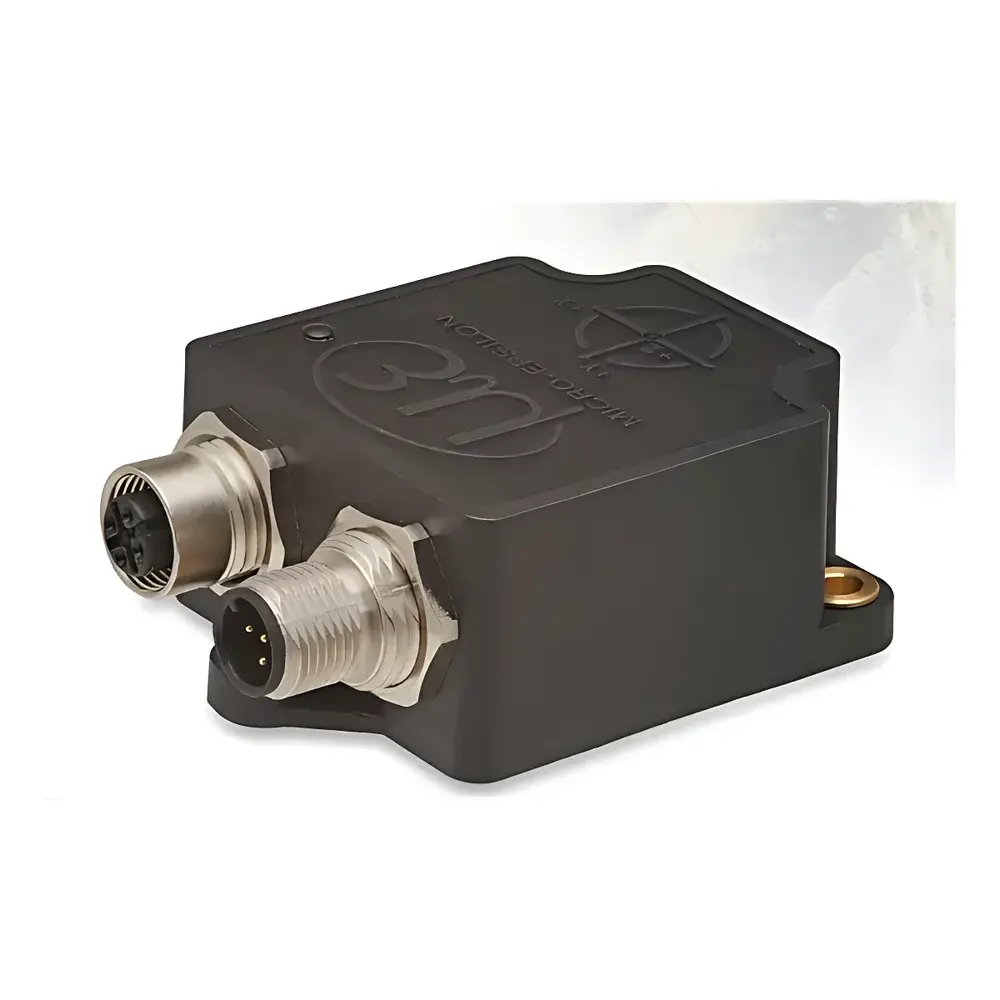
Micro-Hybrid INC5502D High-Performance Dual-Axis Inclinometer
| Brand | Micro-Hybrid |
|---|---|
| Origin | Germany |
| Model | INC5502D |
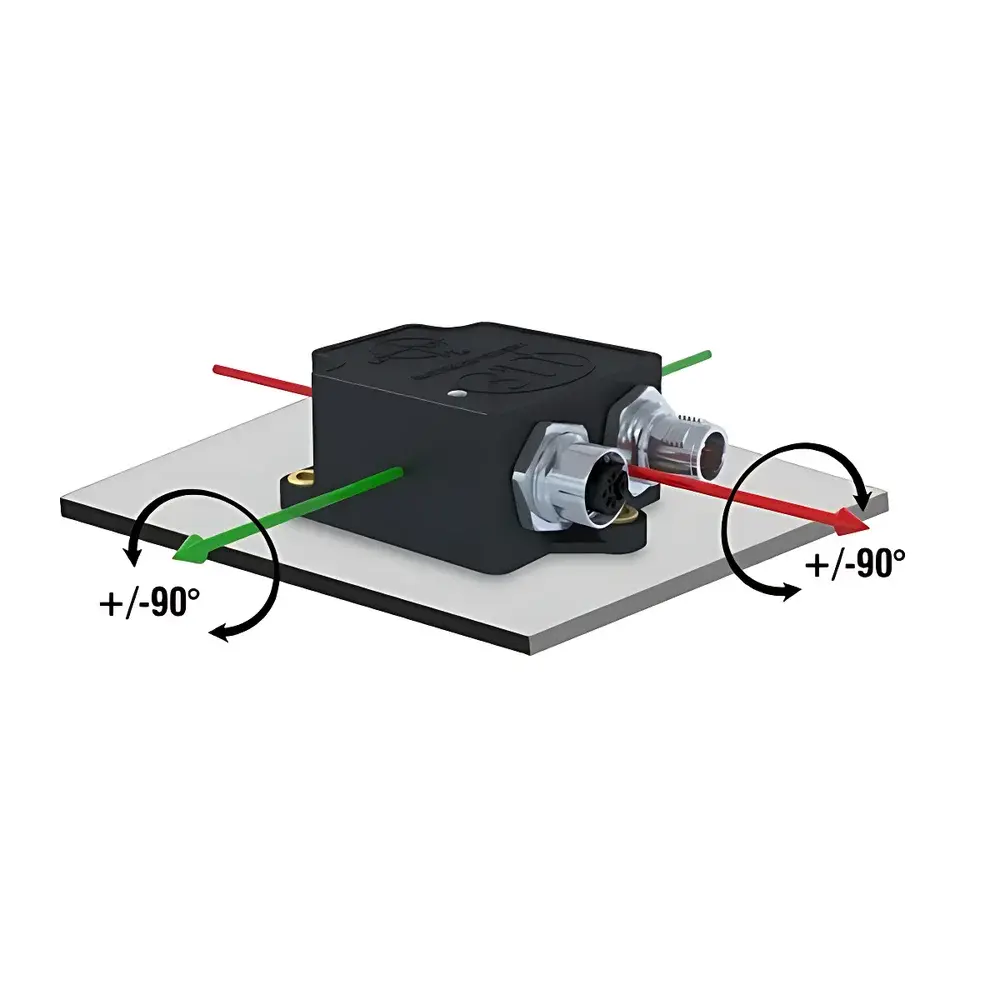
| Measurement Range | Longitudinal (Roll): ±180° (configurable to 0°–360°) |
| Lateral (Pitch) | ±85° (configurable to 95°–265°) |
| Resolution | 0.01° |
| Sampling Rate | 200 Hz |
| Supply Voltage | 9–32 V DC |
| Protection Rating | IP67 / IP69K |
| Weight | ~120 g |
| Output Interfaces | Analog (I/U), CANopen, SAE J1939 |
Overview
The Micro-Hybrid INC5502D is a high-precision, dual-axis digital inclinometer engineered for demanding industrial and mobile machinery applications where reliable tilt measurement under dynamic mechanical stress and harsh environmental conditions is critical. Based on robust MEMS-based capacitive sensing technology, the device delivers true angular position data with high repeatability and minimal temperature drift across its operational range. Unlike single-axis or low-bandwidth alternatives, the INC5502D simultaneously measures roll (longitudinal) and pitch (lateral) angles using independent, factory-calibrated sensor elements—enabling real-time attitude monitoring without cross-axis coupling errors. Its measurement principle relies on detecting minute changes in capacitance between micro-machined silicon plates under gravitational acceleration, translated via integrated signal conditioning into stable, noise-immune angular outputs. Designed for integration into safety-critical control loops and automated guidance systems, it complies with functional safety requirements typical of ISO 13849-1 (PL d) and IEC 61508 (SIL 2) architectures when deployed within validated system contexts.
Key Features
- Dual-axis measurement with independent roll (±180°, switchable to 0°–360°) and pitch (±85°, switchable to 95°–265°) ranges—supporting both signed and unsigned angular representations with configurable axis orientation.
- High-resolution angular detection at 0.01°, enabling precise leveling, slope monitoring, and dynamic attitude feedback in real time.
- Fast sampling capability at up to 200 Hz, suitable for closed-loop control applications involving rapid mechanical motion or vibration-prone platforms.
- Triple-output interface architecture: analog current/voltage (I/U), CANopen (CiA 301/402 compliant), and SAE J1939—ensuring seamless integration into OEM vehicle networks, agricultural machinery ECUs, and industrial PLC environments.
- Ruggedized housing rated IP67 and IP69K, providing full protection against dust ingress, high-pressure water jets, and temporary submersion—validated per DIN EN 60529 and ISO 20653.
- Wide operating voltage range (9–32 V DC) with reverse polarity and transient overvoltage protection, compatible with 12 V and 24 V vehicle electrical systems.
- Low mass (~120 g) and compact form factor (approx. 60 × 40 × 25 mm) facilitate mounting in space-constrained locations without affecting system center-of-gravity dynamics.
Sample Compatibility & Compliance
The INC5502D is optimized for solid-state mounting on rigid metallic or composite structural members, requiring minimal thermal expansion mismatch between sensor housing and host platform. It exhibits stable performance across ambient temperatures from –40 °C to +85 °C and is qualified for shock resistance up to 50 g (6 ms half-sine) and vibration endurance per ISO 16750-3 (10–2000 Hz, 2.5 g rms). While not intrinsically certified for hazardous areas, its design aligns with EMC requirements per CISPR 25 Class 3 and ISO 11452-2/4/8 for automotive electronics. For regulatory traceability, each unit carries CE marking and conforms to RoHS 2011/65/EU and REACH (EC) No. 1907/2006 directives. Calibration certificates are available upon request, traceable to national metrology institutes via DAkkS-accredited laboratories.
Software & Data Management
Configuration and diagnostics are supported via Micro-Hybrid’s proprietary PC-based toolset (INC-ConfigSuite), which enables parameterization of output scaling, filter coefficients (e.g., digital low-pass cutoff at 10–100 Hz), axis inversion, and CAN message mapping—including customizable PDO assignment and node ID setup. All configuration data is stored non-volatilely in EEPROM. The device supports standardized CANopen object dictionary entries (index 2000h–2FFFh) and J1939 SPNs (e.g., SPN 1396 for pitch angle, SPN 1397 for roll angle), facilitating plug-and-play compatibility with third-party telematics gateways and SCADA systems. Audit-ready operation is enabled through timestamped diagnostic event logging (e.g., supply undervoltage, CAN bus off recovery), supporting GLP-aligned maintenance records when integrated into validated instrumented systems.
Applications
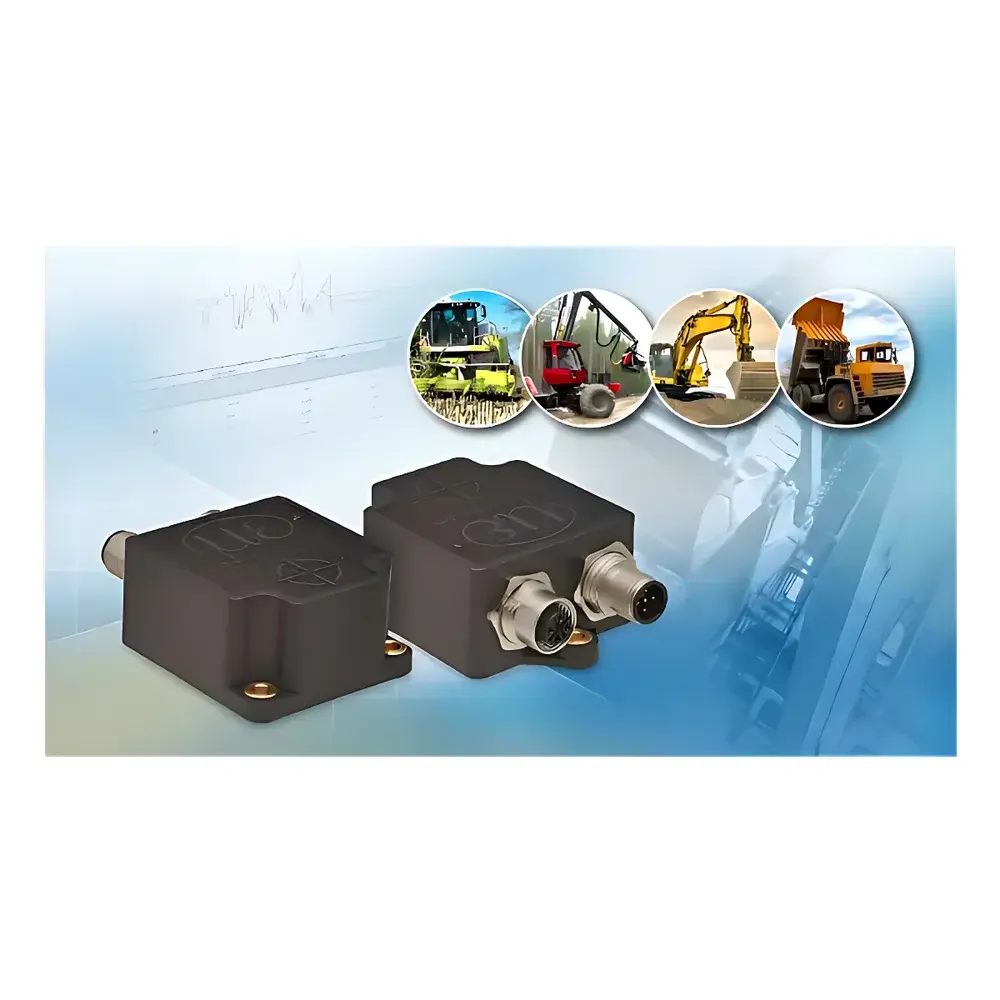
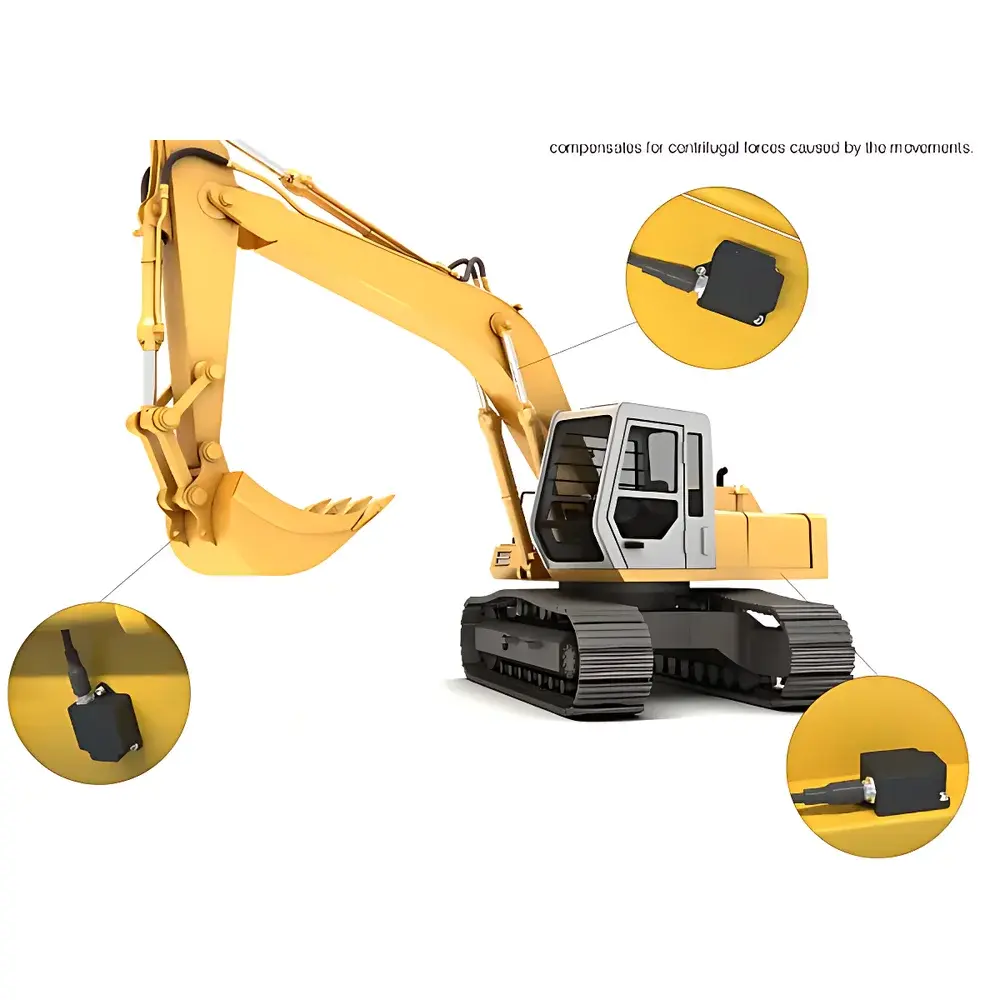
- Construction and earthmoving equipment: automatic blade leveling, boom angle feedback, and stability monitoring in excavators, graders, and telehandlers.
- Agricultural machinery: implement tilt compensation for precision seeding, spraying, and harvesting systems operating on uneven terrain.
- Mobile robotics: real-time chassis inclination estimation for path planning, obstacle negotiation, and autonomous navigation algorithms.
- Test & measurement rigs: static and dynamic tilt validation in vibration shakers, centrifuge calibration benches, and aerospace ground support equipment.
- Renewable energy infrastructure: solar tracker alignment verification and wind turbine nacelle inclination monitoring during commissioning and service intervals.
FAQ
What is the maximum cable length supported for analog (I/U) output without signal degradation?
For analog current output (4–20 mA), cable lengths up to 500 m are feasible with standard 0.75 mm² shielded twisted pair; voltage output (0–10 V) is recommended for ≤10 m runs to maintain accuracy.
Does the INC5502D support field recalibration?
No—calibration is performed at the factory using precision tilt tables and is stored in non-volatile memory; field adjustment is not user-accessible to preserve metrological integrity.
Is CANopen configuration compatible with third-party CAN analyzers?
Yes—standard CiA 301 services (SDO upload/download, NMT control) are fully accessible; EDS files are provided for integration with Vector CANoe, Peak PCAN-Explorer, and similar tools.
Can the device operate continuously at 85 °C ambient temperature?
Yes—thermal derating is not required; full specification compliance is guaranteed across the entire –40 °C to +85 °C operating range.
Are mechanical mounting templates and torque specifications included?
Yes—detailed installation drawings, M4 mounting screw torque recommendation (1.2 N·m), and anti-rotation keyway dimensions are supplied in the technical manual.