
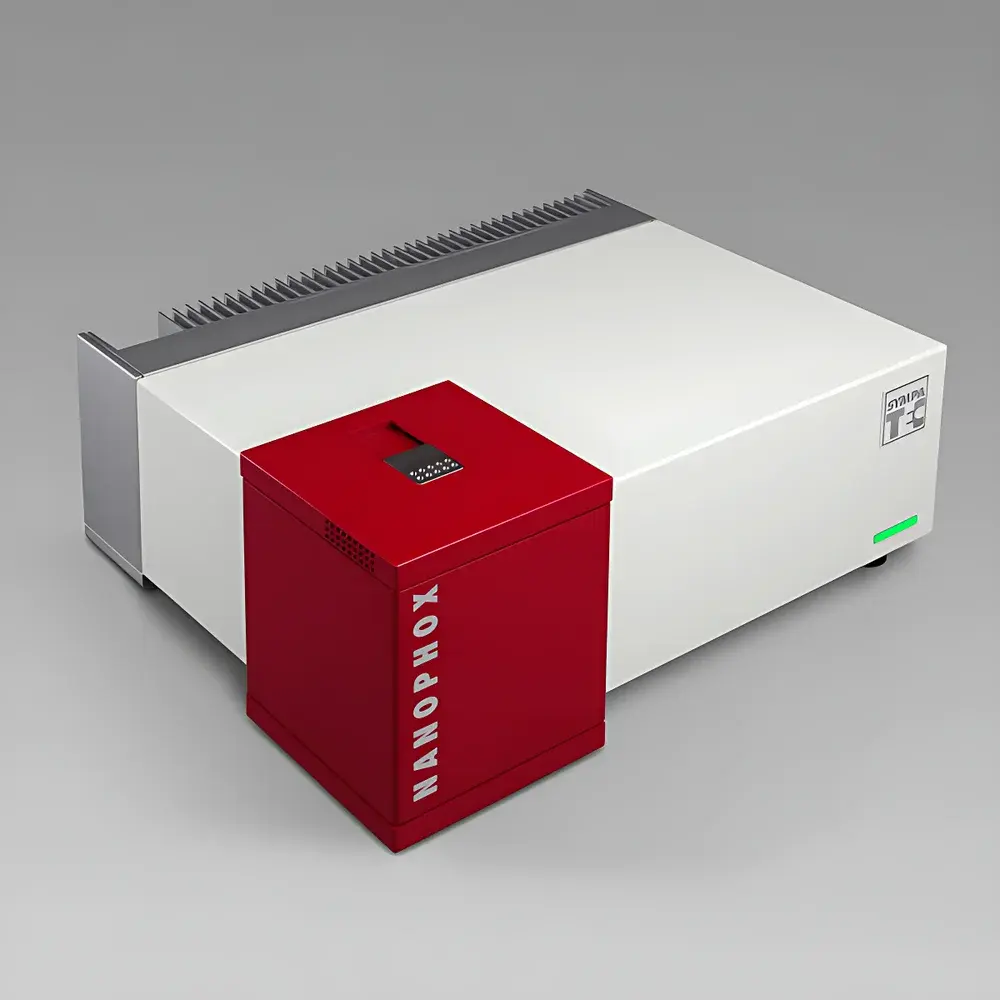
Sympatec NANOPHOX/R Nanoparticle Size Analyzer
| Brand | Sympatec |
|---|---|
| Origin | Germany |
| Manufacturer | Sympatec GmbH |
| Product Type | Imported Instrument |
| Model | NANOPHOX/R |
| Particle Size Range | 0.5–10,000 nm |
| Measurement Principle | Photon Cross-Correlation Spectroscopy (PCCS) |
| Temperature Control Range | 0–90 °C |
| Temperature Stability | ≤ 0.1 °C |
| Optical Signal Resolution | 30 ns |
| Sample Volume Range | 50 µL–4 mL |
| Concentration Tolerance | up to 70 vol.% (sample-dependent) |
| Light Source | 658 nm semiconductor laser, 30 mW output, software-adjustable power |
| Laser Class | Class 1 |
| Detection System | Dual PMT detectors with independent signal acquisition |
| Correlator Architecture | Multi-channel digital correlator with real-time cross-correlation processing |
| Data Acquisition Interface | TCP/IP |
| Sample Compatibility | Aqueous & organic suspensions, emulsions, microemulsions, fluorescent and colored samples |
| Measurement Time | 2–5 min per run |
| Software Compliance | Supports audit trail, user access control, and electronic signature per FDA 21 CFR Part 11 requirements |
Overview
The Sympatec NANOPHOX/R Nanoparticle Size Analyzer is an advanced, benchtop instrument engineered for high-precision particle size characterization of colloidal systems in the sub-micron to nanoscale regime. Unlike conventional dynamic light scattering (DLS) instruments based on Photon Correlation Spectroscopy (PCS), the NANOPHOX/R implements Photon Cross-Correlation Spectroscopy (PCCS)—a patented optical methodology developed by Sympatec to overcome fundamental limitations of traditional single-beam, single-detector DLS. PCCS employs two spatially separated, coherent laser beams intersecting within the sample volume to generate two statistically independent scattered light signals. These signals are simultaneously captured by two photomultiplier tube (PMT) detectors and subjected to real-time cross-correlation analysis. This architecture effectively discriminates true single-scattering events from intensity fluctuations induced by multiple scattering—a primary source of bias in concentrated or turbid dispersions. As a result, the NANOPHOX/R delivers robust, reproducible particle size distributions across an exceptionally wide concentration range—from trace-level suspensions (ppm) up to highly loaded systems (70 vol.%), without dilution or pre-treatment.
Key Features
- Dual-laser, dual-PMT optical configuration enabling true cross-correlation signal processing
- Extended sizing range: 0.5 nm to 10,000 nm (10 µm), validated for nanoparticles, micelles, liposomes, protein aggregates, and polymeric colloids
- Peltier-based temperature control system with ±0.1 °C stability over 0–90 °C operating range—fully software-integrated for method-defined thermal ramping and isothermal hold
- High-temporal-resolution correlator with 30 ns minimum sampling interval, supporting rapid dynamics capture and improved resolution of polydisperse systems
- Flexible sample handling: compatible with disposable acrylic cuvettes (4 mL), low-volume glass cells (50 µL–2 mL), and standard quartz or glass cells (4 mL)
- Class 1 laser safety certification—no external interlocks or operator training required under normal operation
- Real-time monitoring interface displaying normalized intensity autocorrelation decay, count rate, and cumulative particle size distribution during measurement
Sample Compatibility & Compliance
The NANOPHOX/R is explicitly designed for complex, real-world dispersions where conventional PCS fails. It reliably measures opaque emulsions, highly pigmented suspensions, fluorescent dyes, and biologically derived formulations—including those containing proteins, polysaccharides, or surfactants—that absorb or scatter light strongly. Its tolerance for high optical density eliminates the need for serial dilution, preserving native aggregation state and interfacial behavior. From a regulatory perspective, the instrument’s firmware and data acquisition software comply with key quality system requirements: full audit trail logging (user actions, parameter changes, measurement events), role-based access control (administrator, analyst, reviewer), and electronic signature capability aligned with FDA 21 CFR Part 11. All raw correlation data, processed distributions, and metadata are stored in vendor-neutral, timestamped binary files (.dat) with embedded calibration and environmental logs—ensuring traceability for GLP and GMP environments.
Software & Data Management
Control and analysis are performed via WINDOX 6 software—a modular, Windows-based platform certified for ISO/IEC 17025-compliant laboratories. WINDOX 6 supports automated method templates, batch processing, statistical reporting (e.g., D10/D50/D90, span, polydispersity index), and export to CSV, PDF, or XML formats. Advanced algorithms include CONTIN regularization for multimodal analysis and non-negative least squares (NNLS) fitting for improved resolution of overlapping populations. All processing parameters—including baseline correction, correlation decay fitting window, and regularization strength—are fully user-configurable and saved with each measurement. Raw correlator data can be reprocessed offline without instrument connection, facilitating method development, troubleshooting, and retrospective analysis. The software also integrates with LIMS via ODBC and supports scheduled calibration verification using NIST-traceable polystyrene standards.
Applications
- Quality control of nanoparticle drug carriers (e.g., lipid nanoparticles, polymeric micelles) across manufacturing batches
- Stability assessment of industrial emulsions (e.g., agrochemicals, cosmetics, food-grade oil-in-water systems)
- In-process monitoring of nanoprecipitation, solvent displacement, or microfluidic synthesis reactions
- Characterization of environmental colloids, catalyst nanoparticles, and quantum dot dispersions
- Comparative evaluation of surfactant efficacy, flocculation kinetics, and pH-induced aggregation thresholds
- Supporting ICH Q5A/Q5C guidelines for biopharmaceutical aggregate analysis in formulation development
FAQ
Does the NANOPHOX/R require sample dilution prior to measurement?
No. Its PCCS architecture enables direct analysis of undiluted samples across a concentration range of ppm to 70 vol.%, depending on optical density and particle refractive index.
Can it measure zeta potential or molecular weight?
No. The NANOPHOX/R is dedicated to hydrodynamic size determination via PCCS. Zeta potential and molecular weight require complementary techniques such as electrophoretic light scattering (ELS) or multi-angle light scattering (MALS).
Is calibration traceable to national standards?
Yes. Sympatec provides NIST-traceable polystyrene and silica nanoparticle reference materials (e.g., 60 nm, 200 nm, 500 nm) with certified size distributions and uncertainty budgets compliant with ISO 22412.
What maintenance is required for long-term performance stability?
The system requires no routine optical alignment. Annual verification of temperature accuracy, laser power output, and correlator timing resolution is recommended using factory-provided diagnostic routines and certified standards.
How does PCCS compare to asymmetric flow field-flow fractionation (AF4) or TEM for nanoparticle sizing?
PCCS offers rapid, solution-phase, statistically representative ensemble measurements ideal for routine QC and process monitoring. AF4 and TEM provide higher-resolution separation or morphological insight but are lower-throughput, more operator-dependent, and less suited for high-concentration or unstable systems.



