
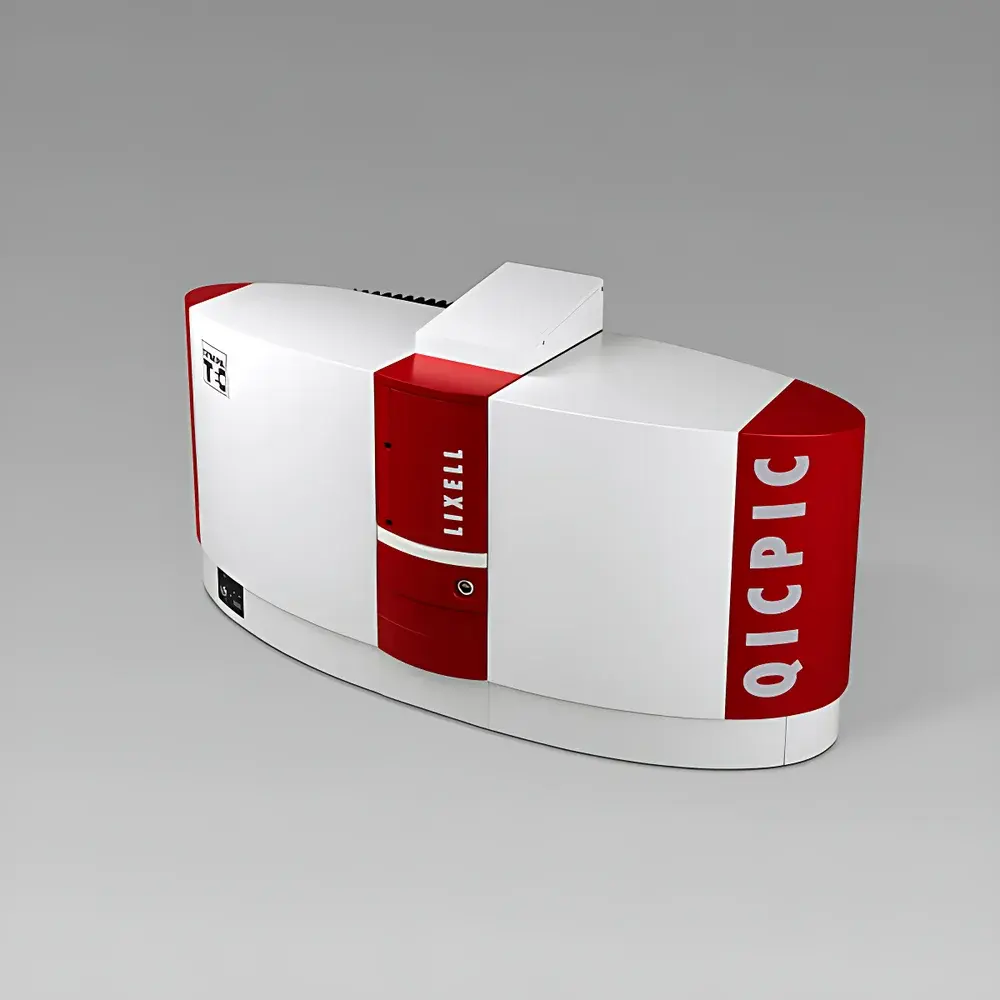
SYMPATEC QICPIC & LIXELL Wet-Dispersion Dynamic Image Analysis System
| Brand | SYMPATEC |
|---|---|
| Origin | Germany |
| Manufacturer | SYMPATEC GmbH |
| Type | Dynamic Image-Based Particle Analyzer |
| Model | QICPIC & LIXELL |
| Lens Count | 6 |
| Measurement Range | 1–2000 µm |
| Dispersion Method | Wet Dispersion (External Circulation) |
| Image Resolution | 4.2 MP |
| Measured Parameters | Chord Length, Feret Diameter (max/min/mean), Fiber Length, Fiber Diameter, Equivalent Circular Diameter (ECD), Sphericity, Aspect Ratio, Convexity, Flatness, Elongation, Light Extinction Feret Index (LEFI), Dynamic Image Feret Index (DIFI), Volume-Based Feret Diameter (VBFD), Projected Area Diameter (PED) |
Overview
The SYMPATEC QICPIC & LIXELL is a high-performance, wet-dispersion dynamic image analysis system engineered for statistically robust, real-time characterization of particle size and shape in liquid suspension. Operating on the principle of pulsed backlight illumination and high-speed digital imaging, the system captures sharp silhouette images of particles as they pass individually through a precisely defined optical measurement zone. Six synchronized, high-resolution lenses (4.2 MP total effective resolution) provide multi-angle imaging to minimize orientation bias and maximize morphological fidelity. Unlike static or batch-based image analyzers, the QICPIC & LIXELL employs true dynamic flow imaging—particles are continuously imaged at velocities optimized for laminar transport and minimal overlap—ensuring high-throughput acquisition (>10 million particles per measurement) without compromising geometric accuracy. The system is fundamentally designed for traceable, ISO 13322-2 compliant particle metrology, where both dimensional equivalence (e.g., equivalent circular diameter) and intrinsic shape descriptors (e.g., sphericity, aspect ratio, convexity) are derived directly from binary edge-detection algorithms applied to raw pixel data.
Key Features
- Integrated LIXELL external circulation module enabling flexible, low-volume wet dispersion (minimum sample volume: 20 mL) with programmable flow rate, pressure, and dwell time control
- Modular inlet options: LIQXI syringe pump, peristaltic pump, or gravity-fed open/closed-loop configurations—compatible with GMP-compliant process integration
- Six-lens optical array with telecentric illumination path, minimizing perspective distortion and ensuring sub-pixel edge localization accuracy
- Real-time image acquisition at up to 1,000 frames per second, synchronized with microsecond-duration LED pulses to freeze particle motion
- Comprehensive shape parameter library compliant with ISO 9276-6 and ASTM E2457 standards—including Feret-based metrics (Feretmax, Feretmin, Feretmean), fiber-specific indices (LEFI, DIFI, VBFD), and topological descriptors (convexity, flatness, elongation)
- Embedded hardware-accelerated image processing engine eliminating post-acquisition bottlenecks and supporting live statistical feedback
Sample Compatibility & Compliance
The QICPIC & LIXELL accommodates a broad spectrum of particulate systems including metal powders (e.g., Ti-6Al-4V, Inconel 718), battery cathode/anode slurries (NMC, LFP, graphite), pharmaceutical suspensions (API crystallites, excipient blends), food emulsions (starch granules, protein aggregates), and ceramic precursors. Its wet dispersion architecture supports aqueous and organic media, surfactant-stabilized suspensions, and low-conductivity solvents. All measurement protocols adhere to ISO 13322-2 (dynamic image analysis), ISO 9276-6 (shape descriptor definitions), and ASTM E2457 (standard guide for particle shape analysis). Data integrity meets FDA 21 CFR Part 11 requirements via audit-trail-enabled software, electronic signatures, and role-based access control—fully validated for GLP and GMP environments.
Software & Data Management
WITec’s proprietary WITec ParticleSight software provides a unified interface for instrument control, real-time visualization, and advanced data mining. Each measurement generates a fully searchable particle image database, time-stamped video sequences, cumulative/differential size and shape distribution plots, and customizable scatter matrices (e.g., sphericity vs. aspect ratio). Users define logical filters (e.g., “sphericity 5”) to isolate subpopulations for targeted morphological review or export. Raw image metadata—including exposure time, lens ID, flow velocity, and calibration timestamp—is embedded in every exported dataset. Batch reporting supports automated PDF/CSV generation with configurable templates aligned to internal SOPs or regulatory submission formats.
Applications
The QICPIC & LIXELL delivers critical insights across R&D and production settings: optimizing powder bed fusion parameters in additive manufacturing by correlating particle sphericity and surface roughness with layer density; monitoring electrode slurry homogeneity in lithium-ion battery manufacturing via real-time fiber length distribution shifts; quantifying crystal habit evolution during pharmaceutical crystallization processes; assessing starch gelatinization kinetics through time-resolved changes in convexity and aspect ratio; and validating nanostructured pigment dispersion stability in coatings through longitudinal tracking of agglomerate fractal dimension. Its dual capability—lab-grade precision and process-compatible modularity—makes it suitable for both offline QC release testing and online PAT deployment.
FAQ
What is the minimum detectable particle size under wet dispersion conditions?
The system achieves reliable detection down to 1 µm based on optical contrast, diffraction-limited resolution, and signal-to-noise optimization—subject to refractive index matching between particle and dispersant.
Can the QICPIC & LIXELL be integrated into an existing production line?
Yes—via optional process interface kits supporting 4–20 mA analog output, Modbus TCP, or OPC UA communication protocols for seamless connection to DCS/SCADA systems.
How does the system ensure measurement reproducibility across operators?
Through standardized dispersion protocols, automated focus calibration, and built-in reference standard verification routines traceable to NIST-traceable particle sets.
Is raw image data export supported for third-party analysis?
Yes—TIFF and HDF5 formats are natively supported, preserving full pixel intensity, metadata, and coordinate mapping for external MATLAB, Python (OpenCV), or ImageJ workflows.
Does the system comply with pharmaceutical regulatory requirements for particle characterization?
Yes—the full software suite is 21 CFR Part 11 compliant, with IQ/OQ/PQ documentation packages available, and validation support provided for USP , , and ICH Q5A/Q5D submissions.



