
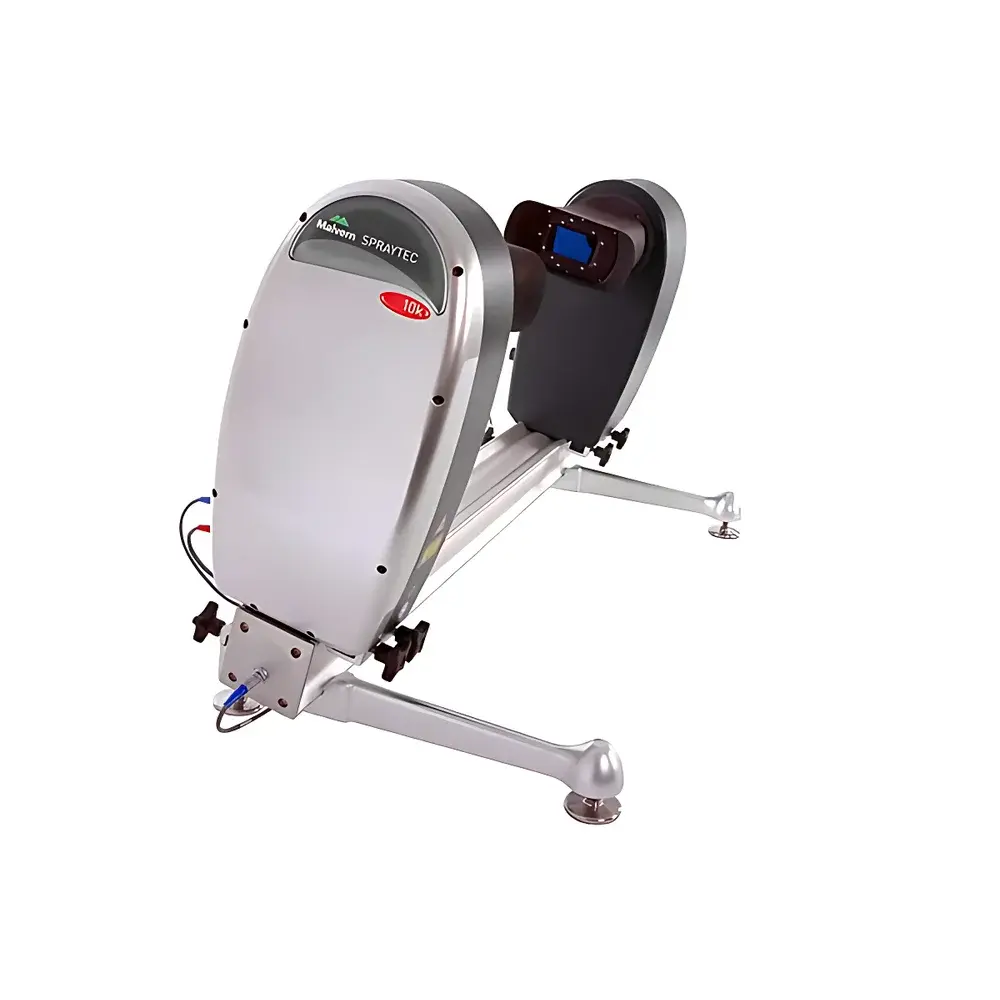
Malvern Panalytical Spraytec Spray Particle Size Analyzer
| Brand | Malvern Panalytical |
|---|---|
| Origin | United Kingdom |
| Manufacturer Type | Original Equipment Manufacturer (OEM) |
| Import Status | Imported |
| Model | Spraytec |
| Dispersion Method | Wet Dispersion |
| Instrument Type | Laboratory Laser Diffraction Particle Size Analyzer |
| Measurement Range | 0.5 µm @ 150 mm path length |
| Repeatability | Dv50 better than ±1% COV (NIST-traceable latex standards) |
| Measurement Duration | Fast Mode: 30 seconds |
| Continuous Mode | up to 60 minutes |
Overview
The Malvern Panalytical Spraytec Spray Particle Size Analyzer is an engineered solution for real-time, in-situ characterization of atomized droplets and aerosolized particles using laser diffraction principles. Unlike conventional static particle size analyzers, the Spraytec system is purpose-built for dynamic spray environments—where high-velocity, transient, and optically dense dispersions challenge traditional measurement paradigms. Its core optical architecture leverages Mie theory-based inversion algorithms applied to angular light scattering intensity profiles collected across a wide detection angle range (typically 0.02°–179°). This enables robust quantification of volume-weighted particle size distributions (PSDs) from 0.1 µm to 2000 µm, even under extreme obscuration conditions—up to 95%—via proprietary multi-scatter correction algorithms. The system operates on a fixed-path, modular optical bench (adjustable up to 2.5 m), ensuring mechanical stability and alignment integrity during extended acquisition periods. Designed for integration into pharmaceutical inhaler development, fuel injector validation, agricultural spray formulation, and industrial coating R&D workflows, the Spraytec delivers traceable, reproducible data compliant with regulatory expectations for process understanding and product quality control.
Key Features
- Real-time acquisition at up to 10 kHz sampling rate—enabling microsecond-scale temporal resolution (100 µs binning) for dynamic雾化 event analysis
- Automated beam alignment with adaptive trigger synchronization (TTL, analog, or software-triggered) for precise timing correlation with nozzle actuation or pump cycles
- Modular optical bench with interchangeable 300 mm and 750 mm focal-length receivers—optimized for low-velocity mist or high-velocity jet characterization
- Multi-scatter correction algorithm validated under NIST-traceable conditions, extending reliable measurement range beyond conventional laser diffraction limits
- Optically isolated measurement zone—eliminating lens contamination risk from volatile solvents, viscous formulations, or particulate-laden sprays
- Comprehensive beam diagnostics and real-time signal quality monitoring—including obscuration tracking, baseline stability metrics, and scatter pattern fidelity assessment
Sample Compatibility & Compliance
The Spraytec accommodates a broad spectrum of spray media—including aqueous suspensions, organic solvent-based formulations, propellant-driven metered-dose inhalers (MDIs), pneumatic and ultrasonic nebulizers, rotary atomizers, and pressure-swirl nozzles. It supports both continuous and pulsed spray modes without hardware reconfiguration. From a regulatory standpoint, the system meets critical requirements for analytical instrument qualification (AIQ) and data integrity: full audit trail logging, electronic signature support, user access controls, and secure data archiving—all aligned with FDA 21 CFR Part 11, EU Annex 11, and ISO/IEC 17025 documentation frameworks. All calibration and verification procedures are traceable to NIST-certified latex standards, and repeatability performance (±1% COV for Dv50) is routinely verified per ISO 13320:2020 guidelines for laser diffraction particle sizing.
Software & Data Management
Spraytec software provides end-to-end control—from hardware initialization and measurement parameter definition to real-time visualization and post-acquisition analysis. The interface includes synchronized time-series plotting of D10/D50/D90, span, and relative width metrics alongside raw scattering patterns. “Size evolution” heatmaps visualize temporal PSD shifts across 60-minute continuous runs, enabling identification of nozzle wear, formulation instability, or environmental drift. Export options include ASCII, CSV, and XML formats compatible with LIMS, statistical process control (SPC) platforms, and multivariate analysis tools. All raw and processed datasets are stored with immutable metadata (instrument ID, operator, timestamp, environmental conditions), satisfying GLP/GMP audit readiness requirements. Software validation packages—including IQ/OQ/PQ documentation templates—are available for regulated environments.
Applications
- Pharmaceutical: Quantitative assessment of pressurized metered-dose inhaler (pMDI) and dry powder inhaler (DPI) aerosol plumes for respirable fraction prediction and QbD-compliant formulation optimization
- Automotive & Aerospace: Fuel injector spray pattern analysis—including cone angle, droplet velocity distribution proxies, and Sauter mean diameter (SMD) mapping under engine-relevant backpressure conditions
- Agricultural Chemistry: Droplet spectrum evaluation of hydraulic nozzles and centrifugal spreaders to optimize pesticide deposition efficiency and minimize off-target drift
- Coatings & Paints: Real-time monitoring of electrostatic spray systems to correlate particle size dynamics with film uniformity and orange peel defect mitigation
- Consumer Products: Characterization of fragrance mists, disinfectant sprays, and cosmetic atomizers for sensory performance and regulatory labeling compliance (e.g., EPA FIFRA, EU Biocidal Products Regulation)
FAQ
How does Spraytec handle highly concentrated sprays where multiple scattering would normally invalidate results?
Spraytec employs a physics-based multi-scatter correction model derived from radiative transfer theory, allowing accurate inversion of scattering spectra up to 95% obscuration—without requiring dilution or flow-cell modification.
Can Spraytec be integrated with third-party test rigs or environmental chambers?
Yes—the system features standard Ethernet (TCP/IP) and USB 3.0 interfaces, plus programmable TTL and analog I/O ports for hardware synchronization with external actuators, climate controllers, or high-speed cameras.
Is the measurement range truly 0.1–2000 µm, and how is lower detection limit verified?
The 0.1 µm lower limit is validated using monodisperse polystyrene nanolatex standards (NIST SRM 1960), with detection confirmed via signal-to-noise ratio thresholds and angular scattering profile consistency across repeated acquisitions.
What maintenance is required to sustain long-term measurement accuracy?
Routine verification using NIST-traceable standards every 30 days is recommended; optical components require cleaning only if visible contamination occurs—enabled by the system’s sealed, non-contact measurement geometry.



