
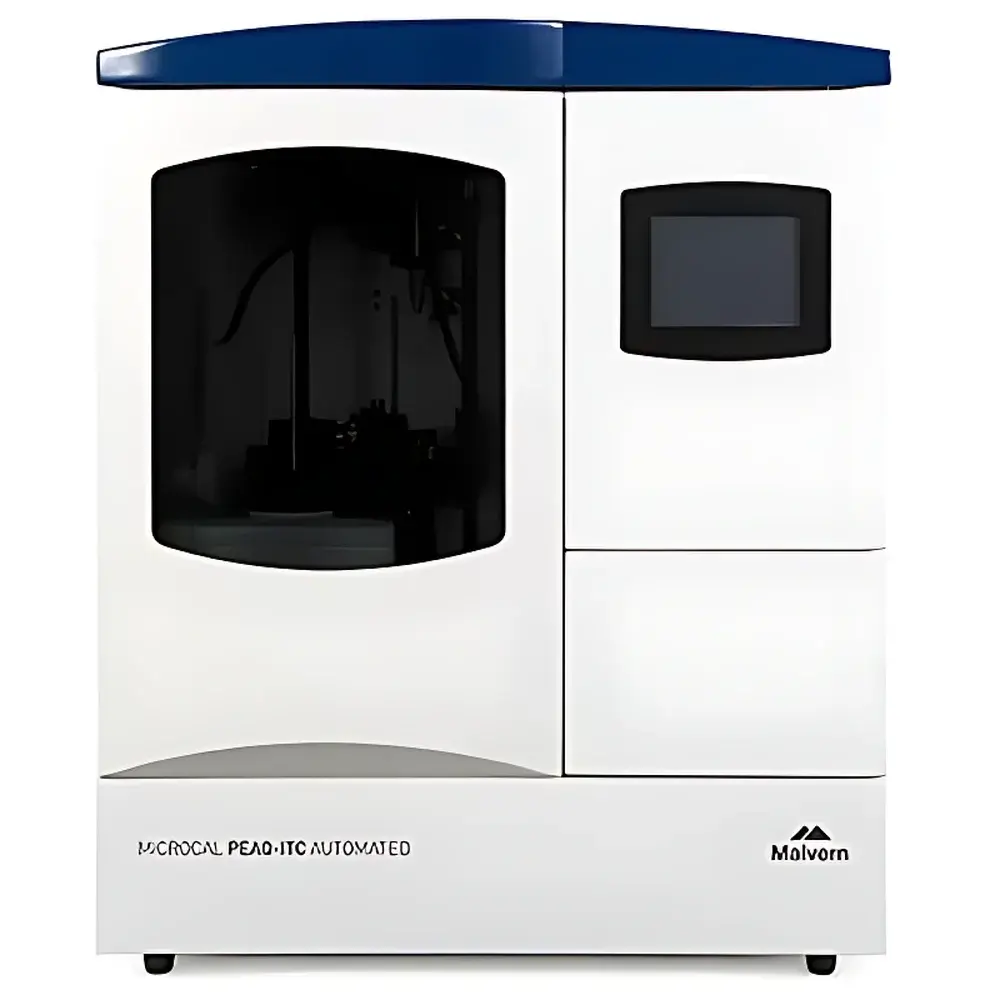
Malvern Panalytical MicroCal PEAQ-ITC Automated Isothermal Titration Calorimeter
| Brand | Malvern Panalytical |
|---|---|
| Origin | USA |
| Manufacturer Type | Original Equipment Manufacturer (OEM) |
| Product Category | Imported Instrument |
| Model | MicroCal PEAQ-ITC Automated |
| Measurement Mode | Isothermal Titration Calorimetry (ITC) |
| Temperature Range | 2 °C to 80 °C |
| Sample Volume Requirement | As low as 10 μg protein per experiment |
| Throughput | Fully automated operation supporting up to four 96-well plates per unattended run |
| Detection Sensitivity | Sub-micromolar to picomolar dissociation constants (KD = 10⁻² – 10⁻¹² M) |
| Cell Material | Chemically resistant nickel-based alloy |
| Cell Geometry | Optimized coin-shaped reaction cell for efficient mixing and minimal sample dispersion |
Overview
The Malvern Panalytical MicroCal PEAQ-ITC Automated is a high-sensitivity, low-volume isothermal titration calorimeter engineered for label-free, solution-phase quantification of biomolecular interactions in real time. Based on the fundamental principle of isothermal titration calorimetry (ITC), the instrument directly measures the heat absorbed or released during a binding event—enabling first-principles determination of thermodynamic parameters without assumptions about molecular size, labeling, or immobilization. Unlike spectroscopic or surface-based techniques, ITC delivers complete thermodynamic profiles—including binding affinity (KD), stoichiometry (n), enthalpy change (ΔH), and entropy change (ΔS)—from a single experiment. The PEAQ-ITC Automated integrates this proven thermodynamic methodology with hardware-level automation, enabling walk-away operation across extended experimental queues while maintaining sub-microwatt thermal detection sensitivity and rigorous temperature control between 2 °C and 80 °C.
Key Features
- Fully automated liquid handling supporting up to four 96-well microplates per unattended session—eliminating manual syringe refills and cell reloading.
- Coin-shaped, nickel-alloy reaction cell (200 µL active volume) optimized for rapid, homogeneous mixing and minimal carryover; chemically inert for compatibility with aggressive buffers, detergents, and organic co-solvents.
- Ultra-low sample consumption: routine characterization achievable with ≤10 µg of purified protein per titration, significantly reducing purification burden and enabling studies of scarce or difficult-to-express targets.
- Integrated touchscreen interface with context-aware workflow guidance—streamlining method setup, queue management, and real-time monitoring without requiring dedicated operator presence.
- Dynamic experiment queuing: new assays can be appended to an active run without interrupting ongoing measurements, improving lab utilization and reducing idle time.
- Multi-dose titration capability from a single syringe load—minimizing pipetting errors, reagent waste, and cross-contamination risk.
Sample Compatibility & Compliance
The PEAQ-ITC Automated accommodates diverse biomolecular systems—including small-molecule ligands, peptides, recombinant proteins, monoclonal antibodies, nucleic acids (DNA/RNA), glycoproteins, lipids, and membrane protein complexes solubilized in mild detergents. Its non-invasive, solution-phase measurement eliminates artifacts associated with surface immobilization or fluorescent tagging. The system complies with Good Laboratory Practice (GLP) and supports audit-ready data integrity through secure user authentication, electronic signatures, and full experimental traceability—including raw power-vs.-time thermograms, metadata logs, and version-controlled analysis scripts. While not inherently FDA 21 CFR Part 11–compliant out-of-the-box, the instrument’s software architecture enables integration with validated LIMS or ELN platforms meeting regulatory requirements for pharmaceutical development and QC environments.
Software & Data Management
MicroCal PEAQ-ITC Analysis Software provides an integrated environment for experimental design, acquisition, modeling, and reporting. It includes built-in simulation tools to estimate optimal concentration ranges and injection schemes prior to wet-lab execution. Batch processing supports parallel evaluation of hundreds of datasets using consistent fitting models (e.g., one-site, two-site, sequential binding, or enzymatic kinetics). Automated quality metrics assess baseline stability, signal-to-noise ratio, and fit convergence—flagging outliers before manual review. All analyses generate publication-ready figures with customizable formatting, error propagation visualization, and embedded metadata. Raw data files (.itc) are stored in open, vendor-neutral formats compatible with third-party statistical or machine learning pipelines.
Applications
- Quantitative characterization of drug–target binding thermodynamics in early-stage hit validation and lead optimization.
- Allosteric modulation studies and multi-site interaction mapping for complex protein assemblies.
- Enzyme–inhibitor kinetics and transition-state analog binding analysis under native conditions.
- Thermodynamic fingerprinting of biosimilar candidates against reference products.
- Validation of structural predictions (e.g., from docking or MD simulations) via direct ΔH/ΔS comparison.
- Buffer and excipient screening to identify formulations that stabilize favorable binding enthalpies.
FAQ
What thermodynamic parameters does the PEAQ-ITC Automated directly measure?
It directly measures heat flow (µcal/sec) during each injection; KD, n, ΔH, and ΔS are derived by globally fitting the integrated heat peaks to appropriate binding models.
Can it handle membrane proteins or aggregates?
Yes—provided samples are monodisperse in solution and compatible with the nickel-alloy cell material; detergent-screened preparations and nanodisc-reconstituted systems have been successfully characterized.
Is method transfer possible between manual and automated PEAQ-ITC systems?
Yes—the core calorimetric cell design, thermal control architecture, and data analysis engine are identical; protocols and fitting parameters are fully portable.
Does the system support kinetic ITC (kITC) measurements?
No—it operates exclusively in equilibrium ITC mode; transient binding kinetics require complementary techniques such as SPR or stopped-flow spectroscopy.
How is data integrity maintained during long unattended runs?
Each experiment is timestamped, digitally signed, and logged with environmental metadata (cell temperature, stirring speed, ambient drift); raw thermograms are immutable and checksum-verified upon export.



