
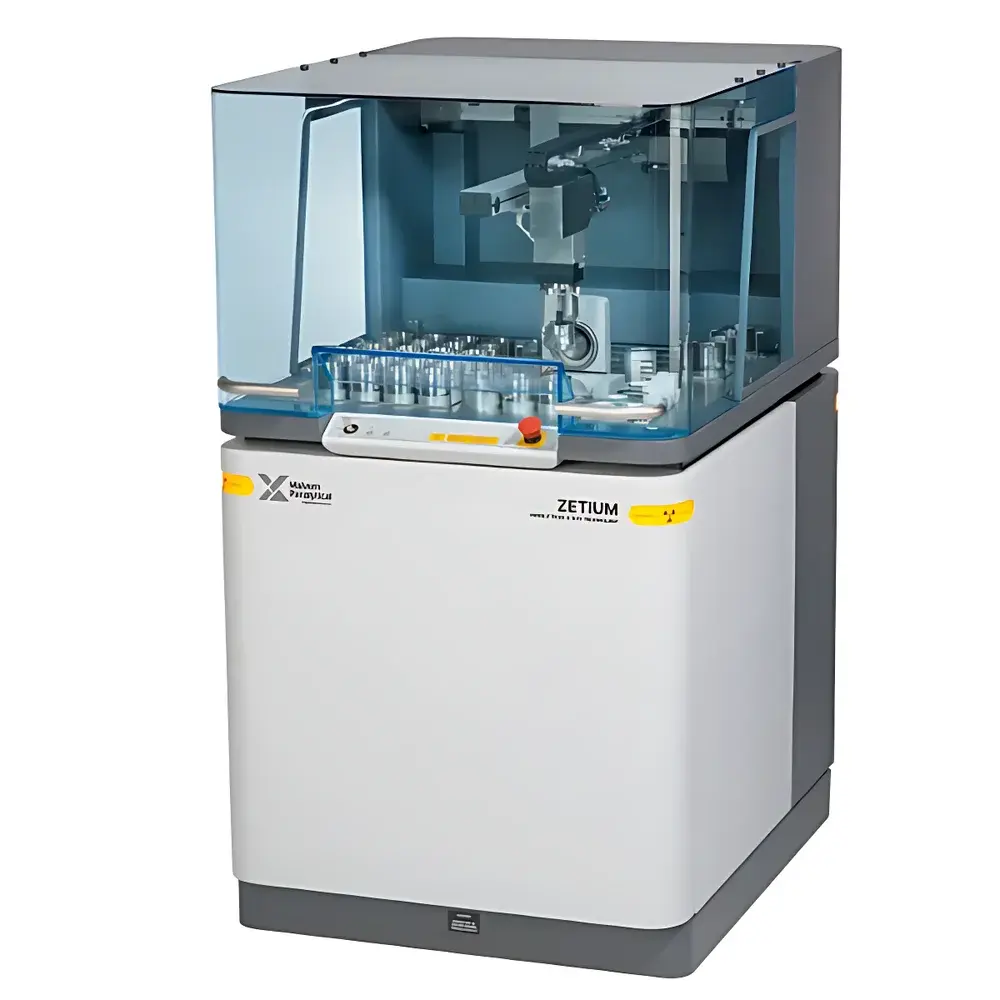
Malvern Panalytical Zetium Wavelength Dispersive X-Ray Fluorescence Spectrometer
| Brand | Malvern Panalytical |
|---|---|
| Origin | Netherlands |
| Manufacturer Type | Original Equipment Manufacturer (OEM) |
| Origin Category | Imported |
| Model | Zetium |
| Instrument Type | Floor-standing |
| X-ray Tube Power | 2.4–4 kW |
| Elemental Range | 4Be to 95Am |
| Instrument Class | Scanning-type WDXRF |
Overview
The Malvern Panalytical Zetium is a high-performance, floor-standing wavelength dispersive X-ray fluorescence (WDXRF) spectrometer engineered for precision elemental analysis across demanding industrial process control, quality assurance, and advanced materials R&D environments. Operating on the fundamental principle of secondary X-ray emission induced by primary X-ray excitation, the Zetium delivers quantitative and qualitative multi-element data from beryllium (Be, Z=4) through americium (Am, Z=95) — covering light elements (e.g., C, N, O, F, Na, Mg, Al, Si, P, S, Cl) with high spectral resolution and heavy elements (e.g., Pb, U, Th, rare earths) with exceptional counting statistics and dynamic range. Its architecture integrates both WDXRF and energy dispersive (EDXRF) capabilities via SumXcore technology — enabling simultaneous high-resolution peak separation and rapid screening within a single measurement sequence. This hybrid detection strategy supports method flexibility without hardware reconfiguration, making Zetium suitable for laboratories requiring both trace-level detection limits and routine bulk composition verification.
Key Features
- Modular high-power X-ray tube system offering selectable power levels (1 kW, 2.4 kW, 3 kW, or 4 kW) to optimize sensitivity, detection limits, and throughput per application requirement.
- Multi-anode X-ray tube options (Rh, Cr, Mo, Au) for tailored excitation efficiency — Rh for general-purpose analysis, Cr for enhanced light-element response, Mo for mid-Z elements, and Au for optimal heavy-element excitation.
- Dual-detector configuration: High-resolution crystal spectrometers for WDXRF line separation, complemented by an ED core (energy-dispersive detector) for fast qualitative survey and background estimation — reducing total measurement time by up to 50% in hybrid acquisition modes.
- HiPer scintillation detector with linear response up to 3.5 Mcps, extending dynamic range for high-concentration heavy elements (e.g., Nb, Mo in steel alloys) while maintaining accuracy at trace levels.
- Vacuum-optimized sample chamber with compact air-lock design: enables rapid sample exchange under vacuum (<60 s cycle time) and low helium consumption for liquid or volatile sample analysis.
- 209-position high-capacity autosampler with integrated barcode reader for unattended operation, full sample traceability, and GLP-compliant workflow integration.
- CHI-BLUE X-ray tube window coating for extended tube lifetime, improved corrosion resistance, and stable output under prolonged operation with aggressive matrices.
Sample Compatibility & Compliance
The Zetium accommodates solid discs, fused beads, pressed pellets, loose powders, thin films, and homogeneous liquids — all without requiring fundamental changes to optical alignment or vacuum configuration. Sample identification via barcode scanning ensures audit-ready sample metadata linkage. The system complies with ISO 22087 (XRF — general requirements), ASTM E1621 (standard guide for WDXRF analysis), and supports 21 CFR Part 11 compliance when deployed with SuperQ software’s electronic signature and audit trail modules. Optional GLP/GMP validation packages include IQ/OQ/PQ documentation templates and instrument qualification protocols aligned with pharmaceutical, cement, and metallurgical industry regulatory expectations.
Software & Data Management
SuperQ software serves as the unified control, acquisition, and quantification platform — featuring Virtual Analyst, a guided workflow interface that enables non-specialist users to configure methods, calibrate standards, and generate reports with minimal training. Core capabilities include fundamental parameter (FP) based standardless analysis, matrix-matched calibration, thin-film modeling (including multilayer and interface roughness correction), and geological trace element quantification with inter-element correction libraries. Additional certified modules support lubricant additive analysis (ASTM D6443), cement clinker phase modeling (Bogue calculation), and polymer halogen screening (IEC 62321). All data are stored in vendor-neutral formats (e.g., .csv, .xlsx, .xml) and support direct export to LIMS via OPC UA or ODBC interfaces.
Applications
Zetium is deployed globally in cement production (raw meal, clinker, slag analysis per EN 196-2), mining and geochemistry (ore grade control, REE partitioning), metal production (alloy certification, inclusion analysis), petrochemicals (S, Cl, Ca, Ni, V in fuels per ASTM D2622), and polymer manufacturing (Br, Cl, Pb, Cd screening per RoHS/REACH). Its top-tier configuration (Zetium Ultimate) adds ultra-high-resolution crystals, cryo-cooled detectors, and automated multi-sample fusion stations — meeting ISO/IEC 17025 accredited lab requirements for certified reference material characterization.
FAQ
What is the minimum detectable limit (MDL) for light elements such as carbon or oxygen?
MDLs depend on matrix, acquisition time, and tube configuration; typical values range from 10–50 ppm for C in Fe-based alloys using Rh anode and vacuum path.
Can Zetium perform analysis of coated or layered samples?
Yes — SuperQ Thin Film module supports quantitative depth profiling of single/multi-layer structures down to sub-nanometer thickness resolution using iterative FP modeling.
Is remote diagnostics and preventive maintenance supported?
Yes — Zetium includes embedded telemetry, cloud-connected health monitoring, and scheduled service alerts via Malvern Panalytical’s SmartService portal.
Does the system support integration with automated sample preparation units?
Fully supported — including fusion robots (Claisse LeNeo), pellet presses (Specac), and robotic sample handling systems via standardized I/O and Ethernet/IP protocols.
How is data integrity ensured during long-term unattended operation?
SuperQ implements automatic checksum logging, real-time acquisition metadata stamping, and configurable audit trails compliant with FDA 21 CFR Part 11 Annex 11 requirements.





