
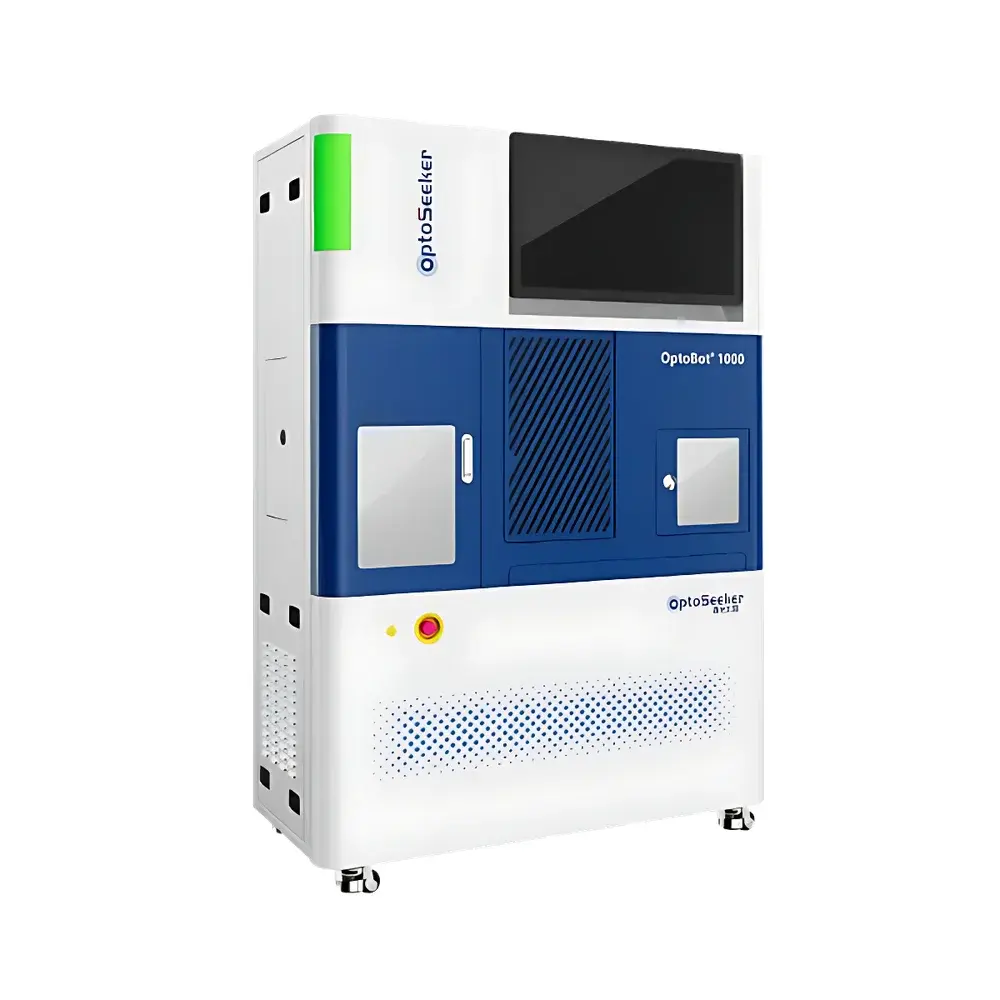
OptoBot®1000 Series High-Throughput Single-Cell Optofluidic Sorter
| Brand | ZhiGuang Biotech |
|---|---|
| Origin | Guangdong, China |
| Manufacturer Type | Authorized Distributor |
| Country of Origin | China |
| Model | OptoBot®1000 |
| Type | Fully Automated System |
| Dimensions (W×D×H) | 120 × 65 × 177 cm |
| Net Weight | 500 kg |
Overview
The OptoBot®1000 Series High-Throughput Single-Cell Optofluidic Sorter is an integrated, fully automated platform engineered for precision single-cell manipulation and functional phenotyping. It leverages optoelectronic tweezers (OET) coupled with programmable microfluidic chip architecture to enable label-free, non-invasive, and force-controlled cell handling—distinct from conventional fluorescence-activated or magnetic-activated sorting methods. Unlike traditional FACS systems that rely on antibody labeling and high-shear fluidics, the OptoBot®1000 applies spatially defined electric field gradients across a photoconductive surface to generate dynamic virtual electrodes, enabling real-time, contactless trapping, translation, rotation, and pairing of individual cells under physiological conditions. This principle supports long-term viability (>95% post-sort recovery) and preserves native cellular states—critical for functional assays in therapeutic antibody development, clonal selection, T-cell receptor profiling, and synthetic biology construct validation.
Key Features
- Fully automated end-to-end workflow: seamless integration of cell loading, single-cell isolation, on-chip culture (up to 72 h), multimodal characterization (brightfield, phase contrast, optional fluorescence), functional screening (e.g., secretion, cytotoxicity, motility), and viable cell retrieval.
- Optoelectronic tweezer (OET) engine: enables parallel manipulation of >1,000 cells/hour with sub-micrometer positioning accuracy and piconewton-level force resolution—ideal for delicate primary cells and stem cell lines.
- Modular microfluidic cartridge system: disposable, sterilized chips with pre-fabricated culture chambers, perfusion channels, and sensor-integrated zones; compatible with standard cell culture media and common reagents (e.g., PBS, RPMI, DMEM).
- Compact benchtop footprint (120 × 65 × 177 cm) with industrial-grade vibration-damping chassis and EMI-shielded electronics—designed for stable operation in shared core facilities and GMP-aligned R&D labs.
- Intuitive graphical user interface (GUI): drag-and-drop protocol builder with pre-validated templates for CHO clone screening, CAR-T enrichment, iPSC differentiation monitoring, and synthetic gene circuit testing.
Sample Compatibility & Compliance
The OptoBot®1000 accommodates suspension and adherent cell types—including mammalian (CHO, HEK293, Jurkat, PBMCs), yeast (S. cerevisiae), and bacterial (E. coli) populations—with minimal preprocessing (no fixation, staining, or centrifugation required). Cell size range: 5–30 µm diameter; viability threshold: ≥85% pre-load. The system meets IEC 61000-4 electromagnetic compatibility standards and complies with ISO 13485 design control principles for in vitro diagnostic-related instrumentation. While not an IVD device per se, its audit trail, user access controls, and electronic signature support align with FDA 21 CFR Part 11 requirements for regulated bioprocess development environments. All microfluidic cartridges are manufactured under cleanroom conditions (ISO Class 7) and certified DNase/RNase-free.
Software & Data Management
The proprietary OptoControl™ software (v3.2+) provides full lifecycle data governance: time-stamped acquisition logs, image metadata embedding (EXIF-compliant TIFF/PNG), and hierarchical project archiving (user → experiment → chip → cell ID). Integrated analysis modules include automated cell segmentation (U-Net-based), trajectory mapping, secretion kinetics modeling (via integrated ELISA-on-chip calibration curves), and statistical clustering (t-SNE, UMAP) for functional phenotype identification. Raw data exports support HDF5 and .ome.tiff formats for downstream integration with Python (scikit-image, napari) or MATLAB workflows. Audit trails record all parameter changes, user logins, and hardware events—enabling GLP/GMP-compliant documentation for regulatory submissions.
Applications
- Therapeutic antibody discovery: high-resolution ranking of monoclonal antibody-producing clones based on titer, stability, and aggregation propensity—without requiring transient transfection or ELISA plate readouts.
- Cell line development (CLD): acceleration of CHO pool-to-clone timelines from months to days via simultaneous assessment of growth kinetics, productivity, and epigenetic stability at single-cell resolution.
- T-cell immunotherapy: functional sorting of antigen-specific CD8+ T cells by cytokine secretion (IFN-γ, TNF-α) or cytolytic activity against autologous tumor spheroids—preserving clonality and transcriptional integrity.
- Synthetic biology: quantitative phenotyping of genetic circuits across isogenic populations under dynamic induction regimes, enabling digital logic gate validation and noise quantification.
- Microbiome engineering: strain-level sorting of engineered probiotics based on metabolite output (e.g., butyrate, folate) measured via on-chip enzymatic biosensors.
FAQ
Is the OptoBot®1000 compliant with FDA 21 CFR Part 11 for electronic records and signatures?
Yes—the system supports role-based user authentication, electronic signatures with timestamped approval workflows, and immutable audit logs for all critical operations.
Can it integrate with existing LIMS or ELN platforms?
Yes—via RESTful API and standardized JSON/XML export protocols; pre-built connectors available for LabVantage, Benchling, and Dotmatics.
What maintenance is required for the OET module?
Annual calibration of electrode uniformity and photodiode response; no consumables or alignment tools required—solid-state design ensures >50,000 operational hours MTBF.
Are custom microfluidic chip designs supported?
Yes—ZhiGuang Biotech offers collaborative co-development services with CAD-to-fabrication turnaround in ≤8 weeks under NDA.
Does the system support live-cell imaging during sorting?
Yes—integrated motorized stage and LED-based brightfield/phase contrast illumination enable time-lapse imaging at up to 30 fps with hardware-triggered synchronization to OET actuation events.





