
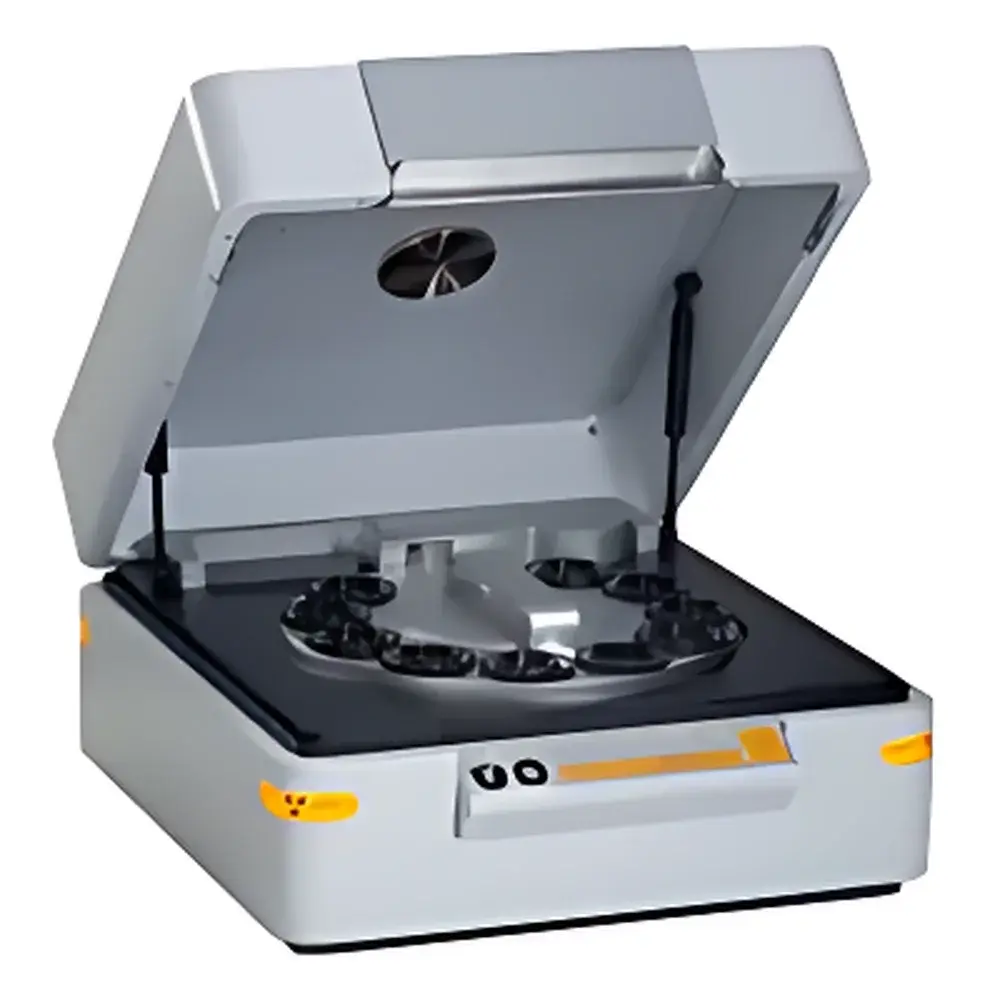
Malvern Panalytical Epsilon 4 Benchtop Energy Dispersive X-Ray Fluorescence Spectrometer
| Brand | Malvern Panalytical |
|---|---|
| Origin | Netherlands |
| Manufacturer Type | Original Equipment Manufacturer (OEM) |
| Product Origin | Imported |
| Model | Epsilon 4 |
| Form Factor | Benchtop / Floor-standing Configurable |
| Application Scope | Universal |
| Elemental Range | F–Am (C–Am with optional configuration) |
| Quantification Range | 0.01 ppm – 100 wt% |
| Energy Resolution | ~135 eV (at Mn Kα, 5.9 keV) |
| Repeatability | As low as 0.02% RSD (relative standard deviation) |
Overview
The Malvern Panalytical Epsilon 4 is a high-performance benchtop energy dispersive X-ray fluorescence (ED-XRF) spectrometer engineered for precision elemental analysis across research, quality control, and industrial process environments. Based on the proven architecture of the Epsilon 3 series, the Epsilon 4 integrates a high-brightness microfocus X-ray tube (10 W or 15 W configurable), a large-area silicon drift detector (SDD30), and an optimized vacuum-free optical path to deliver analytical sensitivity and resolution approaching that of floor-standing ED-XRF and even some wavelength dispersive (WDXRF) systems—without requiring dedicated infrastructure. Its core measurement principle relies on primary X-ray excitation of sample atoms, followed by detection of characteristic secondary (fluorescent) X-rays emitted during electron relaxation. The resulting energy spectrum is deconvoluted using fundamental parameter-based algorithms to quantify elemental composition quantitatively and non-destructively.
Key Features
- Configurable X-ray source: Standard 10 W tube for routine F–Am analysis; optional 15 W tube with 3 mA maximum current enables enhanced light-element performance—including C, N, and O—under ambient air or low-vacuum conditions.
- High-efficiency SDD30 detector: Delivers >1,500,000 cps linear count rate at 50% dead time, with energy resolution consistently ≤135 eV (Mn Kα), enabling robust peak separation for overlapping transitions (e.g., Si Kα/Pb Lα, S Kα/Ca Kβ).
- Atmospheric compensation system: Integrated temperature and barometric pressure sensors dynamically correct for air density variations, ensuring stable quantification of low-energy lines (Na, Mg, Al) during air-mode operation—eliminating reliance on He purge or high-vacuum pumps.
- Modular sample chamber: Accommodates solids, pressed pellets, loose powders, liquids, and filter membranes; supports sample masses from 2 kg with motorized stage positioning and automatic height sensing.
- Robust mechanical design: Vibration-damped optical bench, thermally stabilized detector housing, and sealed X-ray tube assembly ensure long-term calibration stability and minimal maintenance intervals.
Sample Compatibility & Compliance
The Epsilon 4 supports non-destructive, multi-element quantification across heterogeneous and matrix-diverse samples without digestion or coating. It complies with ISO 22083:2021 (XRF for cement and building materials), ASTM D7359-22 (ED-XRF for sulfur in fuels), IEC 62321-5:2013 (RoHS screening), and USP / (elemental impurities in pharmaceuticals). Software audit trails, electronic signatures, and role-based access control align with FDA 21 CFR Part 11 requirements for regulated environments. All firmware and spectral processing modules undergo GLP/GMP-compliant validation protocols, supporting traceable data integrity in QC laboratories.
Software & Data Management
Controlled via the intuitive Omnian software platform, the Epsilon 4 offers three complementary analysis workflows: Omnian for fully quantitative, matrix-matched or fundamental parameter-based analysis; FingerPrint for rapid material identification and batch verification; and Stratos for depth-resolved quantification of coatings, thin films, and multilayer structures (e.g., galvanized steel, printed circuit boards, cosmetic pigments). Data export supports ASTM E1343, CSV, and XML formats; raw spectra are stored in standardized .rtd format. Optional Oil-Trace module enables certified quantification of biodiesel blends (B0–B100), wear metals in lubricants, and additive depletion kinetics per ASTM D6729 and IP 501.
Applications
The Epsilon 4 serves as a primary analytical tool in cement raw meal optimization (SiO₂, Al₂O₃, Fe₂O₃, CaO), mining exploration (Ni, Cu, Zn, Co in ores), RoHS/WEEE compliance screening (Pb, Cd, Hg, Cr⁶⁺, Br), polymer halogen screening (Cl, Br), petroleum sulfur speciation (S in diesel, jet fuel), pharmaceutical catalyst residue monitoring (Pd, Pt, Rh), forensic glass comparison (Mg, Ca, Sr, Zr), and environmental soil screening (As, Se, Pb, U). Its ability to analyze C–Am elements under ambient conditions makes it uniquely suited for carbon-rich matrices (e.g., coal ash, biochar, graphite electrodes) where traditional vacuum-dependent systems fail.
FAQ
Can the Epsilon 4 analyze carbon, nitrogen, and oxygen?
Yes—when configured with the 15 W X-ray tube, optimized Be window, and air-path calibration routines, the Epsilon 4 achieves reliable quantification of C, N, and O in organic matrices, ceramics, and alloys.
Is helium gas required for routine operation?
No. Most applications—including F–Al quantification—run reliably in ambient air. Helium purging is only recommended for ultra-trace F analysis (<100 ppm) in low-Z matrices.
How does the Epsilon 4 handle variable sample heights or irregular geometries?
An integrated laser height sensor automatically adjusts the X-ray focal distance and optimizes take-off angle in real time, ensuring consistent excitation geometry across uneven surfaces and powder beds.
What regulatory standards does the software support for audit readiness?
Omnian includes full 21 CFR Part 11 compliance: electronic signatures, immutable audit logs, user permission tiers, and encrypted data storage—validated per GAMP 5 guidelines.
Can the instrument be integrated into automated production lines?
Yes. RS-232, Ethernet, and OPC UA interfaces enable seamless integration with MES/SCADA systems for unattended batch analysis and real-time SPC reporting.




