
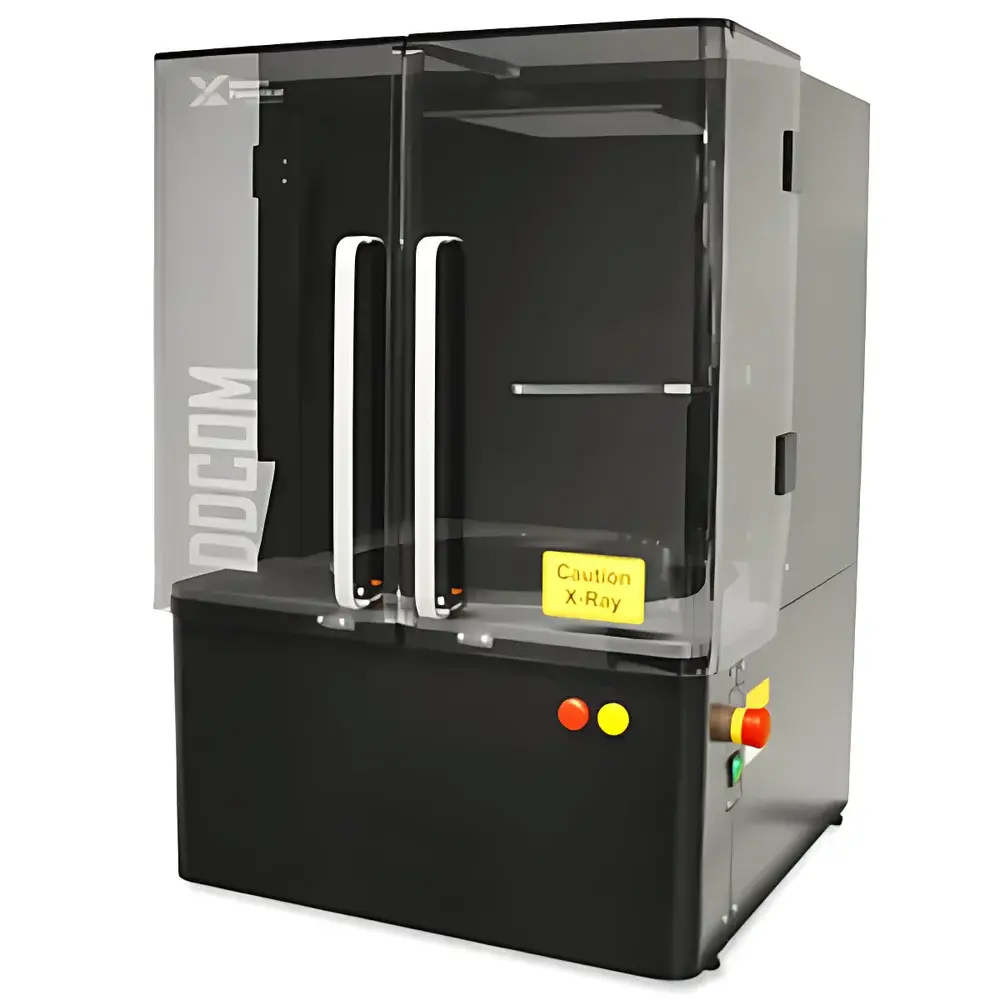
DDCOM Desktop X-ray Diffractometer by Malvern Panalytical
| Brand | Malvern Panalytical |
|---|---|
| Origin | Netherlands |
| Manufacturer Type | Original Equipment Manufacturer (OEM) |
| Product Category | Imported Instrument |
| Model | DDCOM |
| Instrument Type | Single-Crystal X-ray Diffractometer |
| X-ray Source | 30 W Air-Cooled Cu Anode Tube |
| Scan Speed | Up to 200× Faster Than Conventional θ-Scanning |
| Orientation Measurement Time | Full 3D Lattice Orientation Determined in ≤10 s |
| Angular Resolution | ≤0.01° (0.01 degree) |
| Sample Capacity | Wafers 2–12 inches |
| Compliance | Designed for ISO/IEC 17025-aligned QC environments, compatible with GLP/GMP documentation workflows |
Overview
The DDCOM Desktop X-ray Diffractometer by Malvern Panalytical is a compact, high-performance single-crystal X-ray diffractometer engineered for rapid, automated crystallographic orientation mapping. Based on Bragg’s law and precise angular detection of diffracted Cu-Kα radiation (λ = 1.5418 Å), the system delivers full three-dimensional lattice orientation solutions—comprising Euler angles (φ₁, Φ, φ₂) and misorientation tensors—without requiring manual goniometer alignment or iterative zone-axis indexing. Unlike conventional theta-scanning systems that rely on sequential angular stepping and intensity peak integration, the DDCOM employs a fixed-geometry, multi-detector acquisition strategy coupled with real-time kinematic modeling. This architecture enables complete orientation determination within ≤10 seconds per measurement point, making it suitable for inline quality assurance in semiconductor wafer manufacturing, photovoltaic ingot grading, and advanced ceramic sintering control.
Key Features
- Single-crystal orientation analysis with angular resolution better than 0.01°, traceable to NIST-certified reference standards
- Air-cooled 30 W microfocus Cu anode X-ray tube—eliminates external chiller infrastructure, reduces power consumption (<120 V AC, <0.5 A), and supports continuous operation in standard laboratory environments
- Integrated motorized sample stage with ±15° tilt and 360° rotation, programmable via G-code-compatible motion controller
- Preloaded crystallographic databases for cubic systems (e.g., Si, Ge, GaAs, Al₂O₃, MgO), with customizable lattice parameter input for non-standard or doped materials
- Modular optical path design accommodating optional laser alignment aids and CCD-based beam position monitoring
- CE-marked enclosure with interlocked shutter and dose-rate compliance per IEC 61010-1:2010 for Class 1 X-ray equipment
Sample Compatibility & Compliance
The DDCOM accommodates diverse sample geometries without reconfiguration: planar wafers (2″ to 12″ diameter), irregularly shaped castings, cylindrical rods, and bulk ingots up to 20 kg. Its open-stage architecture permits direct mounting using vacuum chucks, magnetic fixtures, or low-outgassing adhesive tapes—no dedicated sample holders required. All measurements adhere to ASTM E1397–22 (Standard Practice for Determination of Crystallographic Orientation by X-ray Diffraction) and are compatible with ISO 11171:2019 traceability frameworks for industrial metrology. Data export formats (HDF5, CIF, .csv) support audit-ready reporting under FDA 21 CFR Part 11 when deployed with validated software configurations and electronic signature modules.
Software & Data Management
Control and analysis are executed via Malvern Panalytical’s proprietary DDCOM Studio software—a Windows 10/11 native application built on Qt framework with deterministic real-time acquisition threading. The interface provides live diffraction pattern visualization, automatic Laue spot detection, and on-the-fly orientation matrix calculation using robust singular value decomposition (SVD) algorithms. All raw detector frames, metadata (sample ID, timestamp, environmental temperature/humidity logs), and processed orientation tensors are stored in hierarchical HDF5 containers with SHA-256 checksum integrity verification. Audit trails—including user login events, parameter changes, and report generation—are retained for ≥36 months and exportable as XML for third-party LIMS integration.
Applications
- Semiconductor fabrication: Rapid verification of wafer crystallographic plane alignment prior to epitaxial growth or ion implantation
- Photovoltaics: Batch-level orientation screening of multicrystalline silicon ingots to optimize sawing yield and minimize kerf loss
- Metallurgy R&D: Quantitative texture analysis of additively manufactured nickel superalloys and Ti-6Al-4V components
- Geosciences: Orientation mapping of quartz and feldspar grains in thin sections for paleostress reconstruction
- Academic crystallography labs: Teaching tool for Laue symmetry classification and reciprocal lattice visualization
FAQ
Is the DDCOM compliant with regulatory requirements for pharmaceutical or medical device manufacturing?
Yes—when configured with 21 CFR Part 11-compliant software options (electronic signatures, audit trail logging, and role-based access control), the DDCOM meets baseline data integrity requirements for GMP-regulated environments.
Can the system be integrated into an automated production line?
It supports Ethernet/IP and Modbus TCP protocols for PLC handshake signaling; OEM integration kits include digital I/O triggers for start/stop synchronization with robotic handlers.
Does the air-cooled X-ray source require periodic anode replacement?
The sealed-tube Cu anode has a rated lifetime of ≥8,000 operating hours under nominal 30 W conditions; no consumable anodes or beryllium window replacements are needed during normal use.
What calibration standards are supplied with the instrument?
Each unit ships with a certified Si (111) reference wafer (NIST-traceable d-spacing: 3.1355 Å ± 0.0002 Å) and a stainless-steel alignment gauge for geometric validation.
Is remote diagnostics supported?
Yes—Malvern Panalytical’s SecureConnect service enables encrypted remote assistance with granular permission controls and session recording for internal IT governance.
Related Products




