
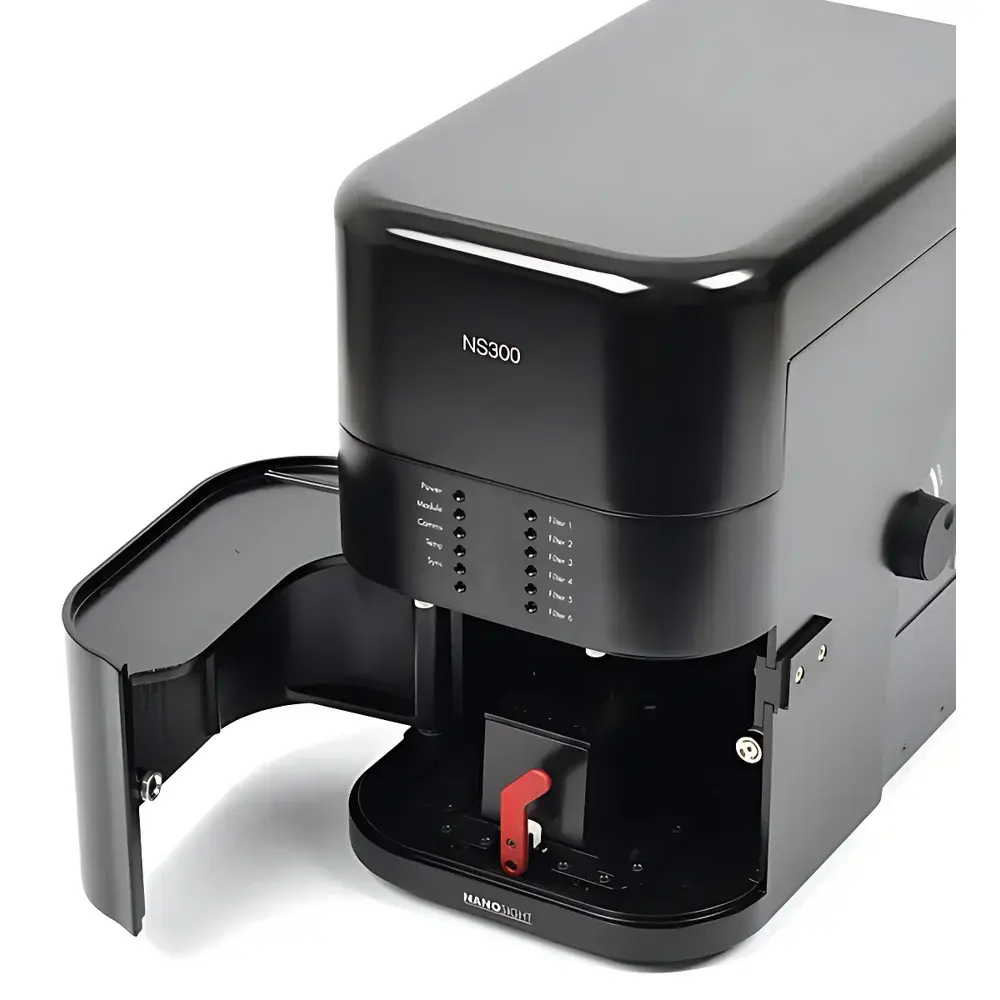
Malvern Panalytical NanoSight NS300 Nanoparticle Tracking Analysis (NTA) System
| Brand | Malvern Panalytical |
|---|---|
| Origin | United Kingdom |
| Manufacturer Type | Original Equipment Manufacturer (OEM) |
| Import Status | Imported |
| Model | NS300 |
| Pricing | Available upon Request |
Overview
The Malvern Panalytical NanoSight NS300 is a high-sensitivity, research-grade Nanoparticle Tracking Analysis (NTA) instrument engineered for direct visualization, real-time tracking, and quantitative characterization of nanoparticles in liquid suspension. Based on the physical principle of Brownian motion, the NS300 illuminates particles with a collimated laser beam and captures their scattered light using a scientific CMOS camera under controlled dark-field conditions—enabled by a precision-engineered metallic-coated optical chamber that eliminates ambient stray light. Each particle is individually resolved, tracked frame-by-frame across multiple video sequences, and its diffusion coefficient calculated via the Stokes–Einstein equation to derive hydrodynamic diameter. This first-principles, particle-by-particle approach delivers number-weighted size distributions with high resolution across the 10–2000 nm range—without reliance on ensemble-averaging assumptions inherent in dynamic light scattering (DLS). The system is particularly suited for heterogeneous, polydisperse, or low-concentration colloidal systems where conventional bulk techniques lack discrimination power.
Key Features
- Integrated high-sensitivity scientific CMOS sensor with adjustable exposure and frame rate for optimal signal-to-noise ratio across diverse particle types and concentrations
- Modular laser platform supporting four discrete wavelengths (405 nm, 488 nm, 532 nm, and 640 nm) to optimize scattering efficiency and minimize photobleaching in fluorescent applications
- Motorized fluorescence filter wheel accommodating up to five user-selectable bandpass filters, enabling sequential multi-color NTA analysis of labeled subpopulations (e.g., antibody-conjugated exosomes or dye-tagged liposomes)
- Pre-aligned optical path with fixed focal plane—users perform only vertical focus adjustment, reducing setup time and operator-induced variability
- Removable sample cell and laser module assembly designed for rapid cleaning, contamination control, and field-replaceable component maintenance without realignment
- Onboard temperature control unit maintaining sample stability within ±0.5 °C over measurement durations up to 60 seconds
Sample Compatibility & Compliance
The NS300 supports aqueous and organic suspensions, including biological fluids (serum, plasma, cell culture supernatants), purified exosome preparations, synthetic lipid nanoparticles, polymeric micelles, protein aggregates, and microbubbles. Its non-destructive, label-optional operation preserves native particle integrity. For regulated environments, the system supports audit-trail-enabled software operation compliant with GLP and GMP documentation requirements. Data files include embedded metadata (instrument ID, date/time stamp, laser wavelength, filter position, temperature, video duration, and calibration parameters), ensuring traceability per ISO 22412:2017 and ASTM E2490-20 standards for nanoparticle size analysis. Fluorescence workflows align with USP guidance for extracellular vesicle characterization.
Software & Data Management
NanoSight NTA Software v3.4+ provides intuitive acquisition control, automated particle detection thresholding, and advanced post-processing tools—including intensity-based gating, cluster removal algorithms, and batch analysis across multiple videos. Raw AVI video files and processed .csv/.xlsx outputs are stored with full metadata linkage. The software includes an optional rheology module that introduces calibrated polystyrene tracer beads into the sample; by tracking their diffusion under zero-shear conditions, it calculates viscosity in the range of 0.4–5.0 mPa·s for non-Newtonian fluids—supporting formulation development in biopharmaceutical and nanomedicine contexts. All software operations comply with FDA 21 CFR Part 11 requirements when configured with electronic signatures and role-based access controls.
Applications
- Quantitative sizing and concentration determination of extracellular vesicles (exosomes, microvesicles) in biomarker discovery and therapeutic monitoring
- Stability assessment of protein therapeutics during aggregation studies under thermal or mechanical stress
- Characterization of lipid nanoparticles (LNPs) and polymeric delivery systems for mRNA and siRNA therapeutics
- Multi-parameter validation of nanoparticle synthesis batches—correlating size, count, fluorescence signature, and dispersion homogeneity
- In-process monitoring of nanocarrier loading efficiency and surface functionalization via dual-channel fluorescence NTA
- Viscosity profiling of low-volume biological formulations where conventional rheometers require excessive sample volumes
FAQ
What sample volume is required per measurement?
Typical analysis uses 300–600 µL of diluted suspension, loaded via syringe into a standardized capillary sample cell.
Can the NS300 distinguish between empty and drug-loaded liposomes?
Yes—when combined with appropriate fluorescent dyes (e.g., membrane- vs. cargo-labeling), differential scattering intensity and fluorescence co-localization enable subpopulation resolution.
Is calibration required before each run?
Instrument calibration is performed once per laser wavelength using NIST-traceable polystyrene standards; subsequent measurements retain calibration until wavelength or optics configuration changes.
Does the system support automated data export for LIMS integration?
Yes—CSV and XML exports include all raw metrics and metadata; API-compatible interfaces are available for enterprise-level laboratory information management system (LIMS) integration.
How is reproducibility ensured across operators and laboratories?
Standardized SOP templates, built-in reference checks, inter-laboratory validation datasets, and ISO/IEC 17025-aligned performance verification protocols are provided with the system.



