
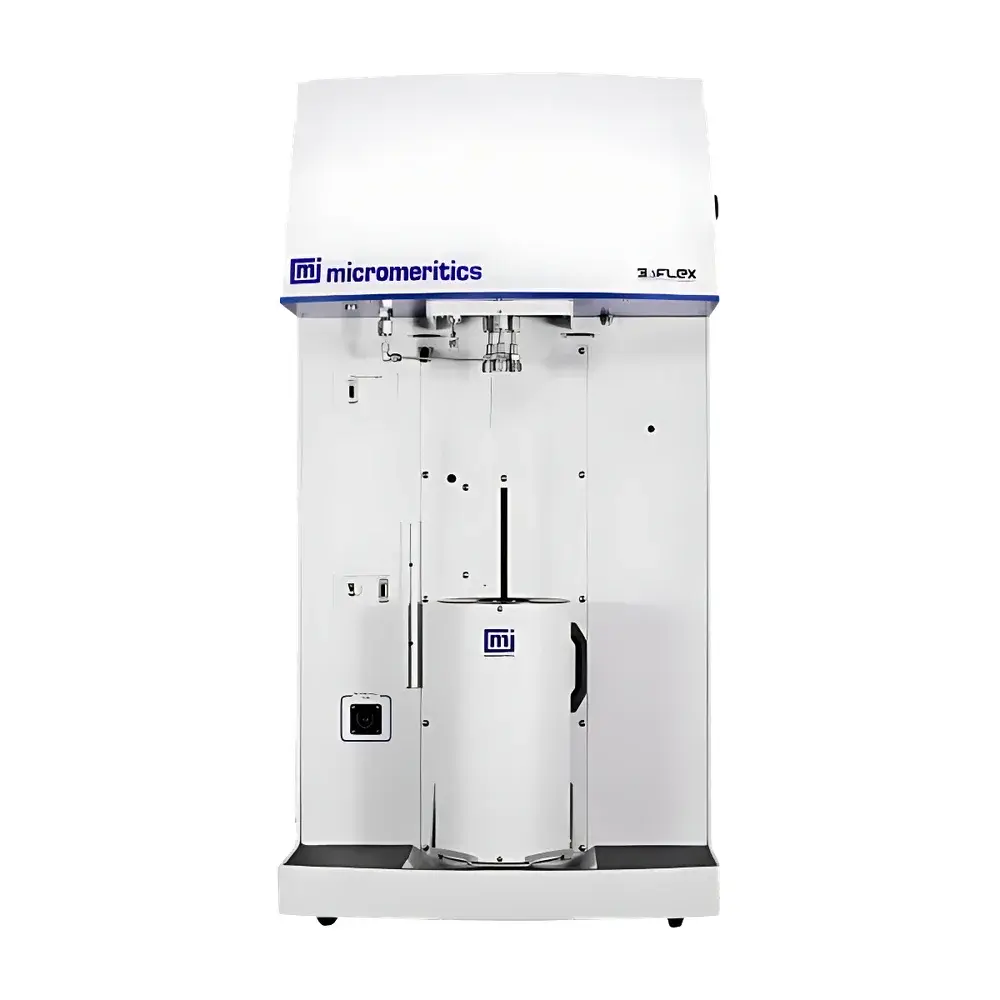
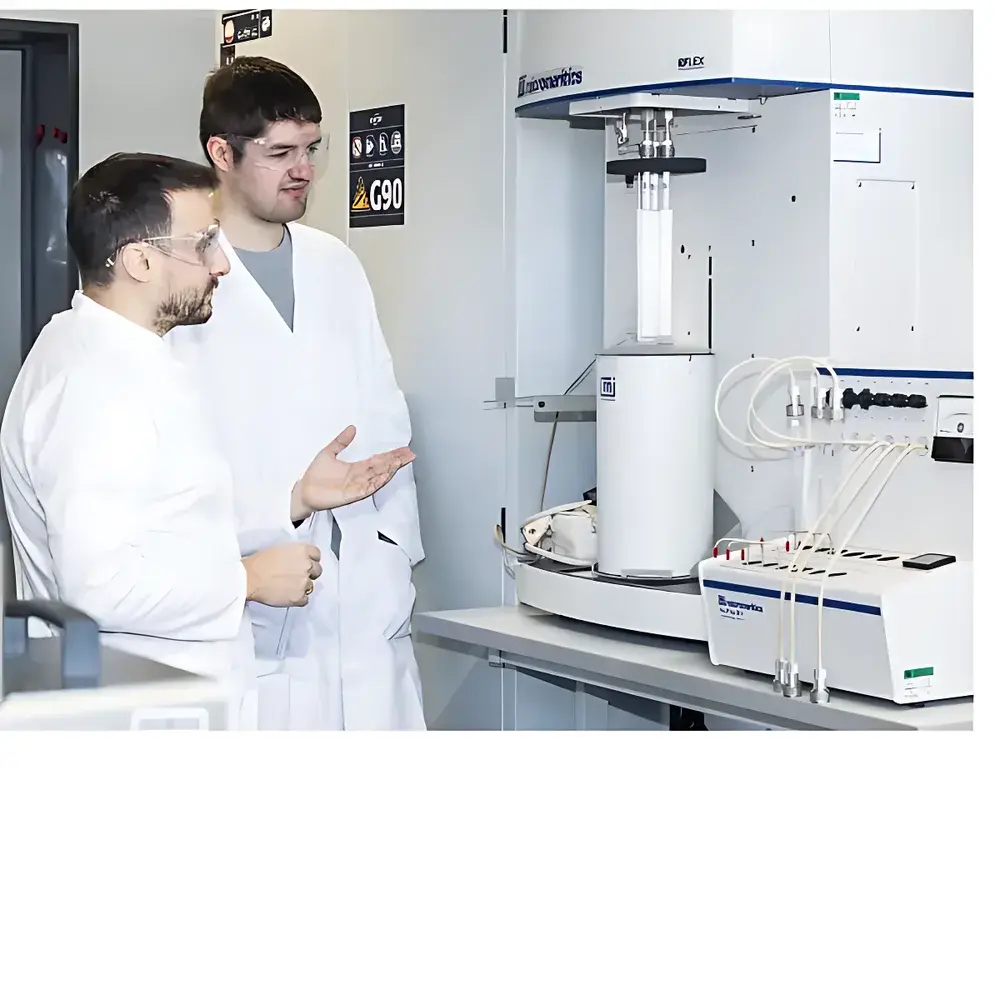
Micromeritics 3Flex High-Performance Gas Sorption Analyzer
| Brand | Malvern Panalytical |
|---|---|
| Origin | USA |
| Manufacturer | Micromeritics Instrument Corp. |
| Type | Specific Surface Area and Pore Size Analyzer |
| Principle | Static and Dynamic Gas Sorption |
| Number of Analysis Stations | 3 |
| Micropore Range | < 2 nm |
| Steam Adsorption Capability | Standard |
| Chemisorption Options | Static, Dynamic (TPR/TPO/TPD/TPSR), Pulse |
| Temperature Control Range | Up to 1100 °C (±1 °C) |
| Pressure Sensing | Ultra-low-range 0.1 Torr sensor for micropore analysis |
| Vacuum Performance | Metal-sealed manifold with ultra-low outgassing rate |
| Software | MicroActive™ Data Reduction Suite |
| Compliance | ASTM D3663, ISO 9277, ISO 15901, USP <846>, IUPAC Recommendations |
Overview
The Micromeritics 3Flex High-Performance Gas Sorption Analyzer is an advanced, tri-station instrumentation platform engineered for comprehensive characterization of porous and non-porous solid materials via gas and vapor sorption. It operates on the fundamental principles of physical adsorption (physisorption), chemical adsorption (chemisorption), and vapor sorption—each governed by distinct thermodynamic and kinetic mechanisms. Physisorption measurements follow IUPAC-recommended isotherm protocols (Type I–IV), enabling precise determination of specific surface area (BET, Langmuir), pore size distribution (NLDFT, QSDFT, BJH), total pore volume, and micropore volume (<2 nm) using nitrogen, argon, or krypton at cryogenic temperatures. Chemisorption functionality—enabled by integrated thermal conductivity detection (TCD), programmable temperature ramps, and pulse injection capability—supports quantitative assessment of active metal surface area, dispersion, and catalyst reducibility through TPR, TPO, TPD, and TPSR experiments. The system’s modular architecture permits concurrent or sequential execution of physisorption, chemisorption, and vapor sorption on a single sample without manual transfer—minimizing exposure artifacts and enhancing measurement integrity.
Key Features
- Triple independent analysis stations with fully configurable sensor suites—including a dedicated 0.1 Torr high-sensitivity transducer optimized for ultramicropore (<0.7 nm) characterization.
- Chemically inert, all-metal vacuum manifold with VCR fittings and hard-seal valves, delivering ultimate base pressure stability (<1×10⁻⁷ Torr) and minimal outgassing—critical for low-pressure isotherm fidelity and oxygen-sensitive material handling.
- Integrated high-precision mass flow controllers (MFCs) and servo-controlled dosing valves enabling reproducible, automated gas dosing across wide pressure ranges—from 10⁻⁶ Torr to atmospheric—with resolution down to 0.001 cm³ (STP).
- Programmable high-temperature furnace (up to 1100 °C, ±1 °C accuracy) with real-time local loop temperature monitoring for TCD-based dynamic chemisorption, ensuring thermal uniformity during ramped experiments.
- Standard steam adsorption module with optional heated vapor source (up to 80 °C), supporting hydrophilicity/hydrophobicity mapping and moisture uptake kinetics in pharmaceutical excipients, MOFs, and zeolites.
- Up to sixteen gas inlets with independent MFC control, facilitating multi-probe gas studies (e.g., CO, H₂, NH₃, O₂, CO₂, H₂O) for selective surface site quantification and reaction mechanism elucidation.
Sample Compatibility & Compliance
The 3Flex accommodates a broad spectrum of powdered, granular, and monolithic samples—including catalysts, metal–organic frameworks (MOFs), activated carbons, zeolites, pharmaceutical active ingredients (APIs), excipients, battery electrode materials, and ceramic precursors. Sample preparation is supported in situ via integrated degas modules with programmable temperature and vacuum profiles, compliant with ASTM D3663 (BET surface area), ISO 9277 (gas adsorption for surface area), ISO 15901 (pore size distribution), and USP (porosity testing for pharmaceutical solids). For regulated environments, MicroActive™ software supports audit trails, electronic signatures, and 21 CFR Part 11-compliant data management when deployed with validated configurations. All chemisorption protocols align with IUPAC guidelines for catalyst characterization, and TPR/TPO data reduction adheres to accepted peak deconvolution and quantification standards under GLP/GMP frameworks.
Software & Data Management
MicroActive™ software serves as the unified interface for instrument control, real-time data acquisition, and advanced post-processing. It provides automated isotherm collection with adaptive dosing algorithms—balancing speed and resolution across low- and high-uptake regions. Built-in models include BET, Langmuir, t-plot, αs-method, NLDFT, QSDFT, and BJH, with user-definable kernel libraries for custom pore geometry assumptions. For chemisorption, MicroActive™ enables full TCD signal integration, baseline correction, peak fitting (Gaussian/Lorentzian), and stoichiometric conversion to active site density (e.g., µmol H₂/g, m²/g). Data export complies with ASTM E1452 (digital data exchange) and supports CSV, XML, and PDF report generation with embedded metadata (instrument ID, operator, calibration logs, environmental conditions). Raw data files are stored in vendor-neutral HDF5 format, ensuring long-term archival integrity and third-party analysis compatibility.
Applications
The 3Flex delivers critical performance metrics across R&D and QC workflows: catalyst development (metal dispersion, support interaction, sintering resistance), battery material optimization (electrode porosity, SEI layer formation), pharmaceutical formulation (excipient surface energetics, moisture-induced phase transitions), carbon capture material screening (CO₂ uptake capacity, selectivity), and nanomaterial synthesis validation (MOF crystallinity, defect density). Its ability to correlate structural parameters (surface area, pore volume) with functional behavior (adsorption enthalpy, acid/base site density, redox activity) makes it indispensable for mechanistic studies in heterogeneous catalysis, separation science, and energy storage. Regulatory submissions for drug product dossiers routinely reference 3Flex-derived surface area and pore data per ICH Q5C and Q5D guidance.
FAQ
Can the 3Flex perform both physisorption and chemisorption on the same sample without removal from the instrument?
Yes—its modular port architecture and automated gas switching allow sequential or interleaved physisorption, vapor sorption, and chemisorption analyses under controlled atmosphere, preserving sample integrity.
What is the lowest measurable surface area using krypton on the 3Flex?
With the optional Kr port configuration and extended dosing protocols, the system reliably quantifies surfaces down to ~0.01 m²/g for low-area ceramics and dense oxides.
Does the 3Flex support in situ activation under reactive gases (e.g., H₂ reduction) prior to chemisorption?
Yes—integrated mass flow control, furnace programming, and real-time TCD monitoring enable full in situ pretreatment sequences, including reduction, oxidation, and passivation steps.
How does the 3Flex ensure reproducibility across multiple labs?
Through standardized hardware calibration (NIST-traceable pressure sensors, certified gas standards), SOP-driven software workflows, and inter-laboratory validation packages aligned with ISO/IEC 17025 requirements.
Is remote diagnostics and software update capability available?
Yes—secure HTTPS-based remote access enables firmware updates, diagnostic logging, and technical support intervention without onsite visits, subject to customer-configured network policies.
Related Products



