
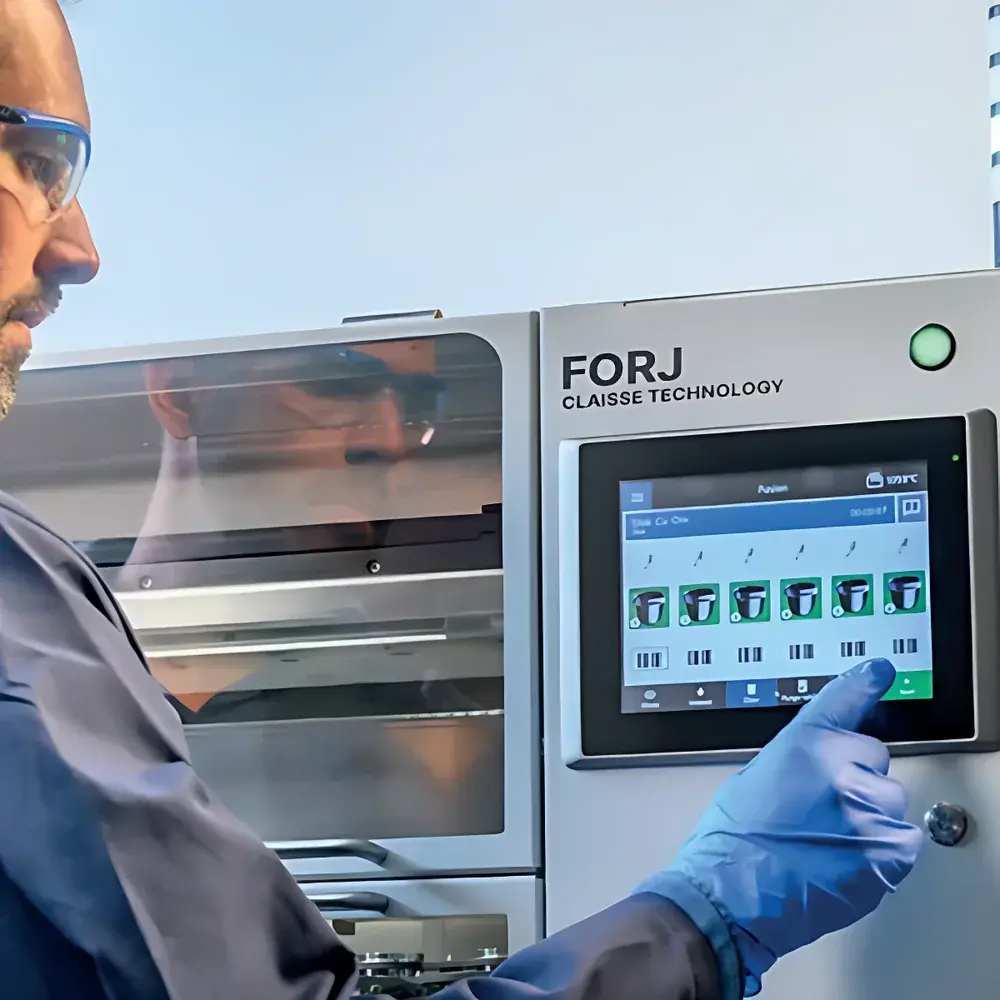
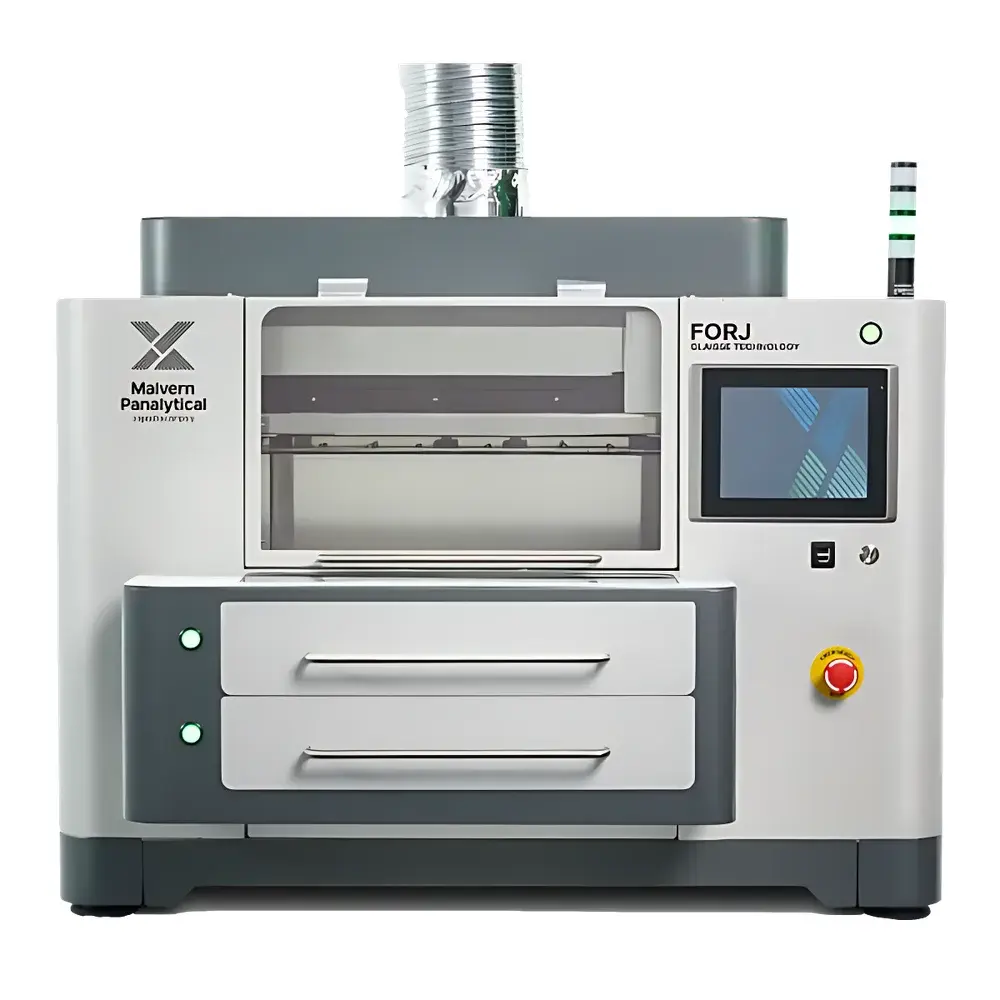
Malvern Panalytical FORJ “Huǒ Xīng” Fusion Machine
| Brand | Malvern Panalytical |
|---|---|
| Origin | Canada |
| Manufacturer Type | Original Equipment Manufacturer (OEM) |
| Origin Category | Imported |
| Model | FORJ |
| Sample Capacity | Up to 12 samples per run (dual crucible & mold carrier configuration) |
| Maximum Operating Temperature | 1250 °C |
| Temperature Control Accuracy | ±2.5 °C at 1050 °C |
| Dimensions (L×W×D) | 71 cm × 102 cm × 72 cm |
Overview
The Malvern Panalytical FORJ “Huǒ Xīng” Fusion Machine is a high-precision, laboratory-grade fusion instrument engineered for the reproducible preparation of homogeneous glass beads from solid inorganic samples—primarily for subsequent elemental analysis by X-ray fluorescence (XRF), inductively coupled plasma optical emission spectrometry (ICP-OES), or atomic absorption spectroscopy (AAS). It employs resistive heating within a refractory-lined furnace chamber to achieve controlled, uniform melting of sample–flux mixtures under inert or oxidizing atmospheres. The system is designed around Claisse’s legacy of fusion methodology, integrating robust thermal architecture and precise thermal profiling to minimize thermal gradients across the crucible array. This ensures consistent melt viscosity, complete dissolution of refractory phases, and minimal volatilization loss—critical prerequisites for trace- and major-element quantification with sub-ppm accuracy and long-term method stability.
Key Features
- High-throughput dual-carrier design supports simultaneous loading of two independent crucible & mold assemblies—enabling up to 12 fused beads per cycle without manual intervention between runs.
- Stable temperature control up to 1250 °C with ±2.5 °C accuracy maintained at 1050 °C, verified via calibrated thermocouple feedback and PID-controlled power regulation.
- Thermally optimized furnace cavity with low-thermal-mass insulation and symmetric heating elements minimizes radial and axial temperature deviation across the sample zone (<±3 °C over full crucible plane).
- Low-maintenance mechanical architecture featuring sealed bearing actuators, corrosion-resistant alloy components, and modular crucible carriers—designed for >10,000 operational cycles under routine lab conditions.
- Compact footprint (71 × 102 × 72 cm) enables integration into standard fume hood bays or dedicated prep rooms without requiring auxiliary cooling or reinforced flooring.
- Compliance-ready hardware interface supports optional integration with LIMS via RS-232/RS-485 or Ethernet (Modbus TCP), enabling audit-trail-capable run logging aligned with GLP and ISO/IEC 17025 requirements.
Sample Compatibility & Compliance
The FORJ accommodates standard platinum–gold (Pt–Au) or graphite crucibles (typically 30–40 mL capacity) and matching borosilicate or fused quartz molds. It is validated for use with common flux systems including lithium tetraborate (Li₂B₄O₇), lithium metaborate (LiBO₂), and mixed-flux formulations (e.g., Li₂B₄O₇/LiBO₂ 67:33 w/w) for silicates, oxides, ores, slags, ceramics, and geological matrices. Method development aligns with ASTM D5630 (for ash fusion), ISO 9556 (iron and steel—determination of carbon), and USP (melting point and related procedures). All thermal protocols are fully programmable and exportable for regulatory documentation; temperature ramps, hold times, and gas purge sequences comply with FDA 21 CFR Part 11 when paired with validated software modules.
Software & Data Management
The FORJ operates via an embedded industrial touchscreen HMI running a deterministic real-time OS. Each fusion sequence is stored with timestamp, operator ID, crucible position map, thermal profile log (sampled at 1 Hz), and final soak temperature confirmation. Raw data exports as CSV or XML for traceability; optional PC-based FusionManager™ software provides advanced scheduling, calibration certificate management, and statistical process control (SPC) charting for melt homogeneity metrics (e.g., bead diameter variance, surface flatness index). Audit trails include user login/logout events, parameter modification history, and firmware version stamping—fully compliant with GMP Annex 11 and ISO 13485 documentation frameworks.
Applications
- Routine geochemical analysis of exploration core samples and mine tailings via wavelength-dispersive XRF.
- Quality control of cement clinker, fly ash, and supplementary cementitious materials (SCMs) per ASTM C114 and EN 196-2.
- Metallurgical grade validation of nickel laterite, bauxite, and rare-earth concentrates prior to hydrometallurgical processing.
- Regulatory testing of hazardous waste leachates (TCLP/SPLP) where matrix-matched fused beads eliminate interferences in ICP-MS multi-element screening.
- Reference material certification workflows requiring ≤0.5% RSD between replicate beads across ≥100-run batches.
FAQ
What types of fluxes are compatible with the FORJ system?
Standard alkaline borate fluxes—including lithium tetraborate, lithium metaborate, and their binary mixtures—are fully supported. High-temperature fluoroborate and ammonium nitrate-assisted fluxes require pre-validation due to exothermic decomposition profiles.
Is the FORJ suitable for fusion of halogen-rich samples such as PVC ash or marine sediments?
Yes, provided appropriate crucible material (e.g., Pt–5% Au) and flux ratios are selected to suppress halogen-induced corrosion; recommended protocols are documented in Malvern Panalytical Application Note AN-FUS-027.
Can the FORJ be integrated into an automated sample prep line?
It features standardized pneumatic and electrical I/O ports, Modbus-compatible communication, and mechanical interlock signals—enabling seamless integration with robotic arms and conveyor-based sample handlers per SEMI E10 standards.
What maintenance intervals are recommended for routine operation?
No scheduled preventive maintenance is required within the first 2,000 operating hours; annual thermocouple verification and crucible carrier alignment check are advised thereafter per ISO 17025 clause 6.4.3.
Does the system support custom thermal ramp profiles for novel sample matrices?
Yes—up to 20-step programmable profiles with independent ramp rates (0.1–50 °C/min), dwell times (1–300 min), and atmosphere control (N₂, Ar, or air) are configurable via the HMI or FusionManager™.



