
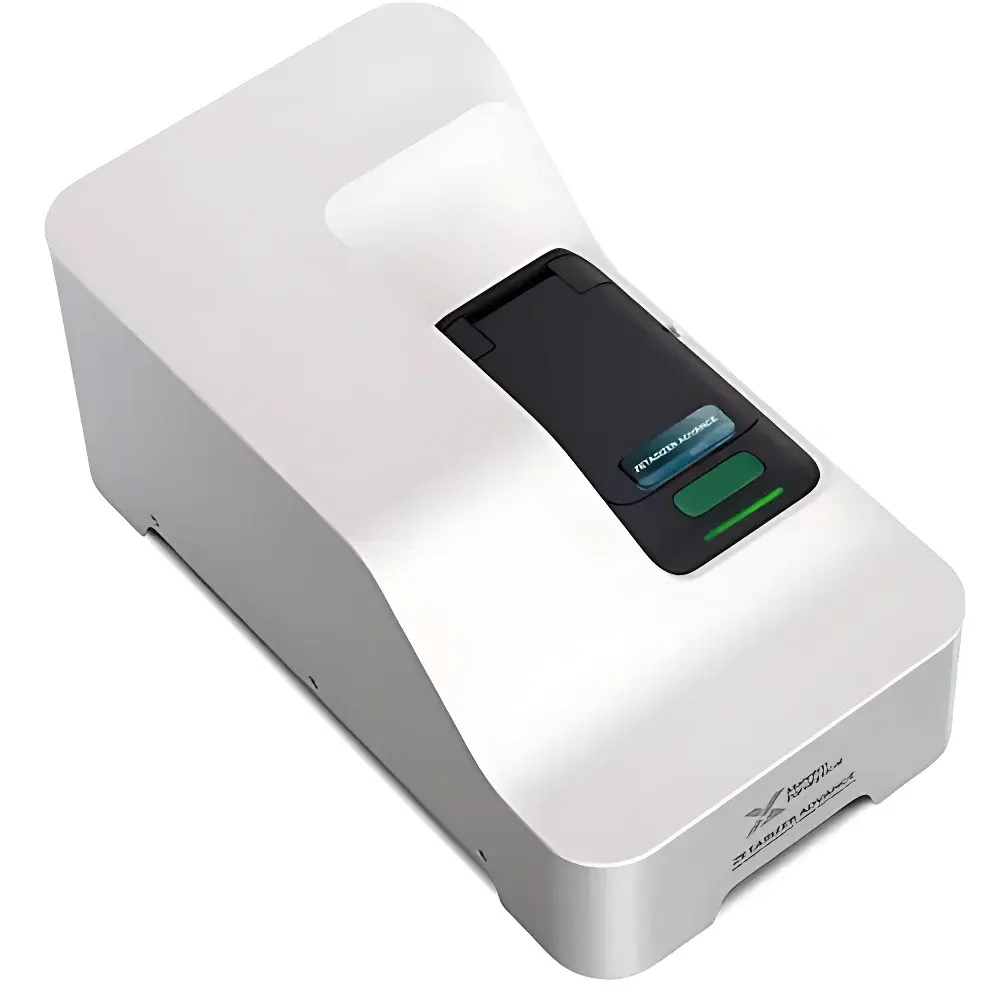
Malvern Panalytical Zetasizer Pro Nanoparticle Size and Zeta Potential Analyzer
| Brand | Malvern Panalytical |
|---|---|
| Origin | United Kingdom |
| Manufacturer Type | Original Equipment Manufacturer (OEM) |
| Import Status | Imported |
| Model Options | Blue Label and Red Label configurations |
| Particle Size Range | 0.3 nm – 10 µm |
| Size Measurement Repeatability | ±2% |
| Temperature Control Range | 10–35 °C |
| Temperature Stability | ±0.1 °C |
| Detection Principle | Non-Invasive Back Scatter (NIBS) Dynamic Light Scattering (DLS) |
| Minimum Sample Volume | 12 µL |
| Sample Concentration Range | 0.1 mg/mL – 40% w/v |
| Zeta Potential Range | No practical lower or upper limit under standard operational conditions |
| Typical Measurement Time | 3–5 minutes per analysis |
| Molecular Weight Range | 980 Da – 20 MDa |
Overview
The Malvern Panalytical Zetasizer Pro is a high-performance, benchtop nanoparticle characterization system engineered for precision measurement of hydrodynamic size, size distribution, zeta potential, electrophoretic mobility, and molecular weight in colloidal and macromolecular systems. It employs Non-Invasive Back Scatter (NIBS) technology—a patented optical configuration that combines variable measurement position, high-efficiency fiber optics, and optimized backscatter detection—to extend the dynamic range of conventional Dynamic Light Scattering (DLS) and Electrophoretic Light Scattering (ELS). Unlike traditional 90° or 173° DLS setups, NIBS enables robust signal acquisition across an exceptionally broad concentration range—from dilute biomolecules to highly concentrated industrial dispersions—without sample dilution or path-length adjustment. The instrument operates on first-principles physics: Brownian motion analysis via autocorrelation of intensity fluctuations (DLS), and phase-analysis light scattering (PALS) with M3-PALS constant-current mode for reliable zeta potential determination in conductive media (up to 200 mS/cm). Its integrated thermostatic cell compartment maintains temperature stability within ±0.1 °C over 10–35 °C, ensuring thermodynamic reproducibility essential for stability screening and formulation development.
Key Features
- Non-Invasive Back Scatter (NIBS) optics enabling simultaneous high-sensitivity detection across 0.3 nm–10 µm particle size range
- M3-PALS (Multi-Mode Phase Analysis Light Scattering) with constant-current electrophoresis for accurate zeta potential measurement in high-conductivity buffers, including physiological saline and formulation excipients
- ZS Xplorer software featuring sample-centric workflow design, guided method setup, and automated model selection (e.g., regularization, CONTIN, NNLS)
- “Adaptive Correlation” algorithm—accelerates correlation function computation by >2× versus prior-generation instruments while preserving statistical rigor and data fidelity
- AI-powered Data Quality System leveraging deep learning to diagnose common artifacts (e.g., dust contamination, aggregation onset, poor signal-to-noise) and recommend corrective actions
- Motorized filter wheel supporting fluorescence filters and orthogonal polarizers (vertical/horizontal) for advanced anisotropy and depolarization studies
- Modular architecture supporting field-upgradeability to Zetasizer Ultra functionality, including multi-angle DLS and automated titration via MPT-3 module
- Comprehensive consumables portfolio: disposable capillaries (12–50 µL), reusable quartz cells, low-volume cuvettes, and dip-cell accessories for heterogeneous or viscous samples
Sample Compatibility & Compliance
The Zetasizer Pro accommodates aqueous and organic dispersions, proteins, liposomes, polymeric nanoparticles, micelles, emulsions, pigments, and inorganic colloids. Its 12 µL minimum volume requirement supports precious or low-yield biologics; the 0.1 mg/mL–40% w/v concentration tolerance eliminates routine dilution errors. All measurements comply with ISO 22412:2017 (DLS), ISO 13099-2:2012 (zeta potential), and USP (particle size distribution of pharmaceuticals). Data integrity meets FDA 21 CFR Part 11 requirements when deployed with audit-trail-enabled ZS Xplorer configuration, including electronic signatures, user access controls, and immutable raw-data archiving. Instrument qualification protocols align with ICH Q5A(R2), Q5C, and GMP Annex 11 for biopharmaceutical stability studies.
Software & Data Management
ZS Xplorer is a purpose-built, role-based software platform supporting GLP/GMP-compliant operation. It provides template-driven SOP execution, customizable reporting (PDF/CSV/XLSX), batch processing, and metadata-rich data storage (including instrument parameters, environmental logs, and operator annotations). Advanced analysis modules include diffusion interaction parameter (kD) calculation, second virial coefficient (B22) estimation, and continuous size distribution deconvolution with error propagation modeling. Raw correlator data is retained in vendor-neutral .DTA format for third-party reanalysis. Integration with LIMS and ELN systems is supported via RESTful API and ODBC connectivity.
Applications
- Biopharmaceutical Development: Rapid assessment of monoclonal antibody aggregation propensity, PEGylated protein stability, mRNA-LNP encapsulation efficiency, and forced-degradation kinetics under thermal/pH stress
- Nanomaterial R&D: Characterization of quantum dots, metal-organic frameworks (MOFs), and catalytic nanocarriers—correlating size dispersity, surface charge, and colloidal stability in functional media
- Food & Beverage Science: Monitoring emulsion droplet coalescence in plant-based dairy alternatives, optimizing pectin-stabilized juice cloud stability, and quantifying starch nanoparticle dispersion in functional beverages
- Coatings & Inks: Quantifying pigment dispersion quality, predicting shelf-life of waterborne acrylic paints, and evaluating surfactant-mediated stabilization of carbon black suspensions
- Consumer Products: Critical micelle concentration (CMC) determination for novel surfactants, zeta potential mapping of cosmetic emulsions across pH gradients, and rheo-optical stability profiling of silicone-based hair conditioners
FAQ
What is the minimum required sample volume for reliable DLS measurement?
12 µL using the low-volume disposable capillary cell—no air bubble correction needed due to integrated meniscus detection.
Can the Zetasizer Pro measure zeta potential in 150 mM NaCl buffer?
Yes—M3-PALS constant-current mode ensures stable electrophoretic mobility measurement up to 200 mS/cm conductivity without electrode polarization artifacts.
Is molecular weight determination absolute or calibration-dependent?
It is derived from translational diffusion coefficient (Dt) via the Stokes-Einstein equation and requires only solvent viscosity and temperature inputs—no calibration standards are necessary.
How does the Data Quality System improve measurement reliability?
It applies convolutional neural networks trained on >10,000 expert-annotated correlation functions to flag outliers, recommend optimal sub-runs, and suggest parameter adjustments—reducing operator-dependent interpretation bias.
Are firmware updates and software patches included post-purchase?
Yes—Malvern Panalytical provides free lifetime firmware and ZS Xplorer updates as part of standard support, including regulatory-compliance enhancements and new analysis algorithms.
Related Products



