
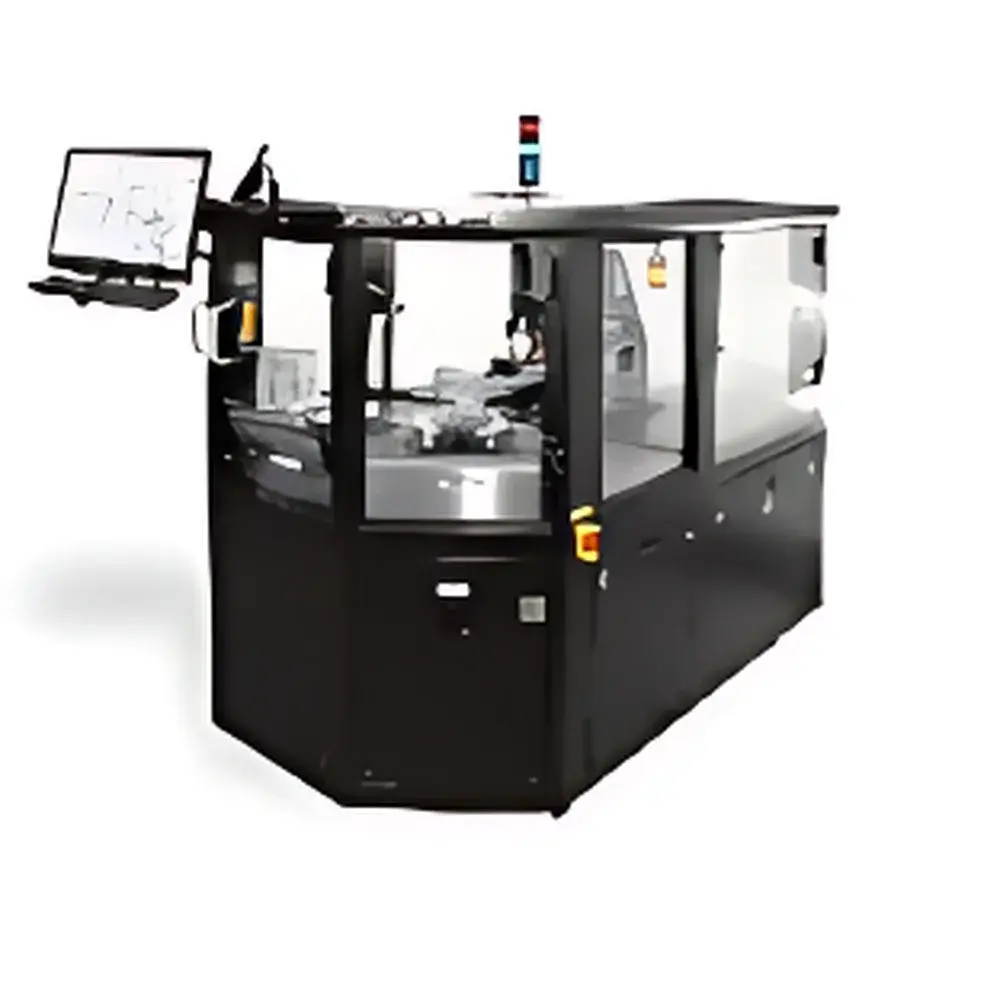
Malvern Panalytical Wafer XRD Automated Single-Crystal X-ray Diffractometer
| Brand | Malvern Panalytical |
|---|---|
| Origin | Netherlands |
| Manufacturer Type | Original Equipment Manufacturer (OEM) |
| Import Status | Imported |
| Model | Wafer XRD |
| Instrument Type | Single-Crystal X-ray Diffractometer |
| Sample Size Compatibility | 3-inch to 8-inch wafers (custom FOUPs, carriers, or single-wafer stages available) |
| Measurement Speed | <10 seconds per wafer |
| Typical Standard Deviation (Tilt Angle) | <0.003° for Si(100) |
| X-ray Source Options | Air-cooled microfocus Cu-target tube (30 W) or water-cooled fine-focus Cu-target tube (1.5 kW) |
| Safety Compliance | Fully CE-compliant with integrated interlock and three-color tower light status indication |
| Interface Protocols | SEMI-compliant MES and SECS/GEM |
| Optional Modules | Resistivity measurement (0.01–0.020 Ω·cm), automated matrix/QR/barcode recognition, unpolished & mirror-surface distance metrology |
| Material Support | Si, SiC, GaAs, GaN, Sapphire (Al₂O₃), Ge, AlN, Quartz, InP, and >100 additional crystalline semiconductor substrates |
Overview
The Malvern Panalytical Wafer XRD is an industrial-grade, fully automated single-crystal X-ray diffractometer engineered for high-throughput structural metrology in semiconductor front-end manufacturing. It operates on Bragg’s law-based θ–2θ scanning geometry, utilizing monochromatic Cu-Kα radiation to determine crystallographic orientation, lattice tilt (e.g., off-cut angle), strain, and epitaxial layer quality across full-diameter wafers. Designed for integration into 24/7 fab environments, the system delivers sub-arcsecond angular resolution and traceable repeatability—critical for monitoring wafer-level process consistency in silicon, compound semiconductor, and wide-bandgap device fabrication. Its rigid granite base, motorized goniometer with high-resolution encoders, and vacuum-compatible optical path ensure long-term mechanical stability and minimal thermal drift during continuous operation.
Key Features
- Fully automated wafer handling for 3″ to 8″ substrates, with optional support for custom FOUPs, SMIF pods, or single-wafer chucks—enabling seamless inline or offline deployment.
- Sub-10-second measurement cycle time per wafer, achieved via optimized scan trajectories, real-time peak detection algorithms, and hardware-accelerated data acquisition.
- Dual X-ray source configuration: selectable air-cooled microfocus (30 W) for low-heat-load applications or water-cooled fine-focus (1.5 kW) for high-intensity diffraction from low-scattering materials such as SiC or GaN.
- Integrated three-color tower light (red/amber/green) provides at-a-glance operational status—compliant with SEMI E10 and factory floor visual management standards.
- CE-certified safety architecture including dual-channel door interlocks, beam shutter control, and radiation monitoring—fully aligned with IEC 61000-6-2/6-4 and EU Machinery Directive 2006/42/EC.
- Robust mechanical design validated for >1,000,000 annual wafer measurements under Class 100 cleanroom conditions (ISO 14644-1).
Sample Compatibility & Compliance
The Wafer XRD supports a broad spectrum of crystalline semiconductor materials—including Si, SiC, GaAs, GaN, Al₂O₃ (sapphire), Ge, AlN, quartz, and InP—with proven performance across both polished and unpolished surfaces. Its non-contact, non-destructive measurement principle eliminates risk of surface contamination or mechanical damage. The system complies with key industry standards: SEMI S2/S8 (safety and ergonomics), SEMI E30 (data collection), SEMI E40 (equipment communications), and ISO/IEC 17025 requirements for calibration traceability. Optional resistivity module enables concurrent electrical characterization per ASTM F84–22, supporting joint structural-electrical qualification workflows.
Software & Data Management
Controlled by Malvern Panalytical’s proprietary eXpert™ software suite, the Wafer XRD supports full audit trail logging, user role-based access control (RBAC), and electronic signature capability compliant with FDA 21 CFR Part 11 and EU Annex 11. All measurement metadata—including goniometer positions, intensity profiles, peak fitting parameters, and barcode/DMC validation logs—are stored in structured SQLite or ODBC-accessible databases. Native SECS/GEM and MES interface drivers enable bidirectional communication with host factory systems for recipe dispatch, lot tracking, and SPC-triggered feedback loops. Raw diffraction data exports in CIF, XYE, and HDF5 formats ensure compatibility with third-party crystallographic analysis tools (e.g., GSAS-II, TOPAS, JADE).
Applications
- Wafer-level crystallographic orientation verification pre-epitaxy or post-lapping.
- Off-angle metrology for Si(100), Si(111), and compound substrate grading in epitaxial reactor qualification.
- Strain mapping in strained-Si, SiGe, and III–V heterostructures using rocking curve analysis.
- Crystal quality screening of GaN-on-sapphire templates for LED and power electronics manufacturing.
- Automated incoming inspection of reclaimed or recycled wafers using DMC-based lot traceability.
- Inline process monitoring of CMP endpoint via lattice tilt shift correlation with removal rate.
FAQ
Is the Wafer XRD compatible with 12-inch wafers?
Yes—custom configurations with extended stage travel and modified FOUP interfaces are available upon request; lead time and qualification requirements apply.
Can the system perform reciprocal space mapping (RSM)?
RSM capability is supported via optional omega-phi two-axis goniometer upgrade and dedicated eXpert RSM module—subject to beamline alignment and detector field-of-view constraints.
Does the resistivity option meet ASTM F84 specifications?
Yes—the four-point probe module is calibrated per ASTM F84–22 and includes NIST-traceable reference wafers for daily verification.
What cybersecurity protocols are implemented for network-connected operation?
All Ethernet interfaces support TLS 1.2+ encryption, VLAN segmentation, and configurable firewall rules aligned with ISA/IEC 62443-3-3 Level 2 requirements.
How is measurement uncertainty quantified and reported?
Uncertainty budgets follow GUM (JCGM 100:2008) methodology, incorporating contributions from encoder resolution, thermal expansion, beam divergence, and statistical peak fitting—documented in the system’s Certificate of Conformance.






