
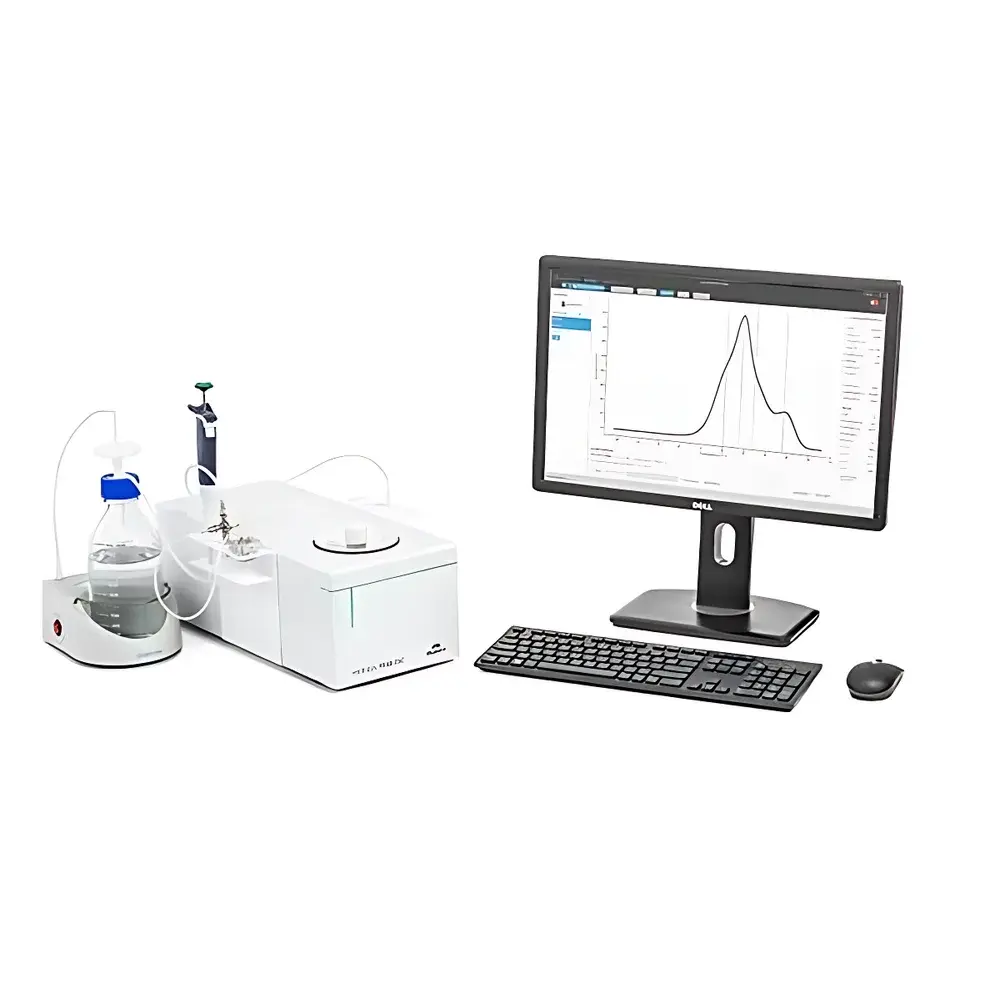
Malvern Panalytical MicroCal PEAQ-DSC Differential Scanning Calorimeter
| Brand | Malvern Panalytical |
|---|---|
| Origin | USA |
| Manufacturer Type | Original Equipment Manufacturer (OEM) |
| Origin Category | Imported Instrument |
| Model | MicroCal PEAQ-DSC |
| Sample Throughput | Multiple samples per run (manual loading) |
| Instrument Type | Differential Scanning Calorimeter (DSC) |
| Temperature Range | –10 °C to 130 °C (expandable) |
Overview
The Malvern Panalytical MicroCal PEAQ-DSC is a high-sensitivity, benchtop differential scanning calorimeter engineered for the precise thermodynamic characterization of biomolecules in solution. It operates on the fundamental principle of heat-flux DSC, measuring the differential heat flow required to maintain identical temperatures between a sample and reference cell as both are subjected to a controlled linear temperature ramp. This enables direct, label-free quantification of thermal unfolding transitions—including melting temperature (Tm), enthalpy change (ΔH), van’t Hoff enthalpy (ΔHvH), and cooperativity—without perturbing the native conformation of proteins, antibodies, nucleic acids, liposomes, or micellar assemblies. Designed specifically for biopharmaceutical development, the PEAQ-DSC delivers reproducible, quantitative stability data under physiologically relevant buffer conditions, supporting critical decisions from early-stage candidate selection through formulation optimization, process change control, and regulatory filing.
Key Features
- High-sensitivity detection optimized for low-volume (≤400 µL), low-concentration (≥0.1 mg/mL) biomolecular samples
- Temperature-controlled operation across an extended range of –10 °C to 130 °C, enabling studies of cold denaturation, aggregation onset, and high-temperature stability
- Manual, cleanable cell design with integrated pipette-compatible sample handling—no consumable cells or proprietary cartridges required
- Modular software architecture supporting progressive compliance readiness: PEAQ-Smart (SOP-driven analysis), PEAQ-Compare (quantitative trace overlay), PEAQ-Performance (automated system qualification), and PEAQ-Compliance (21 CFR Part 11 & EU GMP Annex 11 enabled)
- Automated baseline correction, peak deconvolution, and multi-transition fitting algorithms for objective identification of overlapping or shoulder transitions in multidomain proteins
- Unattended operation post-loading; full thermal scan sequence execution without operator intervention
- No external reagents, gases, or disposable components—reducing operational cost and environmental footprint
Sample Compatibility & Compliance
The MicroCal PEAQ-DSC accommodates aqueous solutions of therapeutic proteins (monoclonal antibodies, fusion proteins, enzymes), peptides, oligonucleotides, viral vectors, and synthetic nanocarriers. All measurements preserve native structure—no immobilization, labeling, or dilution beyond standard buffer exchange is needed. The instrument meets stringent regulatory expectations for analytical method validation in biologics development: data integrity is ensured via electronic signatures, role-based access control (via Malvern Access Configurator), full audit trail logging, and secure report generation compliant with FDA 21 CFR Part 11 and EMA Annex 11. System suitability testing, performance verification, and periodic calibration checks are fully supported by PEAQ-Performance modules, facilitating GLP/GMP-aligned workflows and inspection-readiness.
Software & Data Management
PEAQ software provides a unified platform for acquisition, processing, visualization, and reporting. Raw thermograms are stored in vendor-neutral formats (e.g., .csv, .txt) alongside metadata-rich .peaq files containing instrument parameters, user annotations, and processing history. The “Report Generator” exports PDF reports with embedded electronic signatures, timestamped operator credentials, and version-controlled SOP references. Network integration allows SMTP-based status notifications during runs and API-ready export for ingestion into LIMS, ELN, or enterprise data lakes. All software modules undergo regular security patching and are validated per ICH Q5E and USP guidelines for analytical instrument qualification.
Applications
- Thermal stability profiling for lead candidate ranking and developability assessment
- Formulation screening: excipient effects on Tm, ΔH, and aggregation onset temperature
- Comparability studies across manufacturing batches, process changes, or biosimilar vs. innovator molecules
- Binding affinity estimation via calorimetric titration (Kd down to ~10–20 M) when coupled with stoichiometric ligand titration protocols
- Structural integrity verification after purification, freeze-thaw cycling, or long-term storage
- Regulatory submission support: inclusion of DSC-derived stability metrics in IND/BLA dossiers per ICH Q5C and Q5E
FAQ
What sample volume and concentration are recommended for optimal signal-to-noise ratio?
Typical assays use 200–400 µL at 0.2–2.0 mg/mL protein concentration; lower concentrations may be viable with extended averaging or optimized buffer matching.
Can the PEAQ-DSC be integrated into automated liquid handling workflows?
Yes—the manual system serves as the foundation for the optional MicroCal PEAQ-DSC Automated configuration, which supports 96-well plate compatibility and robotic sample loading.
Is calibration traceable to NIST standards?
Temperature calibration is performed using high-purity indium and zinc standards; heat capacity calibration employs certified reference materials aligned with ISO 11357-1.
Does the software support multi-user environments with audit trail requirements?
Yes—PEAQ-Compliance enforces user authentication, session logging, electronic signature capture, and immutable record retention per 21 CFR Part 11 Subpart B.
How does the instrument handle buffer mismatch artifacts?
The integrated baseline subtraction algorithm accounts for differential heat capacity effects between sample and reference buffers, minimizing artifact contributions from minor compositional differences.



