
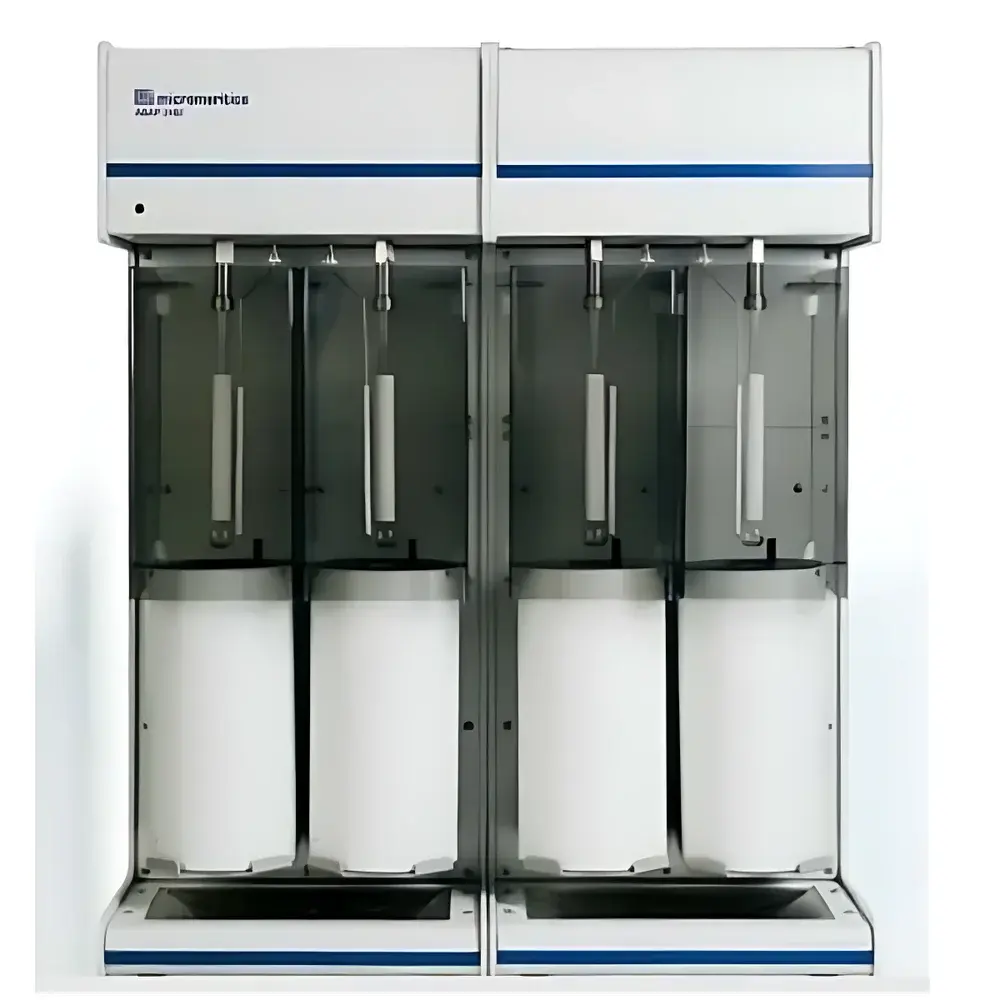
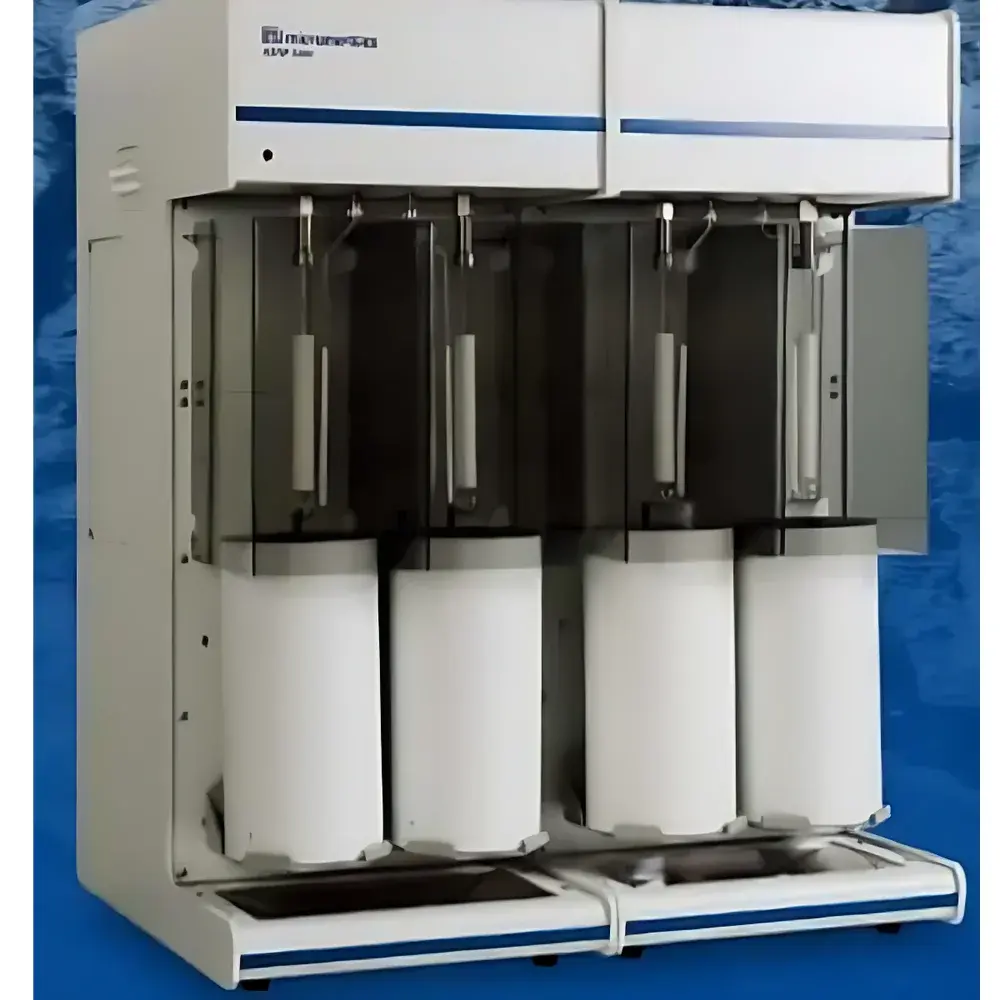
Micromeritics ASAP 2460 Multi-Station Extended Specific Surface Area and Pore Size Analyzer
| Brand | Malvern Panalytical |
|---|---|
| Origin | USA |
| Manufacturer | Micromeritics Instrument Corp. |
| Model | ASAP 2460 Series |
| Analysis Stations | 2–6 (modular expansion) |
| Measurement Principle | Static gas adsorption (volumetric method) |
| Pore Size Range | 0.35–500 nm |
| Pressure Range | 0–1000 mmHg (absolute) |
| Theoretical Basis | BET, t-plot, Langmuir, DFT, NLDFT, BJH, HK, SF |
| Optional Configurations | Low-surface-area (Kr adsorption, 10 mmHg transducer) and micropore (1 mmHg transducer, N₂/Ar/CO₂/H₂ capability) |
Overview
The Micromeritics ASAP 2460 Multi-Station Extended Specific Surface Area and Pore Size Analyzer is a high-precision, modular volumetric gas adsorption system engineered for rigorous characterization of porous and powdered materials. It operates on the fundamental principles of static (manometric) gas adsorption, where controlled doses of inert gases—primarily nitrogen at 77 K—are introduced into an evacuated sample cell, and equilibrium pressures are measured to construct full adsorption/desorption isotherms. The instrument’s architecture supports both standard surface area quantification via the Brunauer-Emmett-Teller (BET) theory and advanced pore structural analysis across micro-, meso-, and macroporous regimes using validated models including t-plot, αs-plot, Barrett-Joyner-Halenda (BJH), Horvath-Kawazoe (HK), Saito-Foley (SF), and non-local density functional theory (NLDFT). Designed for laboratory environments requiring regulatory compliance and long-term data integrity, the ASAP 2460 meets foundational requirements for GLP and GMP workflows through hardware-level stability, traceable calibration protocols, and software audit trails.
Key Features
- Modular station architecture: Base unit comprises two independent analysis stations; up to two additional dual-station modules can be connected to achieve four- or six-station configurations—each station fully autonomous in temperature control, pressure regulation, and data acquisition.
- Uninterrupted 60-hour operation: Integrated liquid nitrogen auto-refill management enables extended isotherm acquisition without manual intervention or cryogen replenishment.
- Precision dosing system: Servo-controlled pneumatic valves govern gas introduction with programmable volume increments or pressure-step targeting, ensuring reproducible dose delivery across all stations.
- Dual-pressure sensing capability: Standard configuration includes a 1000 mmHg absolute pressure transducer; optional low-surface-area kits integrate a 10 mmHg sensor for Kr adsorption (77 K), while micropore-optimized variants feature a 1 mmHg transducer for enhanced sub-torr resolution during CO₂ (273 K), Ar (87 K), or H₂ (20 K) measurements.
- Multi-gas compatibility: Supports N₂, Ar, CO₂, Kr, and H₂—enabling material-specific selection of adsorbate for optimal pore-filling behavior and model applicability.
- Real-time diagnostics interface: Embedded instrument health monitoring displays vacuum integrity, valve actuation status, thermal stabilization progress, and transducer drift alerts—facilitating proactive maintenance scheduling.
Sample Compatibility & Compliance
The ASAP 2460 accommodates a broad range of solid materials—including catalysts, MOFs, activated carbons, zeolites, pharmaceutical excipients, battery electrode materials, and ceramic powders—in standard 6–9 mm OD glass sample tubes. Sample mass ranges from 10 mg to 2 g, depending on expected surface area and pore volume. All analysis modules conform to ASTM D3663 (Standard Test Method for Surface Area of Catalysts), ISO 9277 (Determination of specific surface area by gas adsorption using the BET method), and IUPAC 2015 recommendations for physisorption data reporting. The system supports 21 CFR Part 11-compliant user access controls, electronic signatures, and immutable audit logs when paired with validated MicroActive software deployment under controlled IT infrastructure.
Software & Data Management
MicroActive software serves as the unified platform for instrument control, real-time isotherm visualization, and model-driven interpretation. Its graphical interface allows drag-and-drop selection of data regions for BET linear range validation, t-plot monolayer thickness assignment, or DFT kernel application. Isotherms may be displayed in linear or semi-log format, with overlay support for up to 25 datasets—including complementary mercury intrusion porosimetry (MIP) curves—for cross-technique pore network reconciliation. Report generation is template-driven: users define custom layouts containing summary statistics, tabulated results (surface area, pore volume, PSD integrals), and publication-ready plots—with live preview prior to export. Raw data files (.asap) are stored in ASCII-based, human-readable formats compatible with third-party analysis tools and LIMS integration.
Applications
- Catalyst development: Quantifying active site accessibility and thermal stability via sequential BET analysis before/after calcination or reaction cycles.
- Pharmaceutical formulation: Assessing excipient surface heterogeneity and its impact on drug dispersion kinetics per USP <1060> guidelines.
- Energy storage materials: Characterizing hierarchical porosity in Li-ion battery anodes/cathodes and hydrogen storage MOFs using Ar@87K and CO₂@273K isotherms.
- Environmental sorbents: Validating regeneration efficiency of activated carbon via repeated N₂ isotherm acquisition and hysteresis loop analysis.
- Quality control laboratories: Enabling batch-to-batch comparability through automated 6-sample BET runs completed within 30 minutes—reducing turnaround time without compromising measurement fidelity.
FAQ
What gases can be used for analysis on the ASAP 2460?
Nitrogen (77 K), argon (87 K or 77 K), carbon dioxide (273 K), krypton (77 K), and hydrogen (20 K) are supported, with gas-specific cold traps and transducer options required for optimal low-pressure resolution.
How does the modular station design affect data comparability across stations?
Each station incorporates identical pressure transducers, temperature sensors, and valve assemblies calibrated against NIST-traceable standards; inter-station RSD for BET surface area is ≤1.2% under identical operating conditions.
Is the ASAP 2460 suitable for GLP-regulated environments?
Yes—when deployed with MicroActive software in validated mode, it provides full 21 CFR Part 11 compliance including role-based permissions, electronic signatures, and tamper-evident audit trails for all analytical events.
Can I combine N₂ physisorption data with mercury intrusion results?
Yes—the software natively supports co-plotting of adsorption/desorption isotherms with MIP curves, enabling integrated pore size distribution modeling across the full 0.35 nm–400 µm range.
What level of technical support is available for method development?
Micromeritics offers application-specific consulting, including DFT kernel selection guidance, isotherm quality assessment, and SOP drafting aligned with ASTM/ISO/USP standards.



