
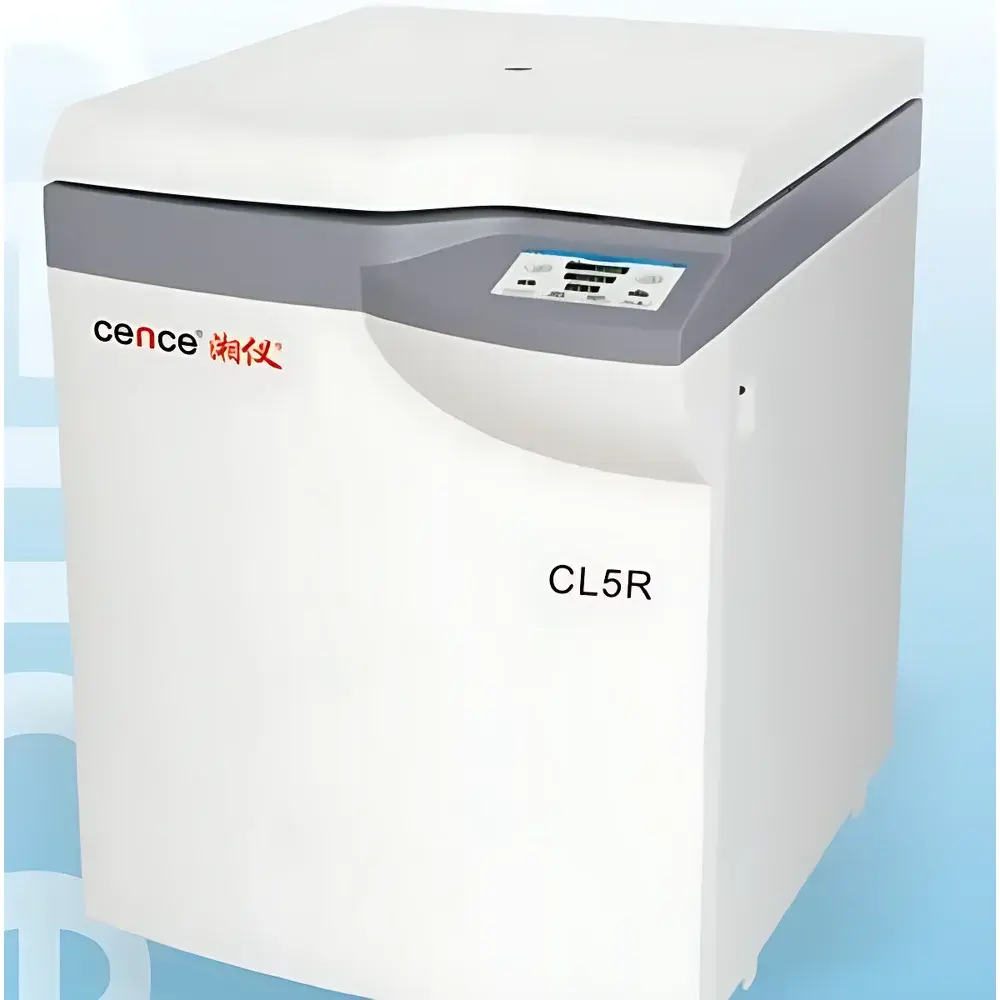
Xiangyi CL5R High-Capacity Refrigerated Centrifuge
| Brand | Xiangyi |
|---|---|
| Origin | Hunan, China |
| Manufacturer Type | Direct Manufacturer |
| Product Category | Domestic |
| Model | CL5R |
| Instrument Type | Floor-Standing Centrifuge |
| Speed Range | Up to 5000 rpm |
| Max RCF | 6100 × g |
| Max Capacity | 4 × 1000 mL (horizontal rotor) |
| Dimensions | 700 × 880 × 930 mm |
| Cooling System | Imported Compressor Unit |
| Compliance | ISO 9001 & ISO 13485 Certified |
| Safety Features | Non-contact imbalance detection, overspeed protection, overtemperature protection, motor overheat protection, lid interlock |
| Control Interface | Multilingual UI (Chinese, English, German, French, Spanish), real-time temperature & speed monitoring, 10 acceleration / 11 deceleration profiles |
| Rotor Material | Forged 7075-T6 aluminum alloy with hard-anodized surface |
| Regulatory Context | Designed for clinical laboratory and blood bank applications under GLP-aligned operational practices |
Overview
The Xiangyi CL5R is a floor-standing, high-capacity refrigerated centrifuge engineered for robust, reproducible separation of large-volume biological samples in clinical, transfusion medicine, and diagnostic laboratory environments. It operates on the principle of sedimentation-based separation under controlled low-temperature conditions, utilizing precise angular momentum generation to achieve differential pelleting of cellular components—particularly red blood cells, platelets, and plasma fractions—from whole blood or other viscous biological suspensions. With a maximum capacity of 4 × 1000 mL in its standard horizontal rotor configuration, the CL5R supports rapid batch processing required in blood banks, regional transfusion centers, and high-throughput hospital laboratories. Its operating range (up to 5000 rpm, 6100 × g) positions it within the low-speed centrifugation category, optimized for gentle yet efficient separation without compromising cell integrity—critical for downstream compatibility with blood component preparation per AABB and EN ISO 22612 standards.
Key Features
- High-strength forged 7075-T6 aluminum alloy rotors with hard-anodized surface treatment—ensuring superior corrosion resistance, mechanical durability, and long-term dimensional stability under repeated thermal cycling.
- Imported high-efficiency compressor system enabling rapid cooling from ambient to –20 °C within ≤15 minutes and maintaining temperature stability ±1 °C across full speed range.
- Ergonomic curved UI interface with multi-language support (English, Chinese, German, French, Spanish), real-time dual-parameter display (speed/RCF and temperature), and intuitive parameter navigation.
- Triple-layer mechanical safety architecture: inner rotor sleeve, outer protective housing, and reinforced steel frame—integrated with non-contact imbalance sensing, automatic rotor recognition, lid interlock, and dynamic overspeed cutoff.
- Precise kinetic control via 10 programmable acceleration and 11 deceleration profiles—minimizing resuspension risk during braking and preserving pellet integrity for sensitive hematological assays.
- Comprehensive audit-ready data logging: system operation events, error codes, user actions, and environmental parameters stored internally with timestamping—supporting internal quality documentation and GLP-aligned record retention.
Sample Compatibility & Compliance
The CL5R accommodates standard clinical sample containers including 450 mL triple-bag blood collection sets (4 units per run), 200 mL triple-bag units (8 per run), and up to 168 vacuum blood collection tubes (e.g., EDTA, serum separator) using the optional 6 × 500 mL horizontal rotor. Adapters are available for 13–16 mm diameter tubes (5–50 mL volume range), ensuring seamless integration into existing hospital laboratory workflows. The instrument complies with ISO 9001:2015 and ISO 13485:2016 quality management systems, reflecting consistent manufacturing controls and traceability across production batches. While not CE-marked for EU IVD Directive or FDA 510(k)-cleared, its design aligns with core safety principles referenced in IEC 61010-1 (electrical safety) and IEC 61010-2-020 (particular requirements for centrifuges).
Software & Data Management
The embedded control firmware supports configurable user access levels (administrator/operator), multilingual interface switching, and persistent parameter memory per rotor type. All operational logs—including start/stop timestamps, setpoints, actual temperature and speed traces, fault diagnostics, and user login/logout entries—are retained onboard for ≥10,000 cycles. Export functionality via USB port enables transfer of CSV-formatted logs for external analysis or inclusion in laboratory information management systems (LIMS). Though not natively 21 CFR Part 11 compliant, the system’s audit trail structure—featuring immutable timestamps, operator ID linkage, and change history—facilitates adaptation to regulated environments requiring electronic record integrity.
Applications
- Blood bank operations: Rapid preparation of packed red blood cells (PRBCs), platelet-rich plasma (PRP), and cryoprecipitate from whole blood units.
- Hospital core labs: High-volume serum/plasma separation prior to immunoassay, clinical chemistry, or coagulation testing.
- Research laboratories: Initial clarification of cell culture supernatants, tissue homogenates, or microbial lysates where thermal stability is essential.
- Public health labs: Field-deployable centrifugation support for mobile blood donation drives and emergency response units requiring compact footprint and reliable refrigeration.
- Quality control labs: Routine verification of centrifuge performance per internal SOPs referencing ASTM E2921-20 (Standard Guide for Performance Verification of Centrifuges).
FAQ
What is the minimum operating temperature of the CL5R?
The unit achieves and maintains temperatures from –20 °C to +40 °C, with typical operational setpoints ranging between 4 °C and 20 °C for clinical sample processing.
Does the CL5R support rotor auto-recognition?
Yes—each certified rotor contains an embedded RFID tag that communicates identification and maximum rated speed to the control system upon loading, preventing unsafe overspeed operation.
Can the CL5R be integrated into a LIMS environment?
While no native HL7 or ASTM E1384 interface is provided, exported CSV logs can be parsed and ingested by most LIMS platforms via scheduled import scripts or middleware adapters.
Is service and calibration support available outside mainland China?
Xiangyi provides technical documentation and remote troubleshooting globally; on-site service requires coordination through authorized regional distributors, with spare parts logistics supported via DHL/FedEx express channels.
How does the CL5R handle imbalanced loads?
Its non-contact vibration detection system continuously monitors lateral displacement during spin-up and spin-down phases, triggering immediate deceleration if imbalance exceeds 5 mm peak-to-peak amplitude—without requiring physical load weighing prior to operation.



