
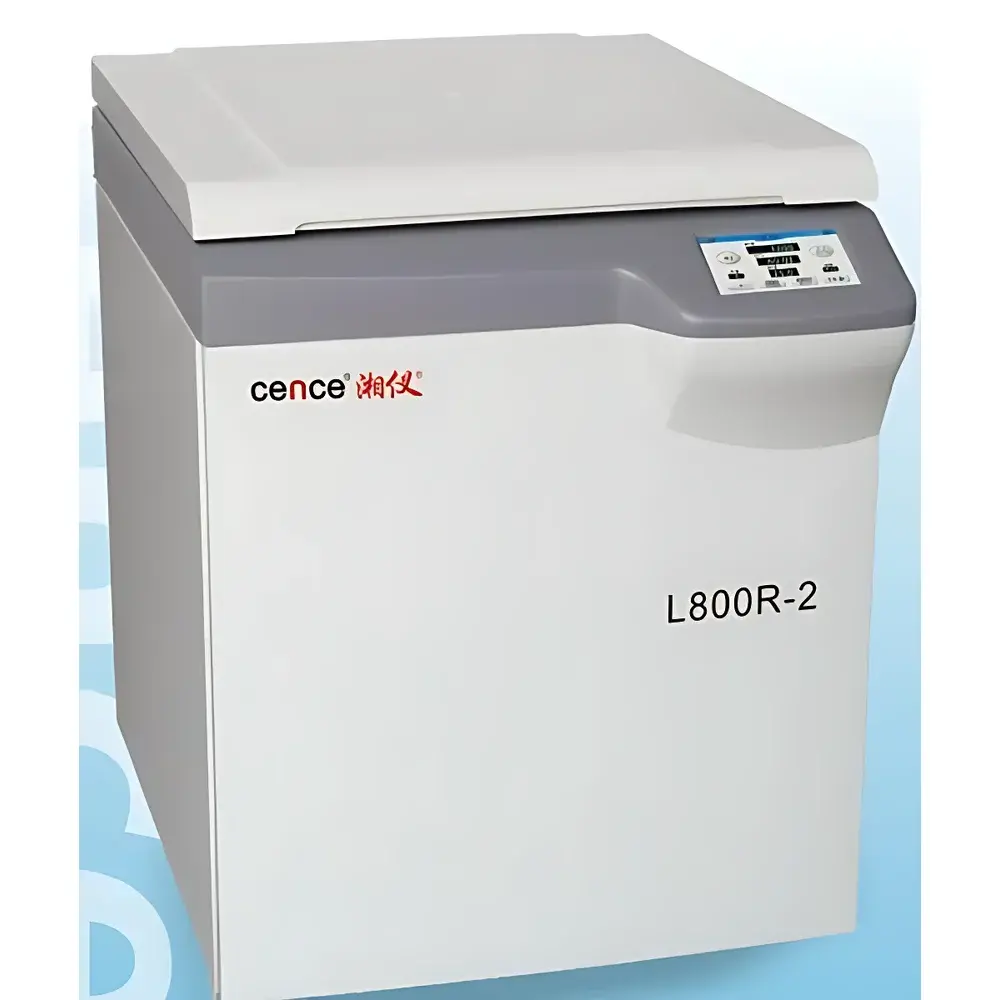
Xiangyi L800R-2 Ultra-High-Capacity Refrigerated Floor-Standing Centrifuge
| Brand | Xiangyi |
|---|---|
| Origin | Hunan, China |
| Manufacturer Type | Direct Manufacturer |
| Product Category | Domestic |
| Model | L800R-2 |
| Instrument Type | Floor-Standing Centrifuge |
| Speed Range | Up to 8,000 rpm |
| Maximum RCF | 11,875 × g |
| Maximum Capacity | 6 × 1500 mL (Horizontal Rotor) |
| Temperature Control Range | -20 °C to +40 °C |
| Dimensions (W×D×H) | 730 × 930 × 960 mm |
| Rotor Material | 7075-T6 Forged Aluminum with Hard-Anodized Surface |
| Chamber Material | 316L Stainless Steel |
| Sample Container Compatibility | Medical-Grade PPCO Bottles (Autoclavable) |
| Safety Certifications | ISO 9001 & ISO 13485 Certified |
| Communication Interface | Standard Ethernet (TCP/IP), Open Protocol Support |
Overview
The Xiangyi L800R-2 is a high-capacity, refrigerated floor-standing centrifuge engineered for demanding biopharmaceutical, clinical diagnostics, and bulk biochemical processing applications. Designed around the principles of sedimentation equilibrium and rate-zonal centrifugation, it delivers precise, reproducible separation of biological macromolecules—including plasmids, viral vectors, exosomes, and cell lysates—at volumes up to 9 L per run (6 × 1500 mL). Its robust mechanical architecture integrates a high-efficiency brushless DC motor, dynamic compressor-based refrigeration, and a vibration-damped structural frame to ensure operational stability under continuous high-load conditions. The system meets foundational requirements for GLP-compliant laboratories and supports traceability-critical workflows through configurable audit trails and user-access controls.
Key Features
- Ultra-High Throughput Configuration: Equipped with a proprietary 6-position horizontal rotor accepting 1500 mL PPCO bottles—certified for autoclaving at 121 °C/20 min—enabling scalable downstream processing without intermediate transfer steps.
- Advanced Thermal Management: Uses an imported eco-friendly refrigerant compressor with adaptive duty cycling; chamber temperature deviation is maintained within ±2 °C during operation, even under full-load conditions. Compressor halts automatically upon lid opening—reducing energy consumption by >40% versus conventional designs and extending service life.
- Multi-Layer Safety Architecture: Includes non-contact imbalance detection, overspeed cutoff, real-time rotor temperature monitoring, motor overheat protection, and interlocked lid safety mechanism. All critical components—including rotor bodies, buckets, and chamber liners—are fabricated from corrosion-resistant materials (7075-T6 aluminum, 316L stainless steel, medical-grade PPCO).
- Precision Motion Control: Offers 11 programmable acceleration and deceleration profiles to minimize particle resuspension and optimize pellet integrity—particularly essential for fragile biomolecular complexes and low-density membrane fractions.
- Ergonomic & Acoustic Design: Low-noise operation (<65 dB[A] at 1 m), compact footprint relative to capacity class, and lowered operating height improve operator accessibility and reduce ambient thermal load in shared lab environments.
Sample Compatibility & Compliance
The L800R-2 accommodates a broad range of sample formats, including but not limited to: sterile 1500 mL disposable bottles, reusable polypropylene centrifuge bottles (500–1500 mL), and custom-fit swing-out buckets compatible with standard blood bags and bioreactor harvest containers. All wetted parts comply with USP Class VI biocompatibility standards. The system adheres to ISO 9001:2015 and ISO 13485:2016 quality management frameworks, ensuring consistent manufacturing control and documentation integrity. While not pre-certified to IEC 61010-1 or FDA 21 CFR Part 11 out-of-the-box, its open Ethernet interface and configurable event logging support integration into validated environments requiring electronic record retention and role-based access control.
Software & Data Management
The optional Centrifuge Management System (CMS) provides centralized monitoring and control of up to 100 L800R-2 units via standard TCP/IP networks. CMS enables remote start/stop commands, real-time parameter visualization (RCF, rpm, temperature, time), and automated export of run logs—including timestamped metadata, user ID, rotor ID, and fault codes—in CSV or XML format. The system supports configurable data retention policies and integrates with LIMS platforms using documented RESTful endpoints and Modbus TCP register mapping. All firmware updates are digitally signed and delivered via secure HTTPS channels to maintain chain-of-custody integrity.
Applications
- Large-scale purification of monoclonal antibodies and recombinant proteins from mammalian cell culture harvests
- Clarification of fermentation broths in industrial enzyme and vaccine production
- Isolation of extracellular vesicles (exosomes, microvesicles) from conditioned media or plasma
- Preparative separation of subcellular organelles (mitochondria, nuclei) from tissue homogenates
- Downstream processing of gene therapy vectors (AAV, lentivirus) requiring high-volume, low-shear handling
- Environmental microbiology workflows involving high-volume water or soil suspension processing
FAQ
What is the maximum allowable imbalance tolerance for the 6×1500 mL horizontal rotor?
The rotor is dynamically balanced to ISO 1940 G2.5 grade; maximum permissible imbalance is ≤5 g·mm at 8,000 rpm.
Can the L800R-2 be integrated into a SCADA or MES environment?
Yes—via its standard Ethernet port and published Modbus TCP register map, enabling direct read/write access to operational parameters and status flags.
Is rotor lifetime tracked and managed within the onboard system?
Rotor usage history—including total run hours, cumulative cycles, and maximum speed records—is stored in non-volatile memory and accessible via CMS or local display.
Does the system support 21 CFR Part 11 compliance?
Out-of-the-box functionality does not include electronic signatures or audit trail encryption; however, CMS v3.2+ offers configurable audit logging, user authentication (LDAP/RADIUS), and tamper-evident log archiving when deployed on validated IT infrastructure.
What maintenance intervals are recommended for the refrigeration system?
Compressor oil and filter replacement is advised every 12,000 operating hours or biannually—whichever occurs first—using only OEM-specified refrigerant and lubricants.



