
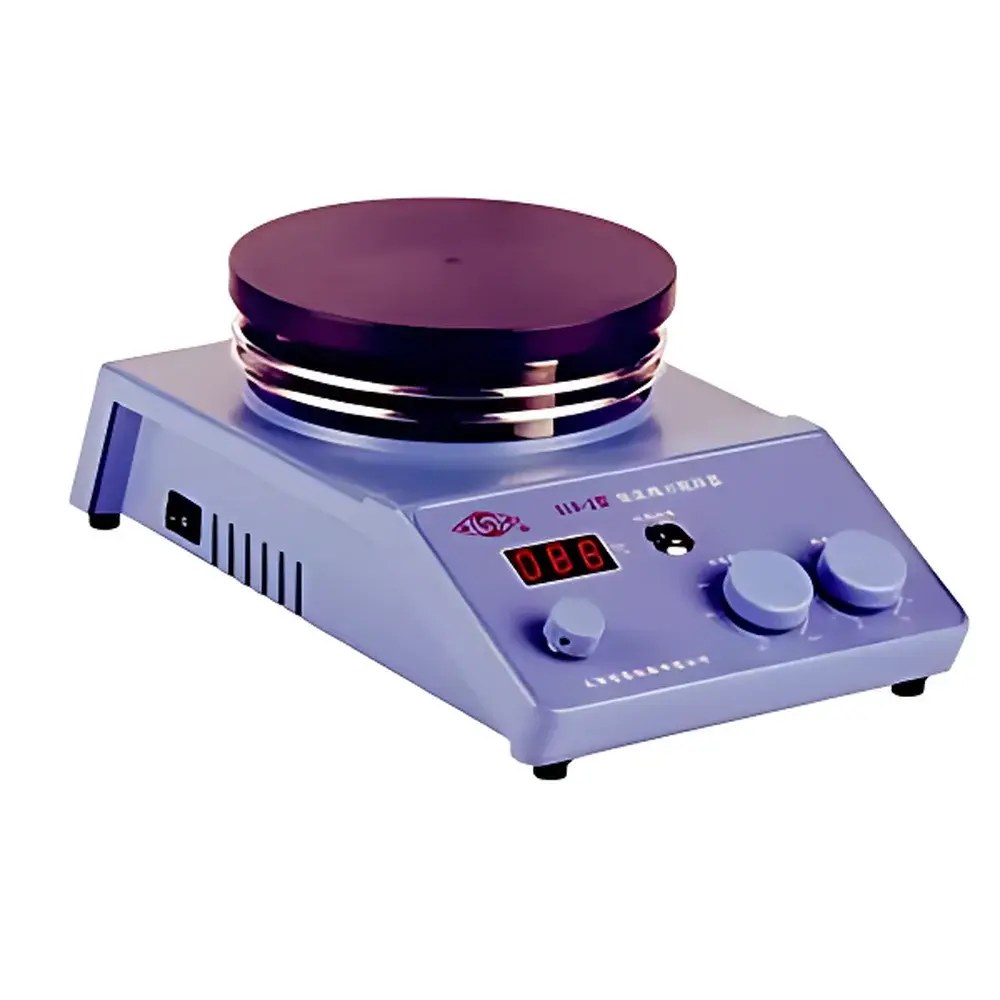
SiLe S10-2 & S10-3 10L Digital Temperature-Controlled Magnetic Stirrers
| Brand | SiLe |
|---|---|
| Origin | Shanghai, China |
| Model | S10-2, S10-3 |
| Max. Stirring Volume | 10 L |
| Speed Range | 50–1700 rpm |
| Temperature Control Range (Hotplate Surface) | RT–330 °C (S10-2), RT–300 °C (S10-3) |
| Heating Power | 800 W |
| Motor Torque | 80 mN·m |
| Temperature Accuracy | ±1 °C |
| Display | Dual digital display (temperature and speed for S10-3 |
| Sensor Type | PT100 platinum resistance thermometer |
| Hotplate Diameter | Φ170 mm, black-coated stainless steel |
| Dimensions (W×D×H, excl. support rod) | 330 × 195 × 125 mm |
| Weight | 3.8 kg |
Overview
The SiLe S10-2 and S10-3 are high-capacity, digitally controlled magnetic stirrers engineered for precision thermal and mechanical manipulation of liquid samples in research laboratories, quality control environments, and pilot-scale synthesis workflows. Designed around a robust electromagnetic drive principle, these instruments generate a rotating magnetic field beneath a thermally conductive stainless-steel hotplate to actuate PTFE- or glass-coated magnetic stir bars immersed in reaction vessels. Unlike conventional analog units, both models integrate closed-loop temperature regulation via integrated PT100 platinum resistance sensors—enabling accurate surface temperature setpoint control (not ambient or inferred liquid temperature). This architecture ensures stable thermal conditions across large-volume containers (up to 10 L), minimizing overshoot and drift during extended heating-stirring protocols. The S10-2 implements digital setpoint control exclusively for hotplate surface temperature, while the S10-3 adds real-time rotational speed feedback and dual-parameter digital display, supporting reproducible method development under GLP-compliant documentation practices.
Key Features
- High-torque DC motor delivering consistent 80 mN·m torque across full speed range (50–1700 rpm), enabling reliable agitation of viscous or dense suspensions
- Dual-mode temperature control: S10-2 offers precise hotplate surface temperature setpoint (RT–330 °C); S10-3 extends functionality with independent liquid temperature monitoring via external PT100 probe (RT–250 °C range)
- Black-coated stainless-steel heating plate (Φ170 mm) optimized for uniform thermal distribution and chemical resistance
- 800 W heating capacity with microprocessor-based PID regulation, achieving ±1 °C surface temperature accuracy over full operating range
- Compact benchtop footprint (330 × 195 × 125 mm) and lightweight design (3.8 kg) suitable for fume hoods, laminar flow cabinets, and shared instrumentation spaces
- Standard accessories include dual-length support rods, PT100 sensor with adjustable stand, and a set of chemically inert magnetic stir bars
Sample Compatibility & Compliance
These stirrers accommodate standard laboratory glassware including beakers (up to 10 L), round-bottom flasks, and jacketed reactors—provided vessel geometry allows effective magnetic coupling. The non-contact stirring mechanism eliminates mechanical seals or shaft penetration, making it ideal for sterile, anhydrous, or oxygen-sensitive preparations. Both models comply with IEC 61010-1:2010 safety standards for electrical equipment used in laboratory environments. While not certified for Class I Div 1 hazardous locations, their solid-state construction and absence of sparking components render them suitable for general organic synthesis, buffer preparation, dissolution testing, and polymerization initiation where solvent vapors may be present. The PT100 sensor interface supports traceable calibration per ISO/IEC 17025 requirements when paired with accredited reference standards.
Software & Data Management
The S10-2 and S10-3 operate as standalone instruments without embedded firmware connectivity; however, their analog-compatible PT100 output (100–138.5 Ω at 0–100 °C) permits integration into third-party data acquisition systems (e.g., LabVIEW, MATLAB, or PLC-based SCADA platforms) via standard 4–20 mA or 0–10 V signal conditioners. For audit-ready workflows, users may log setpoints, actual temperatures, and elapsed time manually or through external chart recorders. Though lacking native 21 CFR Part 11 electronic signature capability, the dual-display interface (S10-3) facilitates visual verification of concurrent speed and temperature parameters—supporting paper-based batch records aligned with GMP Annex 11 principles for manual data capture.
Applications
- Controlled heating and homogenization of aqueous buffers, culture media, and reagent solutions in microbiology and molecular biology labs
- Polymer solution preparation requiring extended shear exposure and thermal stability (e.g., PVA, chitosan, or alginate formulations)
- Preparation of calibration standards and reference materials under ISO Guide 34 conditions
- Accelerated stability studies per ICH Q1A(R2), where consistent agitation and defined thermal profiles are critical
- Inorganic precipitate synthesis (e.g., metal oxides, hydroxides) demanding uniform nucleation kinetics
- Environmental sample digestion protocols (EPA Method 3050B) involving hotplate-assisted acid leaching
FAQ
What is the difference between hotplate surface temperature and liquid temperature control?
Surface temperature refers to the measured temperature of the stainless-steel plate itself, regulated directly by the unit’s PID algorithm. Liquid temperature depends on heat transfer efficiency, vessel material, volume, and ambient conditions—and is monitored separately using the supplied PT100 probe in S10-3 mode.
Can the stirrer maintain temperature stability during rapid viscosity changes?
Yes—the 800 W heating system combined with fast-response PT100 sensing enables dynamic compensation for thermal load shifts caused by exothermic reactions or phase transitions, provided vessel geometry maintains adequate thermal contact.
Is calibration of the PT100 sensor supported out-of-the-box?
The instruments accept standard PT100 elements (DIN EN 60751 Class B); users may perform two-point calibration (0 °C ice bath and 100 °C boiling water) using external reference thermometers traceable to NIST standards.
Are replacement stir bars and sensors available as consumables?
Yes—SiLe supplies calibrated PT100 probes (±0.15 °C tolerance), PTFE-coated stir bars (various diameters and lengths), and high-temp ceramic-coated variants for aggressive solvents or >250 °C applications.
Does the unit support continuous operation for 24/7 unattended use?
Both models are rated for continuous duty (IEC 60034-1), but long-term unattended operation requires risk assessment per local safety policy—particularly regarding fire hazard mitigation and vessel integrity monitoring.



