
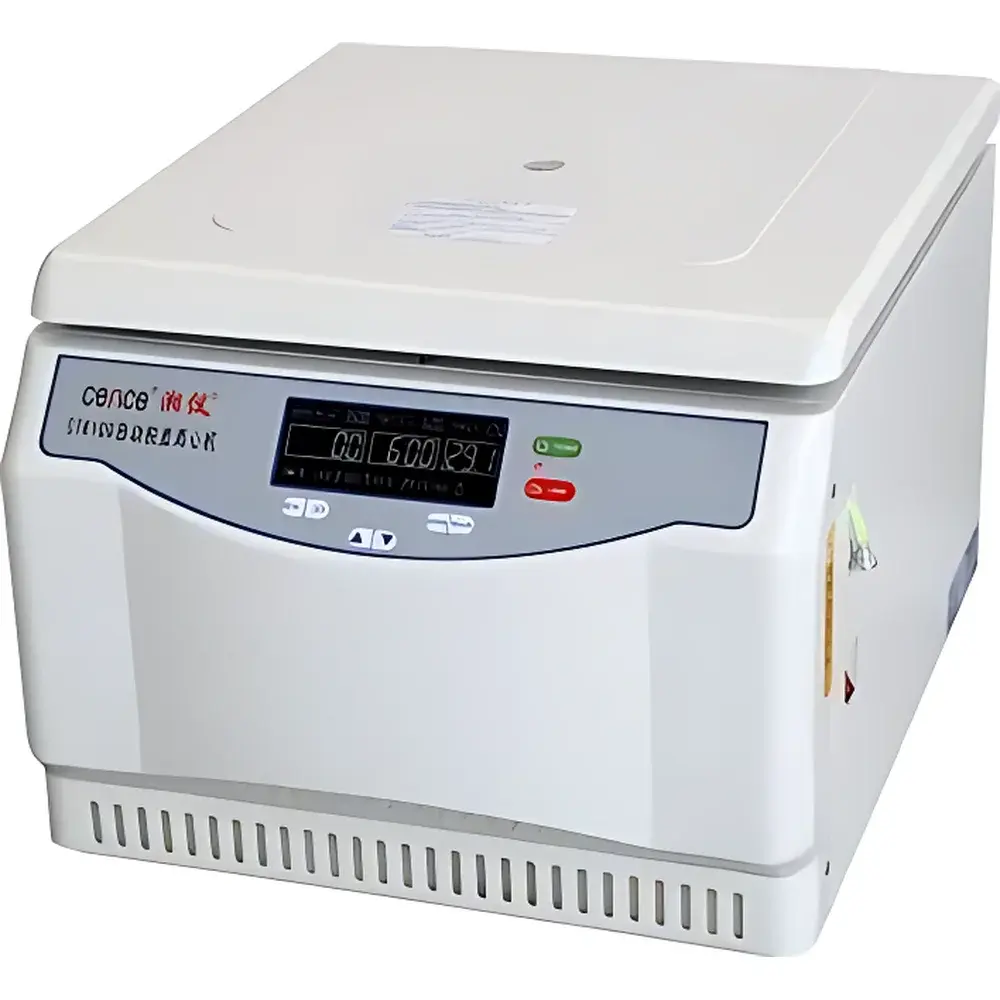
Xiangyi CTK100 Automated Cap-Removal Benchtop Centrifuge
| Brand | Xiangyi |
|---|---|
| Origin | Hunan, China |
| Manufacturer Type | Direct Manufacturer |
| Product Category | Domestic |
| Model | CTK100 |
| Instrument Type | Benchtop Centrifuge |
| Speed Class | Low-Speed Centrifuge (≤4000 rpm) |
| Function | Routine Blood Separation with Integrated Cap Removal |
| Configuration | Horizontal Rotor System |
| Max Capacity | 100 × 13 mm × 75 mm vacuum blood collection tubes (or 84 × 13 mm × 100 mm) |
| Max Speed | 4000 rpm |
| Max RCF | 3030 × g |
| Dimensions (L×W×H) | 470 × 560 × 380 mm |
| Weight | 50 kg |
| Power Supply | AC 220 V ±10%, 50 Hz, 6 A |
| Power Consumption | 700 W |
| Noise Level | ≤65 dB(A) |
| Speed Accuracy | ±30 rpm |
| Rotor Type | Fixed-angle horizontal rotor assembly with interchangeable adapters |
| Cap-Removal Success Rate | >90% |
| Safety Features | Electronic door interlock, automatic shutdown on lid breach, auto-balance detection |
| Drive System | AC frequency-controlled motor with rapid acceleration/deceleration |
| Display | Large LCD touchscreen interface |
| Vibration Damping | Engineered passive damping system |
Overview
The Xiangyi CTK100 Automated Cap-Removal Benchtop Centrifuge is a purpose-built solution for clinical laboratories performing high-volume blood sample processing. Unlike conventional centrifuges requiring manual cap removal post-separation—introducing risks of sample re-mixing, aerosol generation, and operator exposure—the CTK100 integrates mechanical cap extraction directly into the centrifugation workflow. It operates on standard low-speed centrifugation principles (rotor-driven sedimentation under controlled gravitational force), optimized specifically for vacuum blood collection tubes (e.g., EDTA, serum separator, lithium heparin). The instrument achieves a maximum relative centrifugal force (RCF) of 3030 × g at 4000 rpm, sufficient to separate whole blood into serum/plasma and cellular components per CLSI H18-A3 and ISO 15189:2022 requirements for preanalytical phase integrity.
Key Features
- Integrated automated cap-removal mechanism engineered for vacuum blood tubes of two standard lengths: 75 mm (100-tube capacity) and 100 mm (84-tube capacity), with success rate exceeding 90% across validated tube brands (BD Vacutainer®, Greiner Bio-One, Sarstedt)
- AC frequency-controlled drive system ensures precise speed regulation (±30 rpm accuracy) and rapid acceleration/deceleration profiles—critical for minimizing thermal drift and maintaining hematocrit consistency
- Horizontal rotor configuration with fixed-angle geometry and interchangeable adapters (part nos. 851462 and 851463) enables flexible tube-length compatibility without recalibration
- Passive vibration-damping architecture with precision-machined counterbalance supports stable operation at full load, reducing mechanical stress on tube integrity and pipetting station proximity
- Electronic safety interlock system complies with IEC 61010-1:2010 requirements: centrifuge remains inert unless lid is fully engaged; immediate rotor deceleration initiates if lid displacement exceeds 2 mm during operation
- Intuitive 5.7-inch LCD touchscreen interface displays real-time RCF calculation, elapsed time, remaining time, and fault diagnostics—including imbalance detection and cap-removal status flagging
Sample Compatibility & Compliance
The CTK100 accepts standard 13 mm diameter vacuum blood collection tubes conforming to ISO 6710:2017 dimensions and pressure tolerances. It is validated for use with common anticoagulant and separator gel formulations, including but not limited to K₂EDTA, sodium citrate (3.2%), lithium heparin, and serum separator tubes (SST). The cap-removal module exerts controlled axial force (≤12 N) within ISO 8536-1:2020 limits for stopper removal torque, preventing tube deformation or septum puncture. The device meets electromagnetic compatibility (EMC) requirements per EN 61326-1:2013 and carries CE marking under the EU Medical Device Regulation (MDR) Annex XVI classification for ancillary in vitro diagnostic equipment.
Software & Data Management
While the CTK100 operates as a standalone instrument without network connectivity, its embedded firmware logs operational metadata—including run ID, start/stop timestamps, actual speed profile, final RCF, and cap-removal completion status—for local review via USB export (CSV format). Audit trail functionality supports GLP-compliant documentation: all parameter changes are timestamped and user-annotated. Optional integration with LIS systems is achievable through RS-232 serial output (ASCII protocol), enabling bidirectional command transmission and result acknowledgment—fully compatible with ASTM E1384 and HL7 v2.5.1 messaging standards.
Applications
- Routine serum/plasma separation in hospital core labs and reference laboratories handling >500 daily blood draws
- Pre-analytical automation for immunoassay, clinical chemistry, and coagulation testing workflows
- Biobanking operations requiring standardized, low-risk tube processing prior to aliquoting or cryopreservation
- Point-of-care settings where space-constrained benchtop footprint (470 × 560 × 380 mm) and <65 dB(A) acoustic emission enable deployment adjacent to phlebotomy stations
- Research applications involving longitudinal cohort studies with strict preanalytical SOP adherence per ISO 20387:2018 biobank accreditation criteria
FAQ
Does the CTK100 support regulatory compliance for FDA 21 CFR Part 11?
The CTK100 does not include electronic signature capability or role-based access control; however, its audit-trail-enabled firmware and CSV-exportable run logs may be incorporated into a broader Part 11–compliant quality management system when paired with validated third-party data archiving software.
Can the rotor accommodate non-vacuum tubes such as microcentrifuge tubes or conical-bottom tubes?
No—the horizontal rotor and cap-removal mechanism are mechanically calibrated exclusively for rigid-walled, vacuum-sealed glass or plastic blood collection tubes meeting ISO 6710:2017 dimensional specifications.
What maintenance intervals are recommended for the cap-removal actuator?
Xiangyi specifies lubrication-free operation of the pneumatic cap-removal module; routine inspection of gripper alignment and seal integrity is advised every 6 months or after 5,000 cycles, per the Maintenance Log Sheet included in the operator manual.
Is rotor imbalance compensation performed automatically during acceleration?
Yes—the integrated dynamic imbalance detection algorithm monitors vibration signatures in real time and adjusts motor torque distribution to stabilize rotation before reaching set speed, eliminating need for manual tube balancing.
Are replacement adapters certified for traceable calibration?
All rotor components (including adapters 851462 and 851463) carry individual serial numbers and are supplied with factory calibration certificates verifying RCF linearity across the 1,000–4,000 rpm range per ISO/IEC 17025:2017 accredited procedures.



